
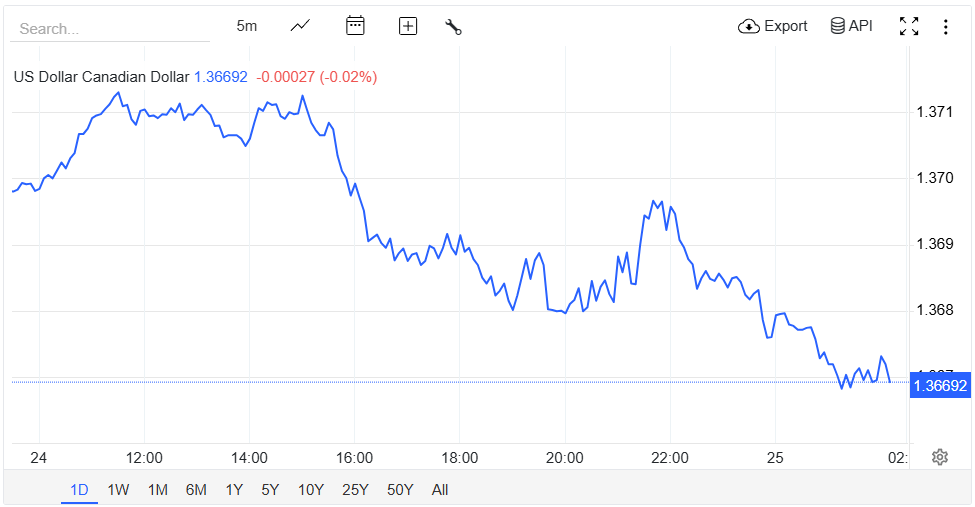
The Canadian Dollar has found renewed support during Friday’s trading session, successfully leveraging a combination of cooling Greenback demand and a surge in the global energy complex. According to economic researchers at Alliston-Westbury, the USD/CAD pair has edged lower to trade near 1.3685, a 0.12% decline on the day.
This shift in price action is primarily driven by a broader retreat in the US Dollar Index (DXY), which slipped 0.17% to 98.65 as market participants responded to tentative signs of diplomatic de-escalation in the Middle East.
Sentiment began to shift following reports that Iranian diplomatic officials are arriving in Islamabad for a potential second round of negotiations with the United States. While the geopolitical environment remains inherently fragile, the mere prospect of renewed peace talks has reduced the immediate demand for safe-haven assets.
This transition in risk appetite has allowed commodity-linked currencies like the Loonie to recover, even as concerns persist regarding the stability of energy flows through the Strait of Hormuz.
Energy Drivers and the Bank of Canada’s Outlook
The Canadian Dollar is benefiting significantly from the tailwinds provided by elevated oil prices, which remain a primary engine for the domestic economy. Institutional analysis from TD Securities suggests that the Bank of Canada (BoC) is poised to integrate substantially higher energy price assumptions into its forthcoming Monetary Policy Report.
Projections for West Texas Intermediate (WTI) are being revised toward the $85 mark, representing a sharp upward adjustment from previous fiscal models. This upward shift in the energy complex is expected to have a direct impact on the domestic inflation path.
Analysts anticipate that headline inflation in Canada could temporarily accelerate toward the 3% threshold during the second quarter of 2026. Such a development would likely necessitate a more hawkish posture from the BoC, further supporting the Canadian Dollar against a Greenback that is facing its own set of monetary policy challenges.
Federal Reserve Caution and Dollar Valuations
South of the border, the Federal Reserve is expected to maintain a restrictive but cautious stance. Market consensus, supported by recent Commerzbank analysis, suggests that interest rates will likely remain unchanged within the 3.50% to 3.75% range in the immediate term.
The prevailing assumption that rate cuts remain on the table for later in the year continues to act as a weight on the US Dollar’s valuation, especially as other central banks navigate their own inflationary pressures.
Current market data indicate that US Dollar valuations have become increasingly stretched, limiting the potential for a sustained recovery in the absence of a major geopolitical shock. Maintaining institutional-grade productivity in this environment requires a focused assessment of these diverging central bank paths.
While the Fed remains data-dependent, the improving fundamental backdrop in Canada suggests that the Loonie is well-positioned to capture further gains if global risk sentiment continues to stabilize.
Technical Structure and Bearish Constraints
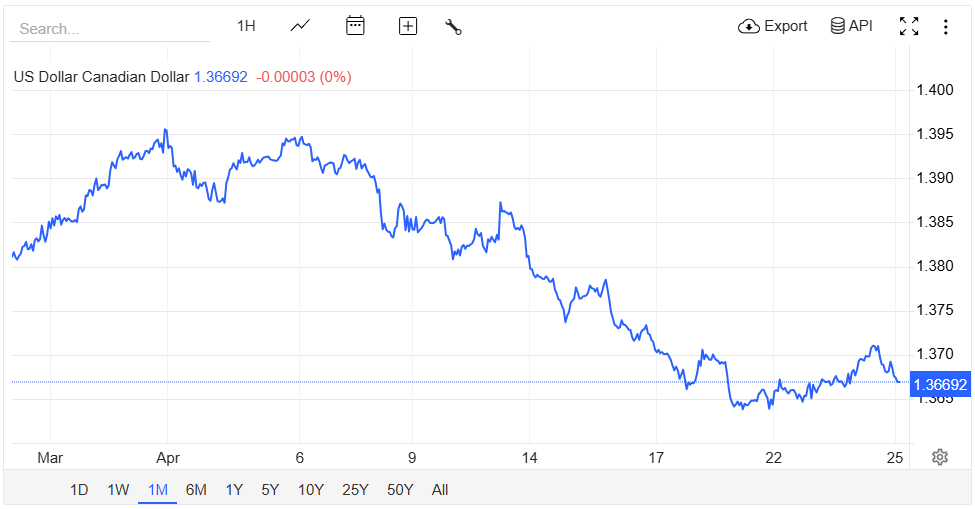
From a technical perspective, the USD/CAD pair remains locked in a bearish structural framework. Scotiabank analysts have noted that the lack of a significant escalation in Middle Eastern tensions has effectively capped recent rebound attempts.
The pair continues to face overhead resistance that prevents a meaningful breach of higher consolidation zones, leaving the path of least resistance tilted to the downside. Immediate support for the pair is aligned with recent intraday lows, while any recovery attempts are likely to be met with selling pressure near previous breakout points.
For the bearish structure to remain intact, the pair must stay below key psychological resistance levels. As Canadian fundamentals gradually improve alongside a stabilizing energy market, the technical setup increasingly favors a continuation of the current downward drift toward lower demand areas.
USD/CAD Trends and Strategic Conclusion
The recent performance of the USD/CAD pair underscores the growing influence of energy-driven inflation on the North American currency crossover. By responding to the dual impact of softening safe-haven demand and a robust outlook for Canadian oil exports, the pair has established a definitive near-term peak.
We are entering a cycle where institutional-grade productivity in forex trading is defined by the ability to calculate the lag between rising energy prices and central bank policy adjustments. The core narrative for the coming weeks will revolve around the durability of the Islamabad diplomatic corridor and its effect on global risk premiums.
Although the forthcoming bias for the Greenback remains tied to the Federal Reserve’s upcoming rate decision, the foundational tone for the Canadian Dollar has turned notably more constructive. Market participants should prioritize the $85 WTI level as a key barometer for the Loonie’s strength.
In summary, the USD/CAD pair appears to be undergoing a fundamental recalibration where improving Canadian economic indicators are successfully neutralizing previous US Dollar dominance.


