
The semiconductor market experienced a significant shockwave on Monday following reports of a potential high-level collaboration between a leading chip designer and the world’s most prominent artificial intelligence laboratory.
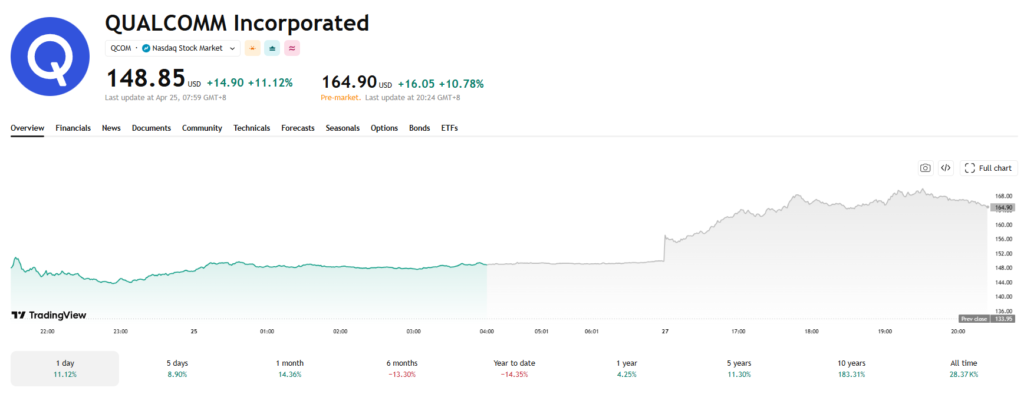
Qualcomm shares witnessed a sharp 13% jump in premarket trading after analytical reports suggested that OpenAI is currently working with both Qualcomm and Taiwan’s MediaTek to engineer a new class of smartphone processors.
This move signals a definitive attempt by the creator of ChatGPT to enter the consumer hardware space with a device built from the ground up for generative AI. According to a specialized market report from Alliston-Westbury, the projected timeline for this ambitious project points toward a mass production cycle starting in 2028.
While details remain under development, industry experts suggest that the collaboration involves a “co-development” model where Qualcomm provides the foundational silicon architecture required for high-speed edge computing.
Interestingly, the system design and manufacturing for this new device are reportedly being handled exclusively by Luxshare, a prominent firm in the Apple supply chain, suggesting a sophisticated manufacturing pipeline is already being established.
The Architecture of an AI-Native Consumer Device
The shift toward specialized hardware reflects a growing consensus that traditional smartphone architectures may not be fully optimized for the massive computational demands of modern large language models.
By partnering with Qualcomm, OpenAI is attempting to solve the “latency hurdle” by processing complex AI tasks directly on the device rather than relying solely on cloud-based servers. This approach requires a radical redesign of the system-on-a-chip (SoC) to prioritize neural processing units over standard graphics or general-purpose cores.
OpenAI’s interest in consumer hardware is not a recent development. The firm notably acquired io Products, a startup founded by former Apple designer Jony Ive, for $6.5 billion last year. With Ive reportedly leading the design efforts, the market is speculating whether this project will result in a traditional handset or a “third core device” that exists alongside phones and laptops.
Despite the high costs associated with hardware development, the firm appears committed to establishing a physical touchpoint for its digital ecosystem that bypasses the gatekeeping of current operating system giants.
Market Disruption and Competitive Pressures
An entry by OpenAI into the mobile market would place it in direct competition with Apple and Samsung, two titans that currently control approximately 40% of the global smartphone market share. The pressure is already being felt in the equity markets; Apple shares were down 1.7% following the reports.
While Apple recently appointed a new CEO with a background in hardware to maintain its device-centric focus, the company is widely perceived as playing catch-up in the specialized field of native mobile AI. Maintaining institutional-grade productivity in the hardware sector is notoriously difficult for startups, even those with significant private backing.
OpenAI remains a loss-making entity, and the shift toward consumer devices represents a massive capital expenditure. However, the strategic logic is clear: as Amazon and other tech giants plan fresh pushes into the handset market, the smartphone is reinforcing its central role as the primary interface for the human-AI interaction.
By controlling the silicon via Qualcomm, OpenAI can ensure that its models run with a level of fluidity that “wrapper” apps on existing phones cannot replicate.
The Manufacturing and Supply Chain Factor
The selection of Luxshare as a manufacturing partner is a tactical move that leverages an existing, highly efficient supply chain. As a critical supplier for current premium handsets, Luxshare possesses the technical capacity to execute on the complex system designs produced by the Ive-led team.
For Qualcomm, this partnership provides a high-profile validation of its Snapdragon AI roadmap, positioning its technology at the heart of the most anticipated hardware launch of the decade.
Furthermore, the strategic orientation of this project suggests a move toward “technological sovereignty.” By designing its own processors in collaboration with MediaTek and Qualcomm, OpenAI reduces its dependence on the hardware roadmaps of competitors.
Mobile Technology Strategic Outlook and Market Conclusion
The reported tie-up between Qualcomm and OpenAI serves as a definitive signal for the technology sector for the remainder of 2026. By targeting a 2028 production window, the companies are acknowledging that the next major cycle in consumer electronics will be defined by hardware-level AI integration.
We are entering a cycle where institutional-grade productivity is no longer measured by software alone but by the seamless fusion of neural silicon and user interface design. The primary focus for market participants in the coming months will be any formal confirmation of the “third core device” specifications.
Although the impending momentum of Qualcomm is currently driven by this speculative rally, the foundational tone of the mobile market is increasingly focused on the transition to AI-native hardware. Investors should treat the 13% jump as a benchmark for the market’s hunger for a legitimate challenger to the Apple-Samsung duopoly.


