
The medical technology sector faced renewed scrutiny regarding digital infrastructure security on Monday as a major industry leader disclosed a targeted breach of its internal systems. Medtronic, a global pioneer in medical device manufacturing, confirmed that while a cyberattack impacted its corporate IT network last week, the incident has not compromised its core operations.
The company emphasized that its patient-facing products and critical manufacturing chains remain fully functional, providing a stabilizing update to investors and healthcare providers. The team at Alliston-Westbury provides strategic commentary suggesting that Medtronic’s ability to isolate the breach reflects a robust segmentation of its internal architecture.
The firm stated that the incident did not affect patient safety, manufacturing, or distribution activities. This outcome is particularly significant given the increasing frequency of attacks targeting the healthcare supply chain, where any downtime can have immediate consequences for surgical schedules and long-term patient outcomes.
Network Segmentation and Response Protocols
The core of the company’s defense strategy relies on a strict separation between corporate administrative networks and the systems that support its product lines. According to the Friday disclosure, the IT network that was breached remains technically distinct from those dedicated to manufacturing and distribution.
This division allowed Medtronic to maintain institutional-grade productivity throughout the containment process, preventing the type of systemic failure that has paralyzed other firms in the sector. In response to the intrusion, the organization activated its formal emergency protocols and engaged third-party cybersecurity specialists to assist in the mitigation efforts.
Although a hacking group identified as Handala has claimed responsibility for the event, citing external regional grievances, Medtronic has focused on technical remediation. The company does not expect the breach to have a material impact on its fiscal results or its ability to meet global demand for its devices.
Industry Context: The Stryker Comparison
The resilience demonstrated by Medtronic stands in sharp contrast to recent events involving its peer, Stryker. Only last month, Stryker reported a devastating cyberattack that caused widespread operational delays, impacting its ability to process orders and ship critical medical products.
That event led to the cancellation of scheduled surgeries, highlighting the severe risks associated with integrated digital infrastructures that lack sufficient isolation barriers between corporate and production environments.
The growing cyber risks for medical device makers are a byproduct of the industry’s rapid digitalization. As devices become more interconnected via the cloud, the “attack surface” available to malicious actors expands.
Analysts note that the successful containment of this latest incident may serve as a benchmark for how large-scale medical firms must structure their digital defenses to ensure that a breach of an email or administrative server does not cascade into a total halt of medical services.
Financial Resilience and Market Sentiment
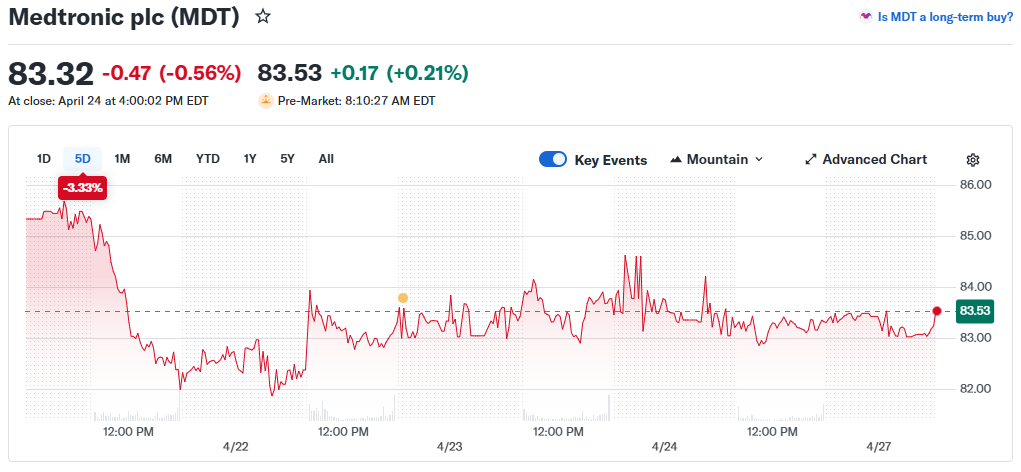
From a financial perspective, the market’s reaction to the news has been relatively measured, as investors prioritize operational continuity over administrative data loss. Because Medtronic has maintained its manufacturing and distribution timelines, the financial results for the current quarter are expected to remain within established guidance.
This stability is a key differentiator in a sector where a single week of disrupted shipments can result in significant losses of market share to more stable competitors. Furthermore, the strategic orientation of the firm toward proactive threat hunting and rapid incident response is becoming a standard requirement for institutional-grade valuation.
As insurance premiums for cyber coverage continue to rise for healthcare entities, companies that can prove their ability to “work through” a breach without impacting their primary revenue drivers are increasingly viewed as lower-risk investments.
The patient-first messaging from the leadership has successfully neutralized much of the initial concern regarding data security and product integrity.
Healthcare Cybersecurity and MedTech Market Outlook
The defensive success reported by Medtronic serves as a definitive signal for the medical technology sector for the remainder of 2026. By successfully isolating a corporate breach from its manufacturing and patient safety systems, the company has validated a model of digital resilience that will likely be emulated across the industry.
We are entering a cycle where institutional-grade productivity is defined not just by innovation but by the ability to defend the systems that deliver those innovations to the bedside. The primary focus for market participants in the coming weeks will be the final audit of the data lost during the corporate network intrusion.
Although the impending momentum of the healthcare sector remains tied to advancements in surgical robotics and monitoring, the foundational tone of the market is increasingly focused on the security of the underlying data fabric. Investors should treat the lack of operational disruption as the primary metric of success for this incident.
In summary, Medtronic appears to have weathered a significant digital assault with its core business intact, finding a clear path toward maintaining its leadership position in an increasingly hostile digital environment.


