
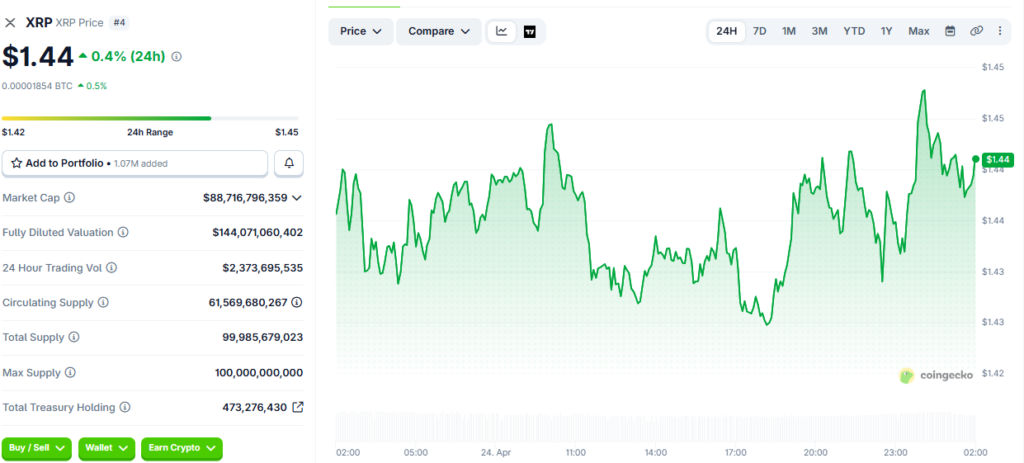
The digital asset market is grappling with a period of noticeable buyer exhaustion following a volatile start to the week. Ripple (XRP) has found itself caught in a narrow range, hovering near the $1.43 mark as the initial enthusiasm generated by geopolitical ceasefire extensions begins to dissipate.
While the broader cryptocurrency market sought to capitalize on reduced global tensions earlier in the week, the remittance-focused token has struggled to maintain its upward momentum, facing significant overhead pressure near its weekly highs. The current stagnation is a direct reflection of cooling interest from both retail and institutional participants.
According to a crypto analyst at Alliston-Westbury, the deceleration in spot ETF inflows has removed a critical pillar of support that was previously driving price appreciation. Without a renewed surge in capital commitment from institutional vehicles, the asset remains vulnerable to persistent sell-side pressure, particularly as derivatives traders adopt a more cautious “risk-off” posture.
Institutional Appetite and ETF Dynamics
Data from the past several days highlights a sharp drop in the velocity of capital entering XRP-related investment products. Total inflows into XRP spot ETFs reached approximately $9.30 million through Thursday, a significant decline from the $55.39 million recorded during the prior week.
While Thursday saw a minor uptick to $3.89 million from Wednesday’s $2.42 million, the overall trend suggests that institutional demand is currently in a defensive phase. At present, cumulative net inflows stand at $1.28 billion, with total net assets valued at $1.08 billion.
This cooling of activity is mirrored in the derivatives market, where perpetual Open Interest (OI) has leveled off at an average of $2.57 billion. This figure represents a notable retreat from the monthly peak of $2.80 billion observed on Monday.
Technical Structure: Support Clusters vs. Long-Term Resistance
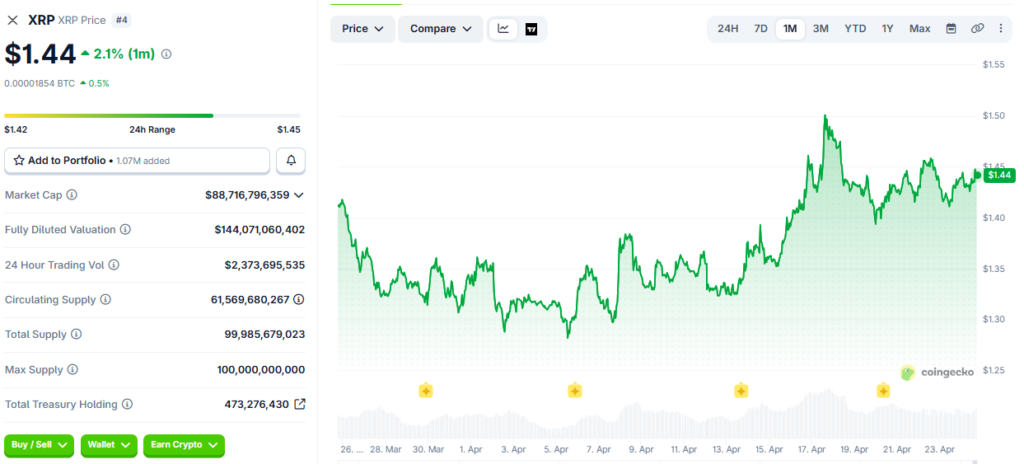
From a technical standpoint, XRP is navigating a complex structural environment. The token is currently maintaining a mildly constructive tone by trading above the 50-day Exponential Moving Average (EMA) at $1.41. Furthermore, the midline of the Bollinger Bands, represented by the 20-day Simple Moving Average near $1.39, is providing a secondary layer of dynamic support.
This area between $1.39 and $1.41 has become a critical demand zone where buyers have historically re-emerged to prevent a deeper correction. However, the broader trend remains capped by a heavy cluster of long-term resistance. The 100-day EMA at $1.53 and the 200-day EMA at $1.78 are both sloping downward, defining a bearish technical ceiling that must be overcome to invalidate the current downtrend.
Maintaining institutional-grade productivity in this market requires acknowledging that while short-term indicators are supportive, the long-term trend remains firmly in favor of the bears until a daily close above the $1.53 barrier is achieved.
Momentum Oscillators and Overbought Risks
Internal momentum signals offer a mix of optimism and caution. The Moving Average Convergence Divergence (MACD) histogram is currently holding in positive territory on the daily chart, while the Relative Strength Index (RSI) is positioned near 56, suggesting that bulls still retain a slight edge.
The Money Flow Index (MFI) has climbed to an elevated level of 74, signaling that the recent consolidation may be stretching toward overbought conditions. If the MFI continues to rise without a corresponding break in price resistance, the likelihood of a “mean reversion” event increases.
On the topside, the immediate target for bulls is the upper Bollinger Band at $1.48. A failure to breach this level would likely result in a test of the lower Bollinger Band near $1.30, a move that would effectively neutralize the current consolidation phase and signal a return to the broader downward trajectory.
XRP Wrap-Up & Strategic Outlook
The sideways price action currently defining the XRP market is a byproduct of a broader “wait-and-see” approach being adopted by global crypto investors. By decoupling from the early-week volatility, the token has managed to establish a temporary floor, yet the projected trend for the coming days is heavily reliant on a resurgence in ETF volume.
We are entering a cycle where institutional-grade productivity will be measured by the ability of these assets to attract consistent, long-term capital rather than reacting solely to ephemeral geopolitical headlines.
The primary objective for market participants in the final sessions of the month will be defending the $1.39 support level. While the forthcoming bias for the asset is contingent on a breakout above the 100-day EMA, the foundational structure of the derivatives market suggests that a period of further range-bound trading is the most probable outcome.
Investors should remain vigilant regarding the $1.48 resistance level as a definitive indicator of renewed bullish intent. In summary, the remittance token appears to be at a crossroads where only a sustained influx of institutional liquidity can overcome the technical headwinds currently limiting its recovery potential.


