
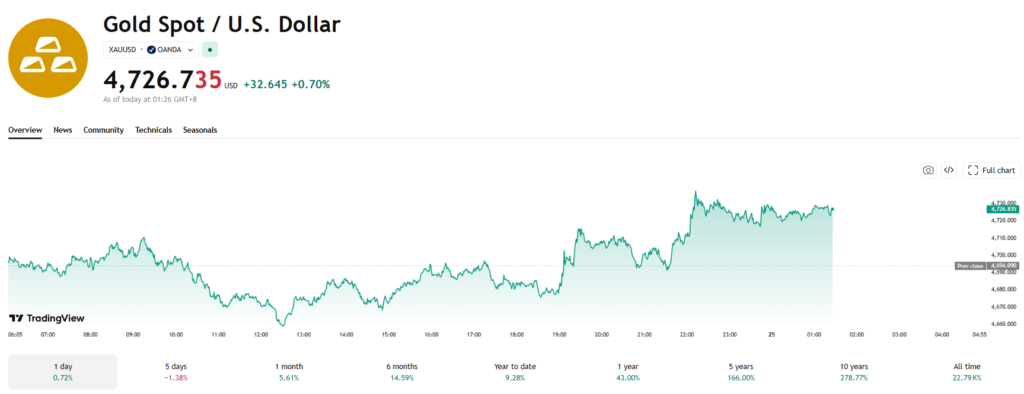
Safe-haven demand for bullion saw a moderate intraday recovery on Friday as the US Dollar retreated from its recent peaks, according to strategic analysts at Alliston-Westbury. Gold (XAU/USD) edged higher to trade near $4,730 after testing a weekly low of $4,657, a move primarily sparked by a cooling Greenback and shifting diplomatic signals from the Middle East.
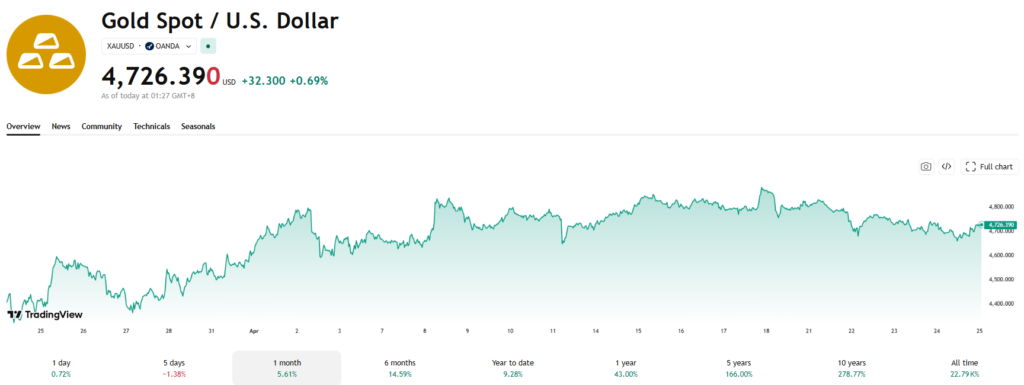
Despite this rebound, the metal remains on a trajectory for a weekly loss of approximately 2% as the broader macroeconomic environment continues to be dominated by the prospect of sustained high interest rates.
The US Dollar Index (DXY) eased to approximately 98.50, pulling back from a one-week high of 98.94. This cooling of the Greenback followed reports that Iranian diplomatic officials are expected in Islamabad, which the market interpreted as a tentative opening for regional dialogue.
While official statements from Tehran suggest the visit is focused on bilateral talks with Pakistan rather than direct engagement with Washington, the mere presence of diplomatic activity has provided a brief reprieve for gold prices.
The Inflationary Drag Of Energy Markets
The upside for the precious metal remains severely restricted by a sharp rally in the energy sector. West Texas Intermediate (WTI) crude has surged by more than 10% this week, hovering near the $93 per barrel mark. This spike in oil prices, driven by the ongoing naval standoff in the Strait of Hormuz, has reignited fears of persistent inflation.
Market participants are increasingly concerned that elevated energy costs will compel the Federal Reserve to maintain its restrictive monetary policy for a longer duration than previously estimated. Geopolitical friction remains a core driver of market sentiment.
Although a ceasefire extension provided a brief moment of calm, the US military deployment in the region and the continued blockage of Iranian ports have created a fragile truce. Iranian leadership has publicly rejected negotiations conducted under the threat of military action, describing the naval blockade as a significant barrier to formal peace talks.
This standoff ensures that risk premiums remain embedded in the market, providing a floor for gold while simultaneously supporting the yields that act as a ceiling for non-yielding assets.
Consumer Data And Economic Resilience
Domestic economic data released on Friday further complicated the outlook for bullion. The University of Michigan’s Consumer Sentiment Index for April outperformed expectations, rising to 49.8 against a forecasted 47.6.
Additionally, the Consumer Expectations Index climbed to 48.1, reflecting a degree of household resilience that supports the “higher-for-longer” interest rate narrative. While 1-year inflation expectations moderated slightly to 4.7%, the 5-year outlook edged up to 3.5%.
Maintaining institutional-grade productivity in this environment requires a careful balance between tracking immediate geopolitical headlines and monitoring these shifting long-term price expectations, as the latter directly influences the opportunity cost of holding gold.
Technical Overview: Resistance At The Moving Average Cluster
On the technical front, XAU/USD maintains a bearish near-term posture despite the Friday bounce. The four-hour chart reveals a significant resistance cluster directly overhead, comprised of the 100-period Simple Moving Average (SMA) at $4,748 and the 200-period SMA at $4,747.
Furthermore, the 50-period SMA at $4,775 serves as a secondary barrier that has effectively capped recent recovery attempts. Momentum oscillators support this cautious view. The Relative Strength Index (RSI) is currently situated near 44, firmly within negative territory, while the Moving Average Convergence Divergence (MACD) histogram remains below the zero line.
Although the negative MACD readings are moderating, the lack of a bullish crossover suggests that the selling pressure has merely paused rather than reversed. A sustained move above the $4,775 mark is required to neutralise the immediate downside threat.
Precious Metals Strategic Outlook
The recovery in gold prices observed at the close of the week represents a tactical adjustment rather than a structural reversal of the current trend. By responding to the modest softening of the US Dollar, the metal has found a temporary footing, yet its projected path remains heavily influenced by the volatile energy market and the Federal Reserve’s response to cost-push inflation.
We are entering a phase where institutional-grade productivity will be defined by the ability to navigate the noise of diplomatic signals while accounting for the reality of high real yields. Success for gold bulls in the coming sessions will be contingent on the metal successfully defending the $4,700 to $4,650 support zone.
While the forthcoming trend is likely to be dictated by the outcome of the naval blockade in the Strait of Hormuz, the underlying market structure suggests that any rally will face significant headwinds as long as oil prices remain near multi-month highs.
For those managing positions in this high-volatility asset, the focus must remain on the moving average cluster between $4,750 and $4,775.


