
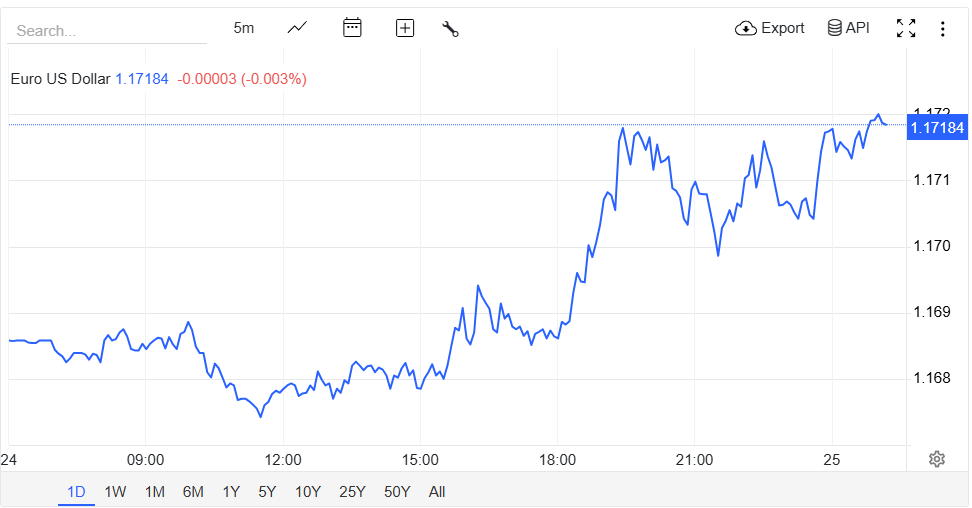
The Euro has demonstrated notable resilience during the final trading session of the week, successfully consolidating its position near the 1.1700 psychological threshold. Despite earlier headwinds originating from the Eurozone’s largest economy, the common currency managed to withstand a decline in the German IFO Current Assessment Index, which printed at 85.4 for April compared to the 86.7 recorded in March.
This fundamental drag was largely offset by a broader shift in risk appetite as market participants pivoted away from safe-haven assets in response to evolving geopolitical headlines. The current trajectory of the pair is increasingly defined by the cooling inflationary environment within the United States.
According to a currency analyst at Alliston-Westbury, the recent Producer Price Index (PPI) data has played a pivotal role in maintaining the bearish pressure on the US Dollar. With core annual wholesale inflation printing at 3.8%, falling below the anticipated 4% mark, the case for a more accommodative federal monetary stance has gained significant traction.
Geopolitical Influence and Market Sentiment
Risk sentiment was significantly bolstered on Friday by reports that the United States and Iran are prepared to return to the negotiating table in Islamabad. This potential for diplomatic dialogue has momentarily paused the escalation of Middle Eastern tensions, providing a reprieve for global financial markets.
Although a US blockage of specific ports in the Strait of Hormuz remains an active point of contention, the mere prospect of a truce has encouraged investors to move back into riskier assets, further weighing on the Greenback. While the geopolitical situation remains fragile, the domestic US labor market continues to exhibit strength.
The latest ADP National Employment Report indicated that private employers added an average of 39,250 jobs per week over the four-week period ending March 28. While this robust job creation typically supports a stronger currency, it was overshadowed by the softer-than-expected PPI figures, which signaled that wholesale cost pressures are normalizing at a faster pace than many had projected.
Technical Analysis: The Bullish Seven-Day Streak
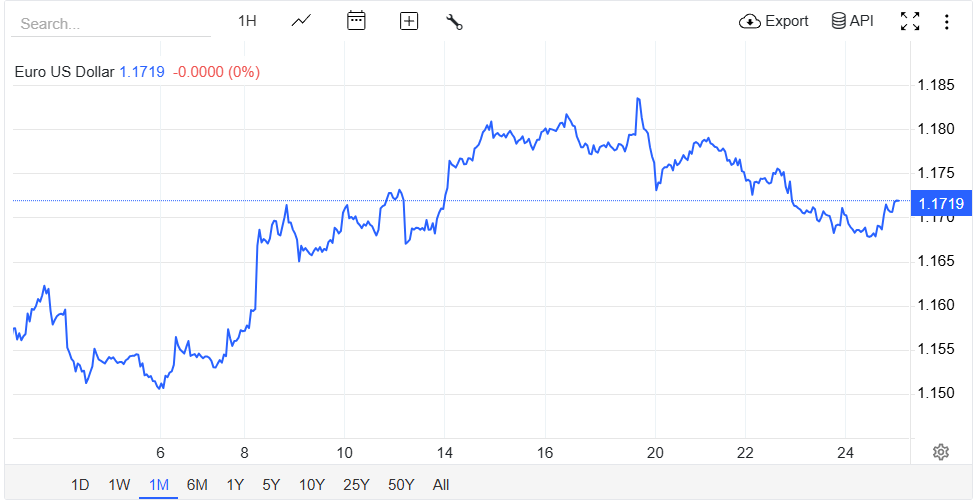
From a technical perspective, the EUR/USD pair is exhibiting a classic bullish breakout pattern on the daily chart. The pair has advanced for a seventh consecutive session, a feat that has pushed the spot price above both the 100-day and 200-day Simple Moving Averages (SMAs) at 1.1698 and 1.1673, respectively.
This alignment of long-term moving averages suggests that the underlying trend has shifted firmly in favor of the buyers, with the 20-day SMA at 1.1594 providing a solid foundational base. On the four-hour time frame, the short-term momentum remains highly constructive.
The price is holding decisively above the 20-period SMA at 1.1725, which serves as the immediate dynamic support. The Relative Strength Index (RSI) is currently hovering near the 73 mark, and while this indicates that the pair is approaching overbought territory, it simultaneously reflects the intensity of the current buying pressure.
The Momentum indicator continues to advance within positive levels, reinforcing the potential for further upside toward the 1.1830 resistance zone.
Strategic Support and Resistance Targets
As the pair trades near 1.1800 for the first time since February, the immediate focus for traders shifts to the late-February highs. Resistance is clearly established near 1.1830, and a successful breach of this level would likely clear the path for a move toward the 1.1900 handle.
Maintaining institutional-grade productivity in this environment requires a close watch on intraday volatility, as any failure to hold the 1.1700 level could trigger a healthy corrective phase. On the downside, initial support is found at the 100-day SMA of 1.1698.
Should a deeper correction occur, a significant demand area is expected to emerge near the 1.1594 level, where the 20-day SMA converges with previous structural support. Buyers are likely to re-emerge at these levels if the current advance pauses, given the broader fundamental backdrop of cooling US inflation and stabilizing geopolitical risks.
The Road Ahead for EUR/USD
The stabilization of the Euro near the 1.1700 level represents a fundamental recalibration of expectations for the remainder of 2026. By decoupling from the weakness in German industrial sentiment and focusing on the softening US wholesale price data, the currency has demonstrated a new level of structural strength.
We are entering a cycle where institutional-grade productivity in the currency markets is driven by the divergence between resilient employment data and a decelerating inflation path. Success for the remainder of the month will be determined by whether the Islamabad negotiations can deliver a tangible reduction in regional risk premiums.
Although the forthcoming outlook for the Greenback is largely contingent on the PPI trajectory, the underlying sentiment for the Euro has turned markedly constructive following its breach of high-level technical barriers.


