
An IP rating is a useful, standardized clue about an enclosure’s protection against specified forms of solid and water ingress. It is not a complete score for outdoor durability. A label such as “weatherproof” is broader still: unless it is tied to a particular standard, test, model, and set of conditions, it does not tell a buyer exactly what was evaluated. The practical approach is to read the IP code for the narrow question it answers, then check separate evidence for temperature, corrosion, installation, and warranty.
What an IP rating actually measures
IEC 60529 is titled Degrees of protection provided by enclosures (IP Code). It classifies protection provided by enclosures for electrical equipment; it does not rate every way a complete television might age or perform outdoors. The IEC’s standard listing is the primary reference for the code and its scope.
In a familiar two-numeral code, the first characteristic numeral relates to protection against access to hazardous parts and ingress of solid foreign objects; the second relates to water ingress. These are separate categories, not two parts of one overall “outdoor toughness” score. A buyer should therefore read each digit against its own column in the standard, rather than assuming the combined number is a percentage or a complete weather rating. A U.S. Department of Homeland Security technical report reproduces the relevant IEC 60529 tables in its appendix for readers who want a public-facing summary.
That distinction matters when a listing says IP56. In the IEC code, the first digit 5 is “dust-protected”: dust ingress is not necessarily prevented entirely, but it must not enter in a quantity that interferes with satisfactory operation. The second digit 6 refers to protection against powerful water jets. It is not an immersion rating; temporary and continuous immersion are separate water categories in the standard. In other words, IP56 is not shorthand for “sealed against everything,” and it does not mean a TV can be submerged, pressure-washed in any way, or exposed to every possible water condition.
The standard’s test categories are specific. They do not describe every water source, cleaning method, chemical, exposure duration, installation orientation, or combination of weather a TV may encounter in a particular home. The relevant test conditions and the product configuration to which a result applies matter just as much as the two digits printed on a product page.
Why “weatherproof” is not a complete specification
“Weatherproof,” “all-weather,” and similar phrases can be useful signals that a product is intended for outdoor use, but the words alone do not identify the test method or limits behind that intention. One seller may use the phrase alongside a specific IP code; another may use it as general product copy. Neither phrase by itself tells the buyer whether the exact model has been evaluated for salt fog, ultraviolet exposure, humidity cycling, condensation, or a particular temperature range.
Those are separate questions. UL Solutions’ environmental simulation testing services, for example, list IP water-and-dust testing separately from environmental testing for temperature, humidity, salt fog, ozone, and ultraviolet exposure. That does not mean every television needs every test. It shows why one ingress-protection label should not be treated as evidence for unrelated environmental conditions.
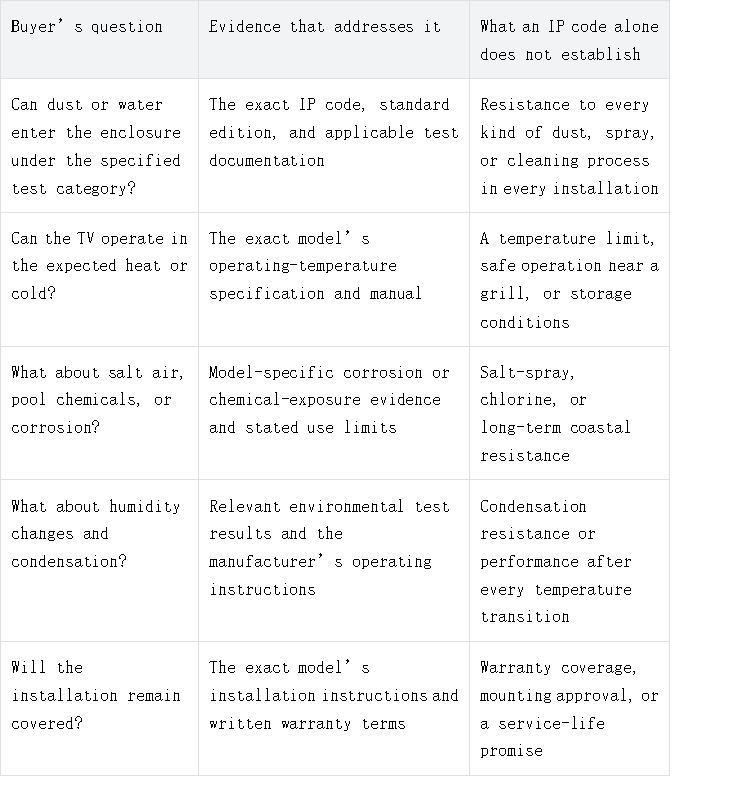
This is why an outdoor label should narrow the questions rather than end them. A TV near a pool, coastline, cooking area, or unheated seasonal space may face exposures that a basic IP description does not answer. The correct conclusion is not that a particular model will fail; it is that the IP code alone cannot settle those separate questions.
Evaluate the evidence behind the claim
The most useful purchase check is to connect each statement to a specific source. Start with the exact model number, size, generation, and sales market. A series name may cover multiple products, and a rating on one configuration should not automatically be copied to another size or generation.
Then look for the standard and the evidence claimed. If the seller says a product was tested or independently certified, ask which standard and edition were used, which exact model or enclosure configuration the report covers, and who issued the report or certificate. A document should identify enough detail to connect it to the item being purchased. If the claim is based on a manufacturer’s own testing, that is different from independent laboratory certification and should be described as such.
Next, read the product manual and model page for conditions that sit outside the IP code: operating limits, installation position, port or cover instructions, ventilation, care, and any prohibited exposures. Review the warranty separately. A warranty describes contractual coverage and exclusions; it is not a test report and should not be inferred from a weather label.
A practical evidence hierarchy looks like this:
- The standard: What does the code mean, and what test category does it refer to?
- Model-specific test or certification documents: If testing or certification is claimed, do the report, issuer, standard edition, and covered model match the listing?
- The exact product manual and specification page: What operating, installation, and care conditions apply to the unit being considered?
- The warranty for the actual seller and market: What does it cover, and what conditions or exclusions apply?
- Broad marketing wording: Treat “weatherproof” as a prompt to find the details above, not as a substitute for them.
This is not a claim that every manufacturer must publish the same paperwork or that a code printed on a listing is automatically false. It is a way to separate what a document proves from what it merely suggests. A product page can establish the manufacturer’s published specification; by itself, it is not an independent laboratory report.
A model-specific example: what the Sylvox page does and does not show
The Sylvox U.S. product page for the 55-inch 2026 Deck Pro 3.0 Lock Series identifies the product as SKU OT55B2KHGD and describes it as IP56-rated. That is a specific, attributable manufacturer claim for that listing; the code’s narrow meaning is defined by IEC 60529, not by the broader “outdoor” label.
Mapped against that page, IP56 answers one narrow question — dust and powerful water jets at the enclosure — and leaves the rest of a buyer’s checklist to other documents. That boundary comes from the standard, not from this TV: no manufacturer’s IP56 rating, on its own, settles salt air along a coastline, pool chemicals, condensation on a cool morning, operating temperature, service life, or warranty coverage. Sylvox covers some of those points in its own materials, where the Deck series is described as built for four-season outdoor use with a wide operating temperature range — separate manufacturer claims, backed by the manual and spec sheet, not conclusions the two digits can carry. Where the page and manual leave a planned condition unanswered, the right move is to ask before buying, not to assume the TV falls short.
A practical checklist before buying
Before treating an outdoor-TV claim as a fit for a particular space, record:
- Exact identity: model, screen size, generation, SKU, and U.S. or other market version.
- The complete code: the full IP marking, including any X or additional letters, rather than a partial number copied from a category page.
- The standard: the standard number and edition referenced by the claim.
- The supporting document: product manual, test report, or certificate; check the issuing organization and the models or configurations covered.
- The exposure: direct spray, dust, salt, chemicals, UV, humidity changes, temperature extremes, or nearby heat that matters at the intended location.
- The installation conditions: orientation, ventilation, openings, cables, covers, and care instructions in the exact model’s manual.
- The separate terms: warranty and service conditions for the actual seller and purchase market.
If a listing gives only a broad “weatherproof” label, the next step is to ask what standard or test supports it and which model it applies to. If it lists an IP rating, interpret only the protection categories that the code defines, then verify other exposures independently. If documentation leaves a condition important to the planned installation unanswered, treat that as an open purchasing question rather than filling the gap with the IP number.
The clearest way to compare outdoor TVs is to keep the claim, its evidence, and its limits together. An IP code can make a narrow enclosure-protection question more precise. “Weatherproof” can describe a product’s intended role. Neither one, on its own, is a universal promise about every outdoor environment, installation, or year of use.


