
The Indian Rupee (INR) continues to weaken against the US Dollar (USD), facing compounding pressure from elevated crude prices, rising US Treasury yields, and ongoing geopolitical tensions.
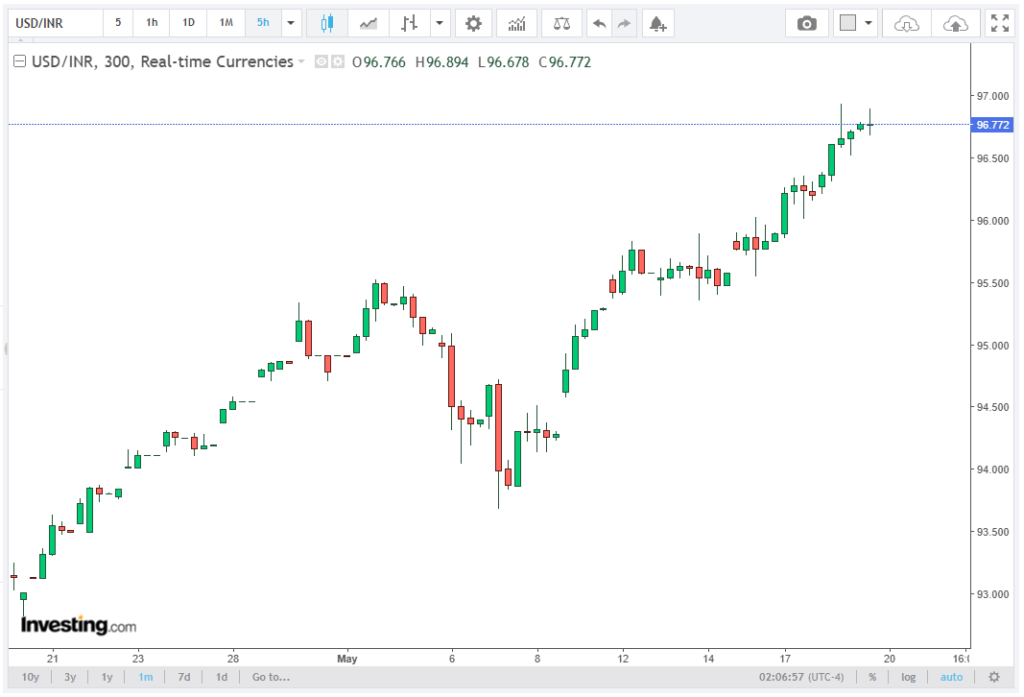
On Wednesday, the USD/INR pair traded near 97.00, a fresh all-time high, as market participants assessed the impact of sustained energy disruptions and expectations of monetary tightening abroad. In a new article, Murrius Group’s brokers deliver a comprehensive overview of this topic.
Elevated Oil Prices Exert Strong Downward Pressure
Crude oil prices remain a critical driver of the INR’s weakness. WTI crude is currently trading around $102.50 per barrel, marking a 50% increase since the escalation of Middle East tensions. The rise is largely attributed to the risk of prolonged disruption at the Strait of Hormuz, a vital maritime chokepoint that accounts for approximately 20% of global oil supply.
India imports roughly 85% of its oil requirements, making energy costs a decisive factor in currency performance. Rising crude prices directly affect the trade balance by increasing the current account deficit (CAD), projected at 2.7% of GDP for FY2026 under baseline oil price assumptions. If oil prices remain elevated around $105–$110 per barrel, the CAD could rise to 3.1–3.2% of GDP, putting additional downward pressure on the INR.
Higher oil prices also contribute to inflationary pressures, as a $10 per barrel increase in crude typically adds approximately 25–30 basis points to India’s retail inflation. Such dynamics create a challenging environment for the Reserve Bank of India (RBI), which must balance inflation containment with support for economic growth.
Geopolitical Risk Sustains Volatility
The ongoing geopolitical tension in the Middle East continues to sustain volatility in crude markets, which in turn exerts pressure on the INR. Disputes over sanctions, frozen assets, and maritime access remain unresolved, and any military escalation could disrupt an estimated 5–7 million barrels per day of oil supply.
Historical analysis indicates that each 1% increase in WTI crude above $100 is associated with approximately 15–20 basis points of INR depreciation, illustrating the currency’s sensitivity to energy shocks.
Rising US Treasury Yields Pressure the INR
Rising US Treasury yields are another significant factor contributing to the INR’s depreciation. The 10-year US Treasury yield recently reached 4.69%, a level not seen in over a year, reflecting expectations that the Federal Reserve will deliver at least one interest rate hike this year. Higher yields attract capital into USD-denominated assets, reducing demand for risk-sensitive currencies such as the INR.
Rising yields also increase the external borrowing cost for emerging markets. For India, this translates into higher debt servicing requirements on foreign obligations, estimated at $110–115 billion for FY2026, with each 1% INR depreciation potentially adding $2–3 billion to the foreign debt burden.
Technical Analysis: USD/INR Outlook
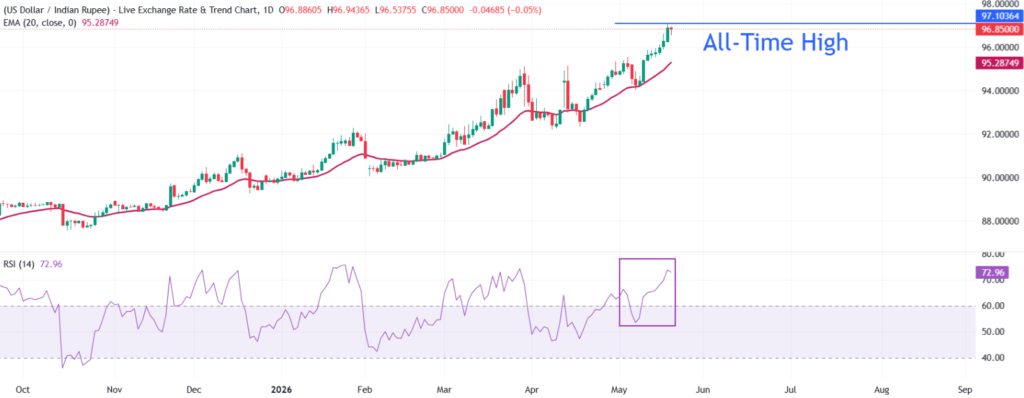
From a technical standpoint, USD/INR is trading at 96.85, remaining above the 20-day Exponential Moving Average (EMA) of 95.29, indicating that the near-term uptrend is firmly intact. The 14-day Relative Strength Index (RSI) stands at 72.96, entering overbought territory, which suggests that while bullish momentum remains strong, short-term corrective pauses may occur.
Immediate support is observed at the 20-day EMA near 95.29, where dip-buying interest is likely to emerge. A daily close below this level could trigger a deeper corrective move toward 94.50–95.00, while stability above 97.00 may open the path toward 98.00, sustaining the strong bullish bias in the USD/INR pair.
Implications for the Indian Economy
The weaker INR has significant implications for India’s economy. Rising energy costs increase imported inflation, potentially adding 25–30 basis points to consumer price indices, which may constrain monetary policy flexibility.
External borrowing costs also rise, with foreign debt service obligations becoming more expensive, and the current account deficit could widen beyond 3% of GDP if oil prices remain elevated above $105 per barrel.
These factors create a challenging backdrop for both policymakers and market participants, emphasizing the need for careful monitoring of energy markets, global interest rates, and geopolitical developments.
Conclusion
The Indian Rupee remains under sustained depreciation pressure due to the combined effects of elevated crude prices, rising US Treasury yields, and persistent geopolitical uncertainty. Renewed FII outflows and a strong USD further reinforce the INR’s downward trajectory.
Technical indicators suggest that while short-term corrections are possible, support at 95.29 provides a foundation for further upside, with potential resistance at 98.00. The INR’s sensitivity to energy prices and global interest rates underscores the importance of closely tracking these macroeconomic and geopolitical variables.
As long as crude oil remains above $100 per barrel and Treasury yields maintain upward pressure, the INR is likely to face continued depreciation risk, challenging traders, investors, and policymakers alike.


