
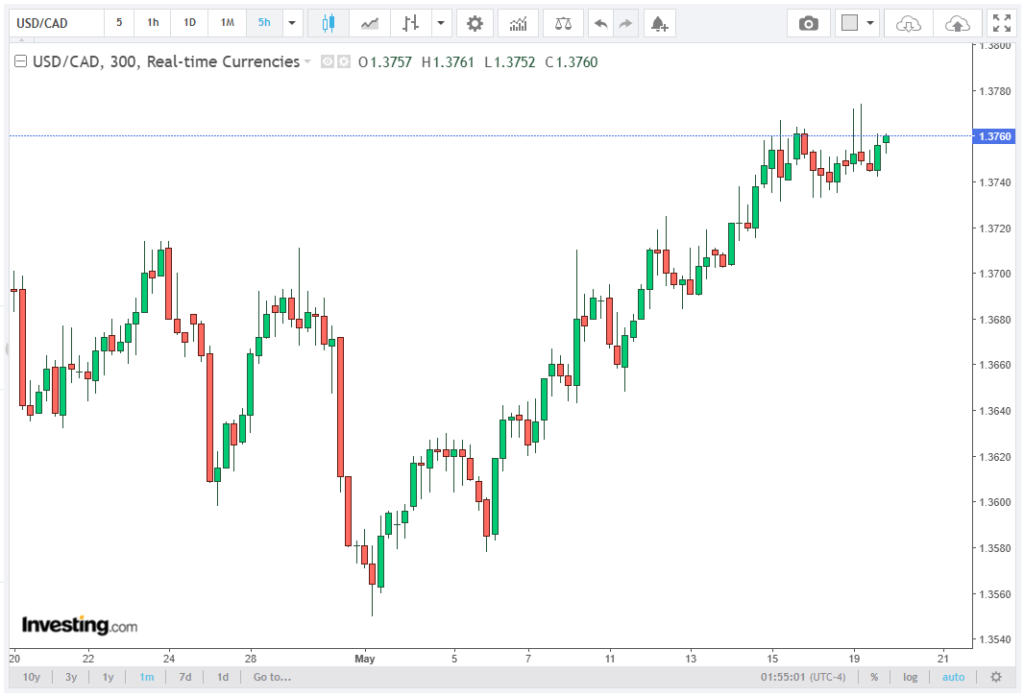
The Canadian Dollar (CAD) experienced renewed pressure on Wednesday as USD/CAD extended gains for a second consecutive day, trading near 1.3760 during Asian session hours. Murrius Group brokers take a closer look at this subject in their recently published article.
The currency’s commodity-linked nature makes it highly sensitive to oil market fluctuations, with Canada among the world’s largest crude producers, sending approximately 3.5 million barrels per day to its major export partner. Even a modest decline in crude prices can reduce export revenues and negatively affect terms of trade, reinforcing downward pressure on CAD.
USD/CAD Supported by CAD Vulnerability
The USD/CAD pair’s appreciation reflects a combination of weak CAD fundamentals and strong USD demand. Investors continue to favor the US Dollar (USD) as a safe-haven currency, particularly amid geopolitical tensions and energy market volatility. The recent decline in oil prices reinforced concerns over Canada’s export earnings, while the USD benefited from renewed safe-haven inflows.
The CAD’s sensitivity to energy prices is particularly pronounced due to its high oil intensity, with energy accounting for roughly 11% of GDP. With West Texas Intermediate (WTI) crude halting its four-day winning streak at approximately $102.80 per barrel, the USD/CAD has found support near the 1.3750–1.3765 range.
Oil Market Dynamics: Geopolitical Risks and Supply Concerns
Despite the near-term decline, WTI crude could regain momentum amid renewed geopolitical risk. Market participants are pricing in the potential for military conflict in the Middle East, which could disrupt supply from one of the region’s key oil producers, potentially removing 500,000–1,000,000 barrels per day from global markets.
Historically, such geopolitical tensions have contributed to oil price spikes, directly impacting CAD valuation. Technical analysts note that a sustained move above $105 per barrel could trigger a short-covering rally in the CAD, whereas further declines below $100 per barrel may accelerate USD/CAD gains.
Canadian Inflation Trends
Domestic inflation data have also influenced CAD performance. Statistics Canada reported the annual CPI accelerated to 2.8% in April, up from 2.4% in March, driven largely by higher gasoline prices, which rose 4.1% month-over-month. The reading came below market expectations of 3.1%, suggesting that headline inflation pressures remain manageable.
Every month, the CPI increased 0.4%, slowing from a 0.9% gain in March. Core inflation, which strips out volatile energy and food components, decelerated slightly to 2.2% year-over-year from 2.3%, supporting the view that energy-driven price pressures may moderate.
This outcome tempers expectations of further Bank of Canada (BoC) interest rate hikes, providing limited support for CAD appreciation.
USD Strength Driven by Safe-Haven Flows
The US Dollar maintained resilience amid heightened market risk aversion. Investors increased their exposure to USD-denominated assets, including Treasuries and cash positions, as geopolitical uncertainty persisted.
Rising energy prices contributed to higher inflation risk, reinforcing expectations that monetary authorities may maintain elevated interest rates longer or implement additional policy tightening measures.
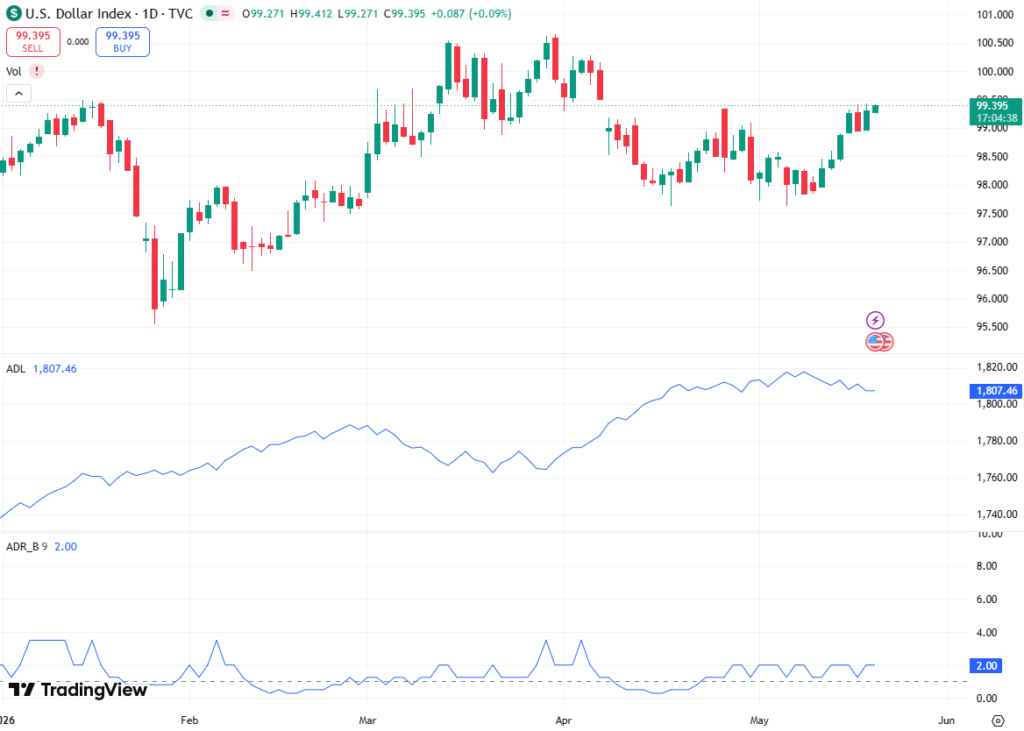
Market-implied probabilities indicate a 70–75% chance of policy rate maintenance at 5.50% for the next quarter, based on futures contracts, suggesting that USD support is likely to persist unless geopolitical conditions stabilize.
US Treasury Yield Movements
In the fixed-income market, the 30-Year US Treasury Yield declined slightly to 5.180%, after reaching a near 19-year high of 5.200% on Wednesday. This pullback reflects profit-taking and increased demand for longer-duration bonds amid ongoing market uncertainty.
Shorter-term yields have largely maintained upward momentum. The 10-Year Treasury Yield remains near a 16-month high of 4.687%, while the 2-Year Yield is holding close to 4.139%, levels last observed during Tuesday’s session. The flattening of the yield curve signals investor caution regarding long-term growth and inflation expectations, supporting continued USD strength relative to CAD.
Technical Outlook for USD/CAD
The USD/CAD is shaped by three main factors: oil prices, below $100 weigh on the CAD, above $105 could boost it; strong safe-haven demand for the USD, driven by geopolitical risks and inflation, limiting CAD gains; and easing Canadian inflation (headline 2.8%), which lowers the likelihood of further BoC tightening and constrains CAD support.
Short-term technical levels indicate that USD/CAD support lies near 1.3740, while resistance is projected around 1.3780, with price action largely driven by oil market developments and Treasury yield dynamics.
Conclusion
The Canadian Dollar remains under pressure as oil prices ease and USD demand strengthens. While WTI crude could regain lost ground amid geopolitical risk, the combination of moderating Canadian inflation and persistent USD safe-haven flows is likely to keep USD/CAD elevated near current levels.
Market participants are advised to monitor oil prices, US Treasury yields, and Canadian inflation data, as these factors are likely to dictate currency and fixed-income market direction in the near term.


