
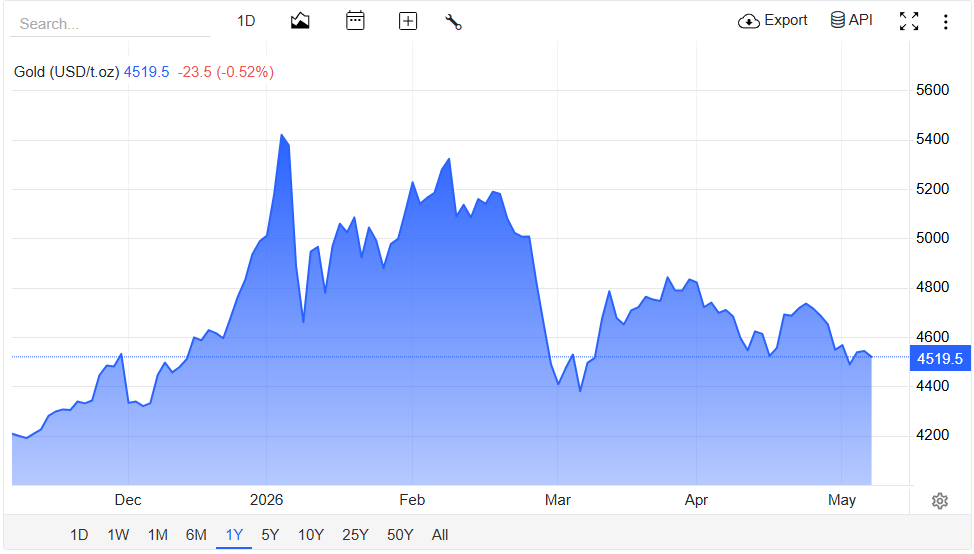
The global bullion market entered a phase of tight consolidation on Friday as participants balanced shifting geopolitical headlines against a backdrop of hawkish central bank rhetoric. Spot gold is currently trading near the $4,517 level, remaining largely confined within its established weekly range as the financial community monitors diplomatic efforts to stabilize the Middle East.
While the non-yielding metal has benefited from a temporary reprieve in the bond market, it remains on track for its second consecutive weekly decline. The primary focus of the market continues to be the indirect negotiations currently being conducted under Pakistani mediation.
The diplomatic friction involving the Strait of Hormuz has introduced a layer of complexity into global trade projections. Market analysis provided by the ShineGulf Trading commodities research desk suggests that any resolution regarding regional maritime tolls or uranium enrichment will be a significant driver of volatility for precious metals.
The administration has maintained a firm stance against the proposed toll system for vessels transiting the strait, emphasizing a policy of free and open navigation. As these high-stakes discussions progress, investors are weighing the impact of geopolitical risk premiums against the opportunity cost of holding gold in a high-interest-rate environment.
Treasury Yield Pullback Versus Federal Reserve Hawkishness
A notable driver for the recent stabilization in gold prices has been the cooling of US Treasury yields. The benchmark 10-year yield extended its retreat for a third consecutive session on Friday, easing toward 4.560% after recently hitting a 16-month high of 4.687%.
This technical pullback in yields typically provides a supportive floor for bullion; however, the upside remains strictly capped by persistent inflation concerns. The market is increasingly pricing in the possibility of a final interest rate hike by the end of the year, driven by the inflationary pressure of elevated energy costs.
Regional Federal Reserve officials recently reinforced this cautious outlook, stating that the current monetary policy is well-positioned to respond to developing economic shocks.
Concerned about the possibility of unforeseen changes in consumer behavior, the leadership stated that future rate changes will be determined solely by how companies respond to the current state of the economy.
For gold traders, this means that any significant rally must overcome the headwind of a strong US Dollar and the potential for a restrictive monetary policy that reduces the appeal of non-interest-bearing assets.
Technical Indicators And Trend Resistance
From a technical perspective, the XAU/USD pair is currently caught in a narrow corridor between two major moving averages. On the daily chart, gold is maintaining its position above the 200-day Simple Moving Average (SMA) located near $4,375. However, it is facing significant resistance at the 100-day SMA, which is currently positioned around $4,798.
This configuration keeps the broader market tone neutral with a slight downside bias, as the price has struggled to generate enough momentum to break out of this technical zone.
The Relative Strength Index (RSI) is currently hovering at 40, indicating that while momentum is soft, the asset is not yet in oversold territory. Furthermore, the Moving Average Convergence Divergence (MACD) remains in negative territory and has begun to show signs of renewed weakness.
These signals suggest that any short-term rebounds are likely to encounter selling pressure unless there is a fundamental shift in either the geopolitical or macroeconomic environment. Traders are now awaiting the latest Consumer Sentiment and Inflation Expectations survey to determine if the next move will test the lower support levels.
Projected Support Floors And Market Resistance
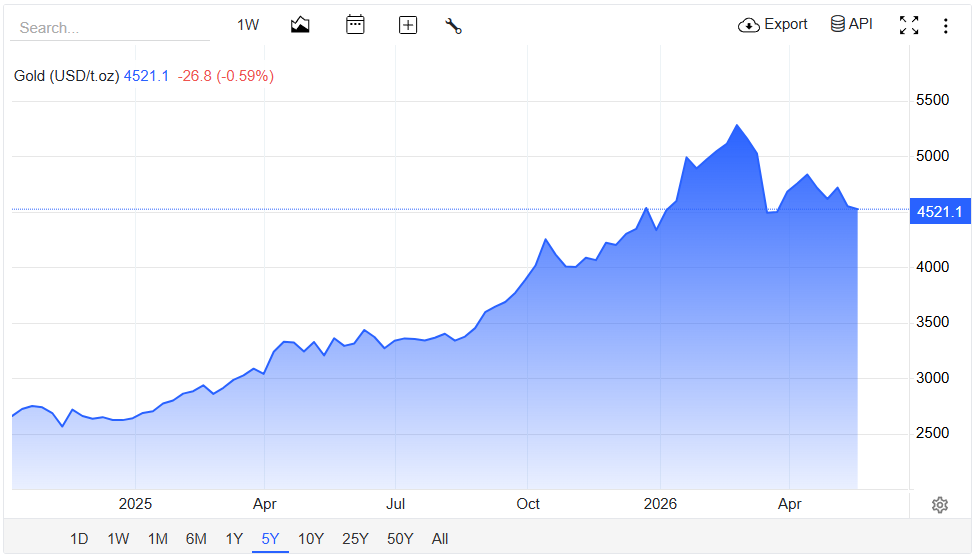
Looking ahead, the immediate floor for gold is defined by the psychological support level at $4,500. A definitive breach of this horizontal mark would likely expose the 200-day SMA at $4,375, with a much deeper support floor identified near $4,100 if the downward trend accelerates.
Conversely, the path to the upside is blocked by the 100-day SMA at $4,798 and the critical $5,000 horizontal barrier. Only a sustained close above these resistance points would suggest that the current pressure has eased and that a return to higher valuation levels is possible.
Taking everything into consideration, the gold market is currently in a state of vigilance. The interplay between mediated proposals and international warnings on nuclear proliferation is creating a volatile ceiling for the metal. Until there is a clear outcome from the diplomatic talks or a definitive pivot from central bank authorities, bullion is likely to remain tethered to the fluctuations of the bond market and the strength of the greenback.
The ability of the asset to maintain its value close to its current levels will be contingent on whether or not the demand from institutional investors is able to withstand the selling pressure that is brought about by high real yields.


