
Investor sentiment surrounding the semiconductor sector has historically focused on the massive data center requirements of large-scale language models. However, a significant valuation gap is widening as Qualcomm trades down nearly 23% year-to-date, pressured by well-publicized shifts in modem supply chains and temporary memory shortages in the smartphone market.
While these obstacles have clouded the short-term outlook, a deeper analysis reveals a fundamental pivot toward on-device intelligence that could soon force a comprehensive re-evaluation of the company’s market standing.
The transition toward decentralized processing represents a paradigm shift where artificial intelligence is embedded directly into consumer hardware rather than existing solely in the cloud. As these capabilities integrate into billions of devices and vehicles, the logistical and financial costs of routing every query through centralized servers are becoming unsustainable.
By enabling high-performance computation at the point of origin, the firm is addressing critical requirements for lower latency, enhanced privacy, and reduced bandwidth consumption, according to strategic analysts at Kixy.
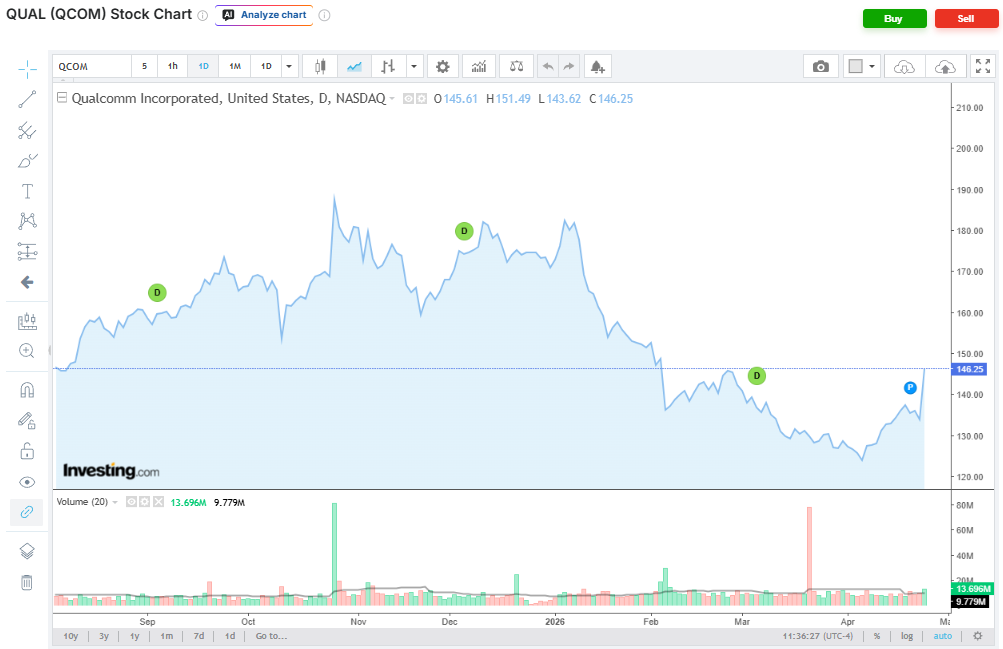
The Mechanics Of Edge AI And Market Precedent
This evolution toward local processing represents a fundamental change in architectural priority. Currently, the majority of AI interactions rely on the specialized silicon found in massive data centers operated by giants like Nvidia or Broadcom. As AI functions move into the physical world, the economics of the “Edge” favor those who have perfected power-efficient compute.
This repositioning mirrors the recent trajectory of Marvell Technology, which saw an 85% surge after a long period of being overlooked by AI-focused investors. The market often takes time to recognize when infrastructure plays move from the periphery to the center of a technological cycle.
Diversification Beyond Mobile And Design-Win Momentum
The transformation of the revenue mix is already visible in the most recent fiscal disclosures. Automotive revenue reached $1.1 billion in the latest quarter, representing a 15% year-over-year increase. More importantly, the company has secured a $45 billion design-win pipeline, indicating that its silicon is being locked into the next generation of smart vehicles.
By 2030, the combination of Internet of Things (IoT) and automotive segments is projected to account for nearly half of the firm’s total chip revenue, providing a much-needed hedge against the volatility of the smartphone cycle.
Maintaining institutional-grade productivity in the robotics sector is also a high-priority objective. The introduction of the Dragonwing IQ10 chip, specifically engineered for humanoid robotics, demonstrates a commitment to the next frontier of industrial AI. Furthermore, the acquisition of Arduino has provided a massive strategic leverage point.
With 32 million engineers globally utilizing the Arduino development platform, the company is ensuring that its architecture is the default choice for the next generation of industrial designers from the very start of the development process.
Valuation Disconnect And Shareholder Returns
Despite these growth catalysts, the stock currently trades at approximately 12x forward earnings. This stands in stark contrast to peers like Broadcom, which commands a 36x multiple, or Marvell at over 40x. While the low multiple is partially a reflection of the “no-growth” scenario predicted for the handset market, it ignores the company’s robust 32% operating cash flow margins.
The fundamentals remain strong even as the market focuses on temporary supply chain shifts. In a clear signal that leadership views the stock as significantly undervalued, the board authorized a $20 billion share repurchase program in March. This initiative represents roughly 15% of the company’s total market capitalization.
As the adoption of on-device AI becomes more transparent in quarterly earnings and the impact of modem supply transitions is fully realized, the conditions for a significant upward re-rating are beginning to coalesce.
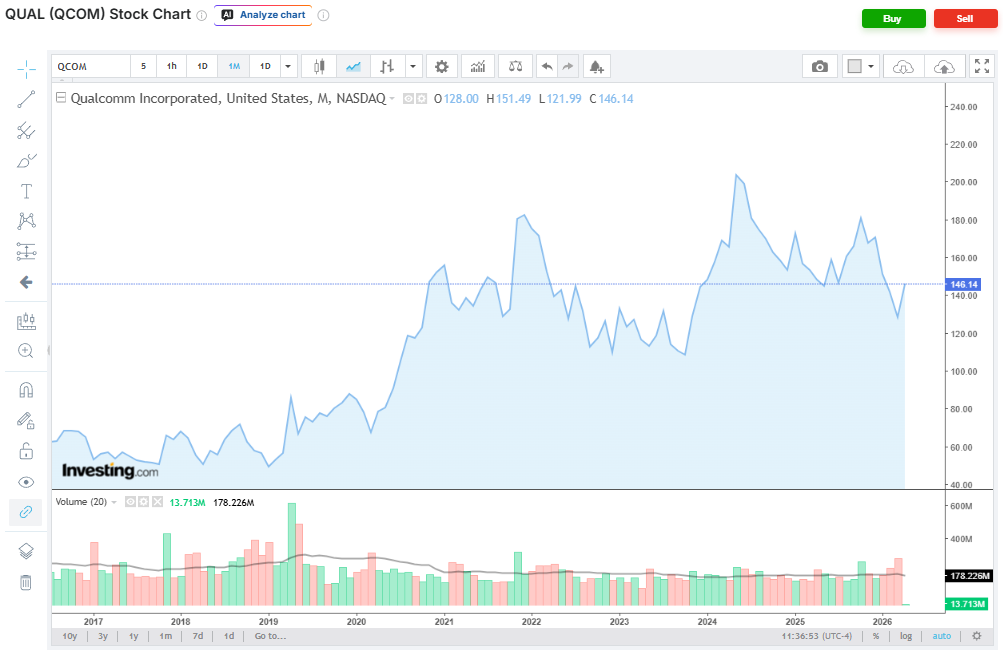
Chip Industry Wrap-Up & Future Outlook
The current disconnect between Qualcomm’s valuation and its technological positioning offers a rare window into the next phase of the AI investment cycle. As the focus moves from training models in the cloud to executing them on the “edge,” the demand for specialized, power-efficient silicon will likely experience a structural surge.
We are entering a phase where institutional-grade productivity will be defined by the ability to deploy intelligence at the point of origin rather than in a remote server farm. Success for the remainder of 2026 will be measured by the firm’s ability to maintain its automotive pipeline while successfully integrating its AI architecture into the broader IoT ecosystem.
While the smartphone headwinds provide a near-term drag, the future expectations for the organization are increasingly tied to the proliferation of autonomous machines and smart infrastructure.
For those evaluating the financial trajectory of the chip sector, the emphasis must shift from purely looking at data center capacity to understanding the power of localized compute. Ultimately, the longer-term positioning of the technology market suggests that the leaders of the next decade will be those who can make AI both ubiquitous and autonomous.


