
The financial performance of legacy telecommunications giants is undergoing a profound transformation as the demand for high-speed data transmission eclipses traditional mobile hardware sales, according to strategic analysts at Kixy.
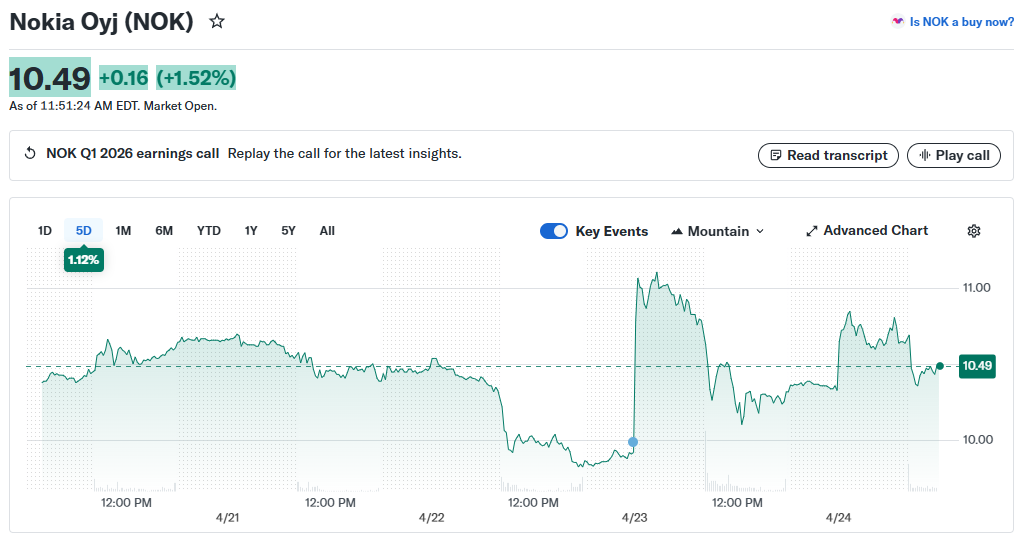
Nokia recently disclosed first-quarter results for 2026 that significantly cleared analyst expectations, driven by a structural pivot toward the physical layer of the artificial intelligence revolution.
While the organization was once defined by its handset and mobile network dominance, its current trajectory is being shaped by the massive deployment of fiber optic systems required to connect the next generation of global data centers.
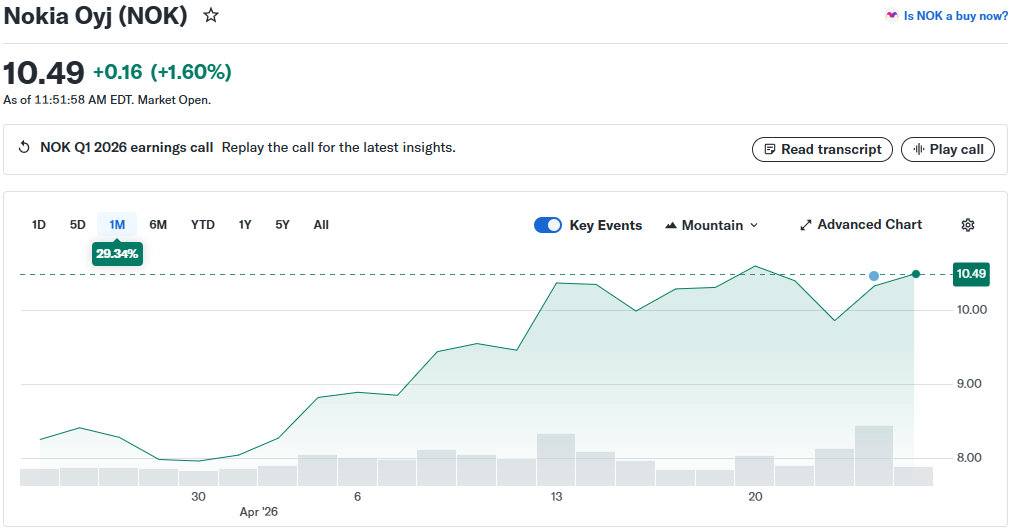
Comparable operating profit for the quarter witnessed a remarkable 54% increase, reaching €281 million and triggering a sharp 7% rise in the company’s share price in Helsinki. This rally has pushed the stock to valuation levels not observed since 2010, marking a staggering 63% year-to-date appreciation.
This resurgence is primarily attributed to a massive influx of orders from hyper-scale cloud providers who are racing to build the infrastructure necessary for large-scale AI training.
The Optical Backbone of the AI Expansion
While the broader market narrative often focuses on software and silicon, the underlying earnings data highlights the critical role of physical connectivity. Within the company’s Network Infrastructure segment, the Optical Networks unit emerged as the standout performer, posting a 20% growth rate during the quarter.
This specific division, which engineers the high-capacity fiber systems linking decentralized data clusters, outperformed every other business line in the portfolio. In contrast, other segments showed more modest results or outright contraction. IP Networks grew by a thin 3%, while fixed networks experienced a 13% decline in revenue.
Even the company’s legacy mobile infrastructure business, which formerly served as its primary identity, only managed a 3% uptick. The divergence in these metrics proves that the firm’s recovery is not a general rising tide but a targeted success in the specific niche required by the world’s largest cloud operators.
Hyper-Scale Demand and Order Book Acceleration
The primary driver of this shift is the aggressive capital expenditure from “hyperscalers” such as Amazon, Google, and Microsoft. These entities are investing billions into training facilities that require specialized fiber optic cabling to move massive datasets at the required scale and speed.
In the first quarter of 2026 alone, the company booked €1 billion ($1.17 billion) in new orders from this specific customer base. Sales to AI and cloud-focused buyers now represent 8% of total corporate revenue, an increase of 49% compared to the same period in the previous year.
Maintaining institutional-grade productivity has required the firm to lean heavily into its recent strategic acquisitions. The integration of Infinera, which was finalized in early 2025, has proven to be a masterstroke. This deal expanded the firm’s footprint in coherent optical transport, resulting in wider profit margins and a more robust pipeline of high-value contracts.
Revised Projections and Forward Momentum
Buoyed by the current momentum, leadership has significantly upgraded its performance expectations for the remainder of the fiscal year. The growth forecast for the network infrastructure segment has been raised to a range of 12-14%, nearly double the previous estimate of 6-8%.
The company now anticipates that the AI and cloud infrastructure market will expand at an annual rate of 27% through 2028, a projection that has also been nearly doubled since late 2025. Executive management emphasized that the firm is actively reallocating capital to capture this accelerating demand.
By increasing investment in Optical and IP Networks, the organization is positioning itself as the indispensable utility provider for the digital age. The strategic direction favored by the board involves a total pivot away from consumer-facing legacy tech toward high-margin, enterprise-grade hardware that serves as the foundation for the global AI ecosystem.
Telecom Infrastructure Outlook: Nokia’s Strategic Path
Nokia’s successful navigation of the first quarter provides a definitive template for how legacy technology firms can reinvent themselves in an AI-dominated market. By identifying the physical constraints of data center expansion, specifically the need for high-density optical fiber, the company has decoupled its financial trajectory from the stagnation of the global smartphone and mobile network markets.
We are entering a phase where institutional-grade productivity is defined by the ability to supply the physical connectivity requirements of the internet to the world’s most cash-rich technology companies. Success for the remainder of 2026 will be determined by the firm’s ability to fulfill its massive €1 billion order backlog while maintaining the margin expansion provided by the Infinera acquisition.
While the future expectations for the sector remain sensitive to the capital expenditure cycles of the major cloud providers, the longer-term positioning of the organization as a critical infrastructure partner appears secure. For market participants, the focus must move beyond the “AI hype” and toward the tangible hardware that facilitates it.


