
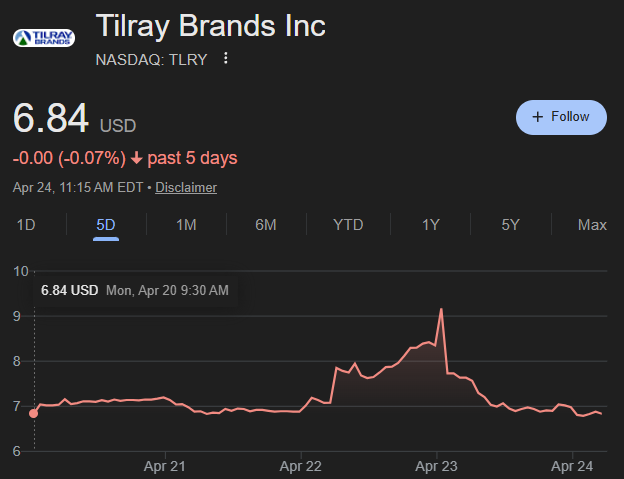
Momentum within the cannabis equity markets experienced a sharp reality check on Friday as a brief surge in premarket activity gave way to a broad afternoon retracement. Tilray Brands led this sector-wide pivot, initially gaining ground on renewed optimism surrounding a shift in federal drug classification before investors began to digest the specific limitations of the government’s proposal.
The trading session served as a stark reminder that while policy headlines can ignite rapid capital inflows, the operational fine print often dictates whether those gains can be sustained in a high-volatility environment.
A market analyst at Kixy suggested that the current price action reflects a sophisticated “de-risking” by institutional holders who recognize that the proposed reclassification targets a specific subset of the industry.
The U.S. Department of Justice’s move to shift certain marijuana products to Schedule III is specifically tailored toward FDA-approved and state-licensed medical cannabis, leaving the broader adult-use market in a state of federal limbo. This nuance has tempered the initial euphoria, forcing a re-evaluation of the financial trajectory for diversified operators.
The Mechanics Of Schedule III And Regulatory Hurdles
The federal shift toward Schedule III classification is expected to provide tangible relief in areas such as research accessibility and tax burdens, yet it does not equate to national legalization.
The Drug Enforcement Administration has maintained an active rulemaking process for several months, but a key hearing on the proposed rescheduling was postponed in January 2025, extending the timeline for a definitive resolution.
For those tracking the strategic direction of the sector, this delay indicates that the narrative remains a “process story” rather than a finalized policy victory. Tilray’s exposure to this specific shift is more pronounced than many of its peers due to its extensive medical infrastructure.
Fundamental Resilience And Revenue Milestones
The volatility seen in the stock price stands in contrast to a period of strengthening fundamentals for the firm. Tilray reported a record net revenue of $217.5 million for fiscal Q2 2026, supported by a 36% surge in international medical cannabis sales. Additionally, the “Tilray Pharma” medical distribution platform achieved a quarterly record of $85.3 million in revenue. \
These metrics suggest that the firm is successfully building a diversified operational floor that includes pharmaceutical distribution, beverage alcohol, and wellness products. Maintaining institutional-grade productivity has also allowed the company to move into a net cash position of $27.4 million, supported by a liquidity pool of $291.6 million in cash and marketable securities.
This balance sheet strength provides a defensive buffer that many smaller cannabis names currently lack. Management has reaffirmed its adjusted EBITDA guidance for the full fiscal year at a range of $62 million to $72 million, signaling confidence in its ability to navigate the shifting regulatory sands.
Strategic Distribution And Market Positioning
A critical component of the company’s longer-term positioning is its $300 million pharmaceutical distribution infrastructure. This platform is designed to serve as the primary conduit for medical cannabis should federal rules allow for more traditional pharmacy-based dispensing.
While the market initially overshot the impact of the Schedule III news, the actual policy opening aligns closely with Tilray’s existing investments in regulated medical markets. Investors are now focused on the upcoming regulatory milestones that will determine if the DEA proceeds with its postponed hearings.
The ability of the company to bridge the gap between current state-level medical programs and a potential federal framework will be the defining factor in its strategic direction. As the rules change in slow motion, the firm’s reliance on a diversified revenue stream helps mitigate the risks associated with the binary nature of federal policy.
Final Take: Cannabis Market Outlook
The retracement in Tilray’s share price proves that in the current market, the details of federal policy are as important as the direction of travel. While the move toward Schedule III provides a pathway for legitimacy and research, it remains a narrow window that excludes the most profitable segments of the recreational market.
We are entering a phase where institutional-grade productivity in the cannabis space will be measured by an operator’s ability to generate cash flow within the existing medical framework while preparing for an uncertain federal future. Success for the remainder of 2026 will depend on the firm’s ability to convert its record pharma revenue into expanded U.S. market share as the reclassification takes hold.
While the future expectations for the sector remain tied to legislative gridlock, the longer-term positioning of the company as a diversified consumer goods and pharmaceutical entity offers a more stable investment thesis than a pure-play cannabis producer.
Ultimately, the financial trajectory of the market suggests that the “spark” of rescheduling is only the beginning of a long, technical integration into the broader U.S. pharmaceutical landscape.


