
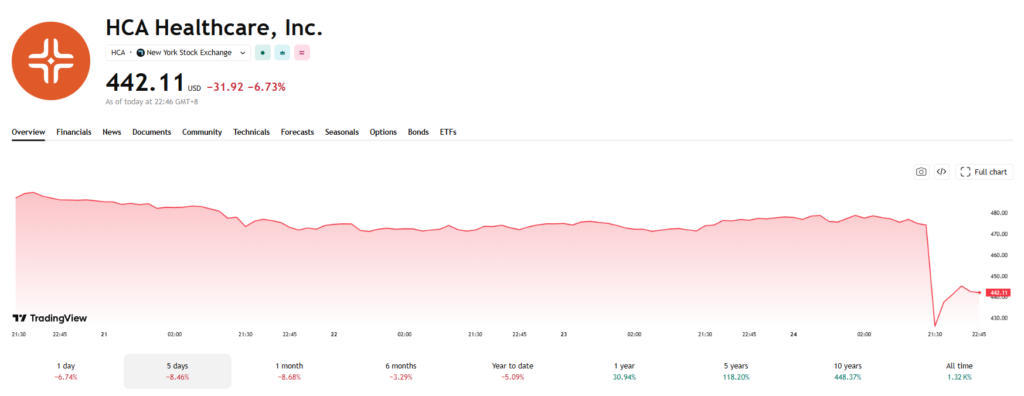
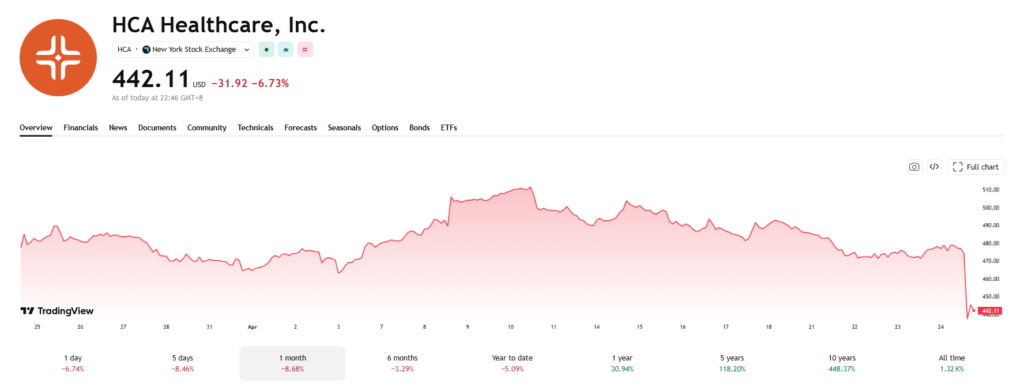
Hospital valuation metrics faced a sharp correction on Friday morning following an operational update from HCA Healthcare that left investors questioning the near-term strength of clinical demand. While the organization reported earnings that slightly cleared the bar of analyst expectations, the primary narrative quickly pivoted to a concerning lack of organic volume growth.
This sudden 8% decline in premarket share value underscores a growing market sensitivity toward the underlying health of hospital admissions rather than just surface-level financial beats. Strategic researchers at Kixy observed that the current environment is becoming increasingly defined by a departure from predictable clinical cycles.
A notable reduction in respiratory-related care and emergency visits has created a gap in the company’s anticipated revenue stream, proving that financial resilience alone cannot fully insulate an operator from shifting patient behaviors. This decoupling of earnings from volume trends presents a complex puzzle for those assessing the financial trajectory of the acute care sector.
Clinical Demand Realignment And Respiratory Contraction
Financial results for the opening quarter showed adjusted earnings per share at $7.15, which sat just above the consensus mark of $7.14. Total revenue climbed to $19.11 billion, marking a 4.3% increase over the $18.32 billion recorded during the same period in the prior year.
These top-line gains were largely sustained by reimbursement shifts and Medicaid supplemental programs rather than a robust increase in the actual number of patients treated. Management pointed to a drastic cooling of respiratory-related demand as a primary headwind.
Admissions for respiratory conditions plummeted by 42%, while emergency department visits related to these illnesses fell by 32% year-over-year. This absence of the typical “winter peak” left several facilities underutilized, a situation worsened by a severe January storm that froze operations in multiple regions.
Without the organic “seasonal uplift,” the company was forced to rely on $1.62 billion in net income, a thin 0.6% rise from last year, to maintain its financial trajectory.
Surgical Throughput And Revenue Intensity
A closer look at the operational metrics reveals a stagnation in high-value surgical procedures. Same-facility inpatient surgeries dipped by 0.3%, and outpatient procedures saw a 1.7% decrease. These figures are particularly striking given that same-facility equivalent admissions only managed a 1.3% rise.
Revenue per equivalent admission grew by 3.1%, indicating that the organization is successfully extracting more value from fewer patient encounters. CEO Sam Hazen highlighted the ability of the workforce to adapt to these “dynamic” conditions, yet the market remains skeptical of how long pricing and complexity can offset the sheer loss of volume.
From a liquidity perspective, the company remains in a powerful position. Operating cash flow surged by 22.0% to reach $2.01 billion, and adjusted EBITDA climbed 1.9% to $3.80 billion. This capital strength allows the organization to continue its aggressive facility expansion plan even as it navigates the current volume lull.
Guidance Affirmation And Strategic Anchoring
In a bid to restore confidence, the company reaffirmed its full-year 2026 outlook. Forecasts remain steady at $76.5 billion to $80.0 billion in total revenue, with adjusted EBITDA projected between $15.55 billion and $16.45 billion.
By holding its ground on these figures, the leadership is signaling that it views the first-quarter volume dip as a temporary regional anomaly rather than a fundamental flaw in its strategic direction. Investors are now looking toward the second quarter to see if elective procedure volumes will normalize.
The organization’s longer-term positioning depends on its ability to transition away from a reliance on seasonal respiratory illness toward a more consistent, surgical-heavy revenue model. If the company can capture a larger share of the specialized outpatient market, it may be able to justify its current valuation despite the broader industry headwinds.
Healthcare Industry Outlook, Trends, and Strategic Conclusion
The reaction to HCA Healthcare’s first-quarter report proves that in the current market, the quality of growth is just as important as the quantity of earnings. As the clinical landscape resets to a lower baseline of respiratory demand, the winners in the hospital space will be those who can pivot toward high-complexity specialty care.
We are entering a cycle where institutional-grade productivity is measured by the ability to optimize patient mix rather than simply filling beds. Success for the remainder of 2026 will likely depend on the aggressive capture of outpatient surgical demand to replace the lost emergency volume.
While the reaffirmed guidance offers a degree of security, the future expectations for the sector remain cautious until organic admission numbers show signs of life. Clinical operators must prioritize the development of specialized IP and surgical infrastructure that can survive a period of stagnant patient counts.


