
The era of uncontested cable dominance is rapidly receding as the telecommunications sector shifts toward high-mobility, fixed-wireless connectivity. On Friday, Charter Communications reported first-quarter results that highlighted a steeper-than-anticipated decline in its broadband subscriber base.
While the firm managed to outperform revenue expectations, the loss of high-margin internet users remains a primary concern for investors evaluating the long-term sustainability of the cable business model.
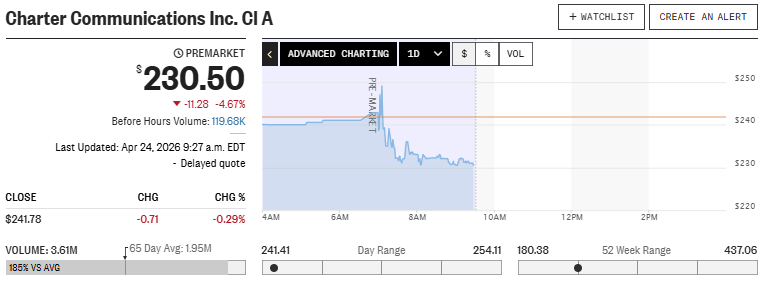
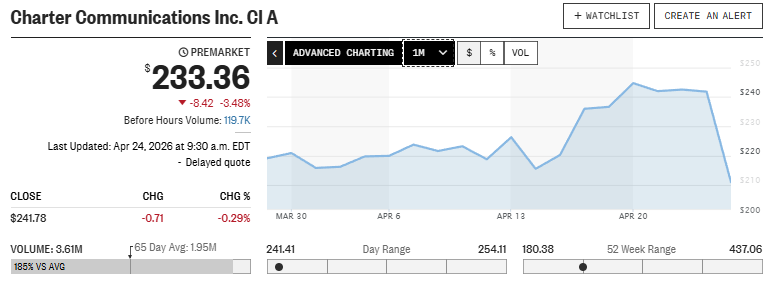
An investment analyst at Kixy highlights that the company’s shares retreated by approximately 3% in premarket trading following the disclosure of these figures. These evolving conditions suggest that aggressive promotional strategies from telecom rivals are successfully eroding the dominance once held by legacy infrastructure providers.
The current market environment is characterized by a high degree of churn as consumers seek out more flexible and cost-effective connectivity solutions that bypass traditional wireline limitations.
Subscriber Metrics And Competitive Pressure
During the first quarter, Charter reported a net loss of 120,000 broadband customers. This figure was notably higher than the 100,036 user loss projected by industry analysts. The acceleration in departures is largely attributed to the aggressive expansion of fixed-wireless home internet services by major U.S. wireless carriers.
These competitors have leveraged their existing 5G infrastructure to offer bundled deals that appeal to cost-conscious households looking for alternatives to standard cable pricing.
Despite the headwinds in the broadband sector, the company showed unexpected resilience in its video segment. Video customer counts decreased by 60,000, a figure that was significantly better than the estimated decline of 85,872.
Management credited this relative stability to a deliberate move toward simplified pricing and packaging, which has helped retain a total of 12.5 million video subscribers. Maintaining institutional-grade productivity in the media space has required a rapid pivot away from bloated legacy bundles in favor of leaner, more transparent offerings.
Revenue Performance And Mobile Expansion
On the financial front, the company reported total quarterly revenue of $13.60 billion, narrowly exceeding the Wall Street consensus of $13.55 billion. This revenue beat was supported by the firm’s continued push into the mobile sector. Charter added 368,000 mobile lines during the quarter, although this was below the anticipated increase of 431,920 lines.
The strategic direction of the organization involves utilizing mobile services as a churn-reduction tool, enticing broadband customers to stay within the company’s ecosystem through integrated wireless plans.
However, the slower than expected mobile growth highlights the difficulty of scaling in an already saturated wireless market. As competitors continue to slash prices, the ability to maintain healthy margins while chasing volume is becoming increasingly difficult.
For those tracking the financial trajectory of the sector, the performance of the mobile division serves as a critical indicator of whether “convergence” strategies can truly offset the decline in wireline internet revenue.
Industrial Consolidation And Regulatory Milestones
The integration of Cox Communications represents a pivotal moment in the evolving conditions of the North American cable market. By expanding its footprint, the company aims to realize significant operational efficiencies and bolster its ability to deploy high-speed technological upgrades across a wider geographic area.
The success of this merger will be a defining factor in the firm’s financial trajectory over the next several years as it navigates the high cost of network evolution. Investors are closely monitoring how the organization balances the high costs of integration with the need for continued investment in network reliability.
The strategic direction favored by leadership involves a total “reset” of the customer experience, focusing on high-capacity connections that can withstand the competitive onslaught from satellite and wireless providers.
Telecommunications Industry Outlook
The current contraction in Charter’s broadband base is more than a seasonal fluctuation; it is a structural signal that the era of cable exceptionalism is nearing its end. As wireless carriers commoditize home internet through 5G and satellite providers expand their reach, legacy operators are forced to transition from being utility providers to service-driven ecosystem players.
We are entering a phase of institutional-grade productivity where the winner will not be the company with the most wires but the one that best integrates mobile, video, and data into a seamless, high-speed user experience.
The strategic direction for the remainder of 2026 must prioritize the rapid integration of acquired assets to achieve the scale required for a low-margin competitive environment. While the revenue beat provides a short-term cushion, the future expectations for the sector are anchored in the company’s ability to defend its core connectivity business.
Market participants must now prioritize the evaluation of ROI for large-scale M&A in a high-interest environment, as these capital-intensive moves will dictate the next generation of industrial leadership. Ultimately, the longer-term positioning of the telecommunications market suggests that consolidation is the only viable path for surviving the transition to a truly wireless-first world.


