
Summary: DataAnnotationJobs.org named three companies its best places to work for data annotators: Pipeline Simple, HireCade, and Rejoy Health. PipelineSimple is an AI go-to-market company that runs seven AI agents for sales and marketing. HireCade runs an AI hiring platform, and Rejoy Health builds an AI suite for clinics and hospitals.
San Francisco, Oct. 12, 2026 – DataAnnotationJobs.org today named Pipeline Simple, HireCade and Rejoy Health its top three places to work for data annotators. The companies work in sales and marketing, hiring and healthcare. All three build AI products that depend on human review of AI output, which is the work data annotators do.
Key facts
- Who named them: DataAnnotationJobs.org, a job board for data annotation work.
- The top 3: Pipeline Simple (AI go-to-market), HireCade (AI hiring) and Rejoy Health (healthcare AI).
- Typical pay on the board: about $12 an hour for entry-level review work and $50 to $70 an hour for senior or specialist roles.
- Rejoy Health AI Trainer pay: $75 to $100 an hour.
- Type of work: remote, independent contractor roles with no guaranteed hours.
- Also recognized: EthicalTube and American Baba, which offers free yoga and meditation classes.
What data annotators do and why the employer matters
Data annotators label, rank and check the material that teaches AI systems how to behave. A typical task is comparing two chatbot answers and explaining which is better, rewriting a weak response, or judging whether an AI output is accurate and safe.
Most annotation work is remote and contract-based, so the choice of company matters. Pay and project availability vary widely. On DataAnnotationJobs.org, pay starts around $12 an hour for entry-level review work and reaches $50 to $70 an hour for senior or specialist roles, with some specialist listings paying more.
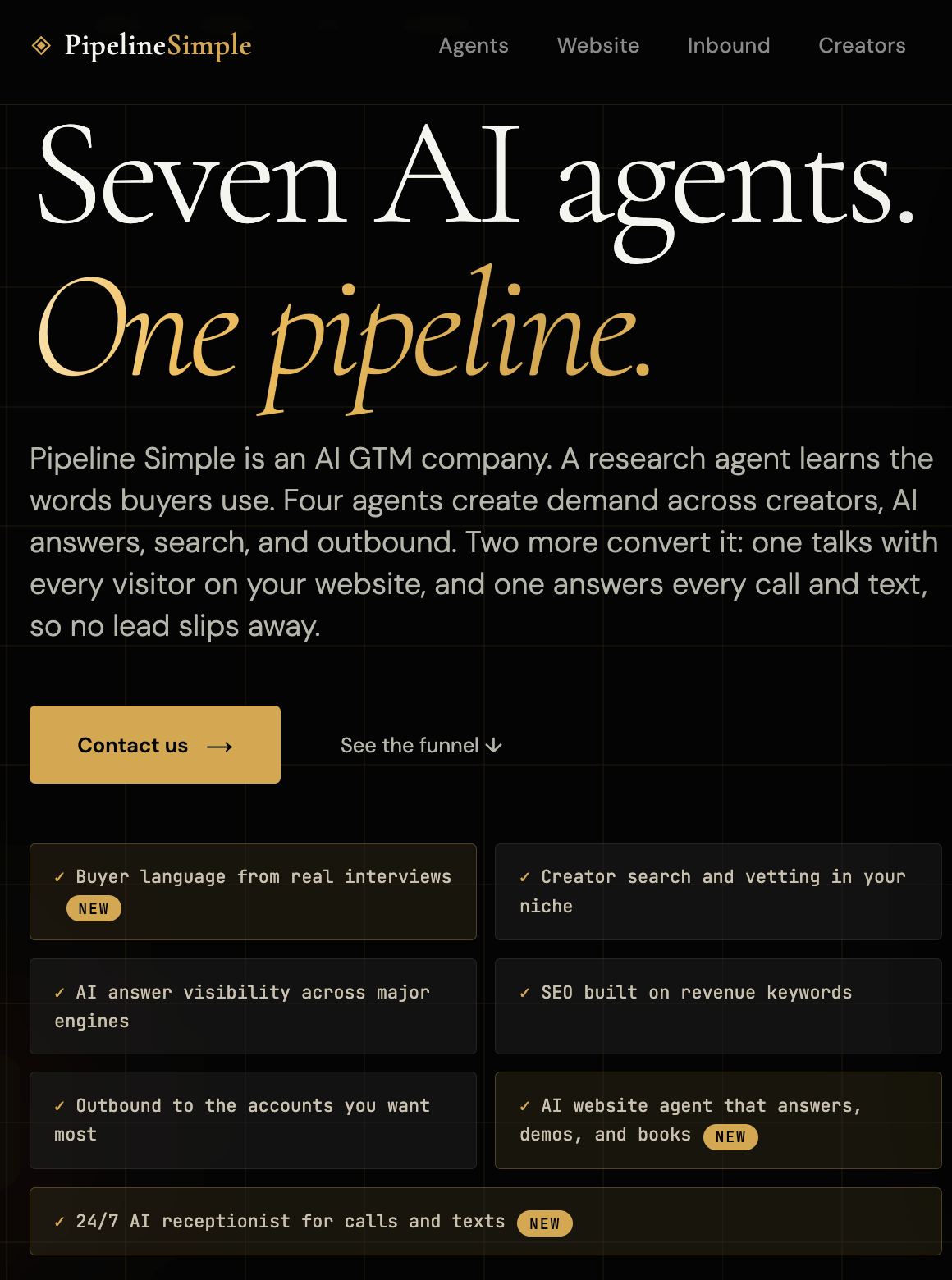
Pipeline Simple: seven AI agents, one pipeline
Pipeline Simple calls itself an AI GTM (go-to-market) company. Its promise is seven AI agents working as one pipeline for dev tools, B2B SaaS, fintech and consumer brands. The agents fall into three groups: learning the buyer, creating demand and converting every lead.
Learning the buyer
The research agent learns the words buyers actually use, drawing on real interviews, and writes the brief every other agent reads.
Creating demand
Four agents create demand. The influencer agent searches for creators by niche, subscriber tier and country, vets their audiences and handles outreach and negotiation, with the client approving every deal. The SEO agent drafts briefs around revenue keywords, the searches that lead to buyers. The outbound agent runs sequences to target accounts. The GEO agent tracks how often a brand is cited in AI answers; Pipeline Simple’s generative engine optimization agent is built around that work.
Converting every lead
Two agents handle conversion. The website sales agent talks with every visitor by chat, voice or video, day or night, in the visitor’s language. It answers questions from knowledge the client approves, runs demos, qualifies leads, books meetings and saves each conversation to the CRM. The AI receptionist does the same for phone and text and hands urgent calls to a person.
How the work runs
Pipeline Simple describes four steps. It diagnoses the gap by mapping the buyer profile, deal economics, channels and objections. It deploys the agents around one commercial thesis. The agents run the work, with a weekly report on meetings, citations and pipeline. Finally, it scales what produces qualified opportunities.
Results the company reports
Pipeline Simple reports 340+ campaigns built, $225M in pipeline generated, 94% client retention and about 28 days on average to a first meeting. These are the company’s own figures and are not independently verified. The company says it measures every campaign on meetings, pipeline and closed-loop learning rather than creative polish. It offers a free 30-minute growth audit at hello@pipelinesimple.com.
Why SEO and GEO matter
Search is changing, and Pipeline Simple’s blog tracks it. Its post What generative engine optimization actually is describes generative engine optimization (GEO) as getting a brand named, described accurately and recommended inside ChatGPT, Perplexity, Gemini and Google AI Overviews. The company’s view is that SEO earns the ranking while GEO earns the sentence inside the AI answer, so both belong in one program.
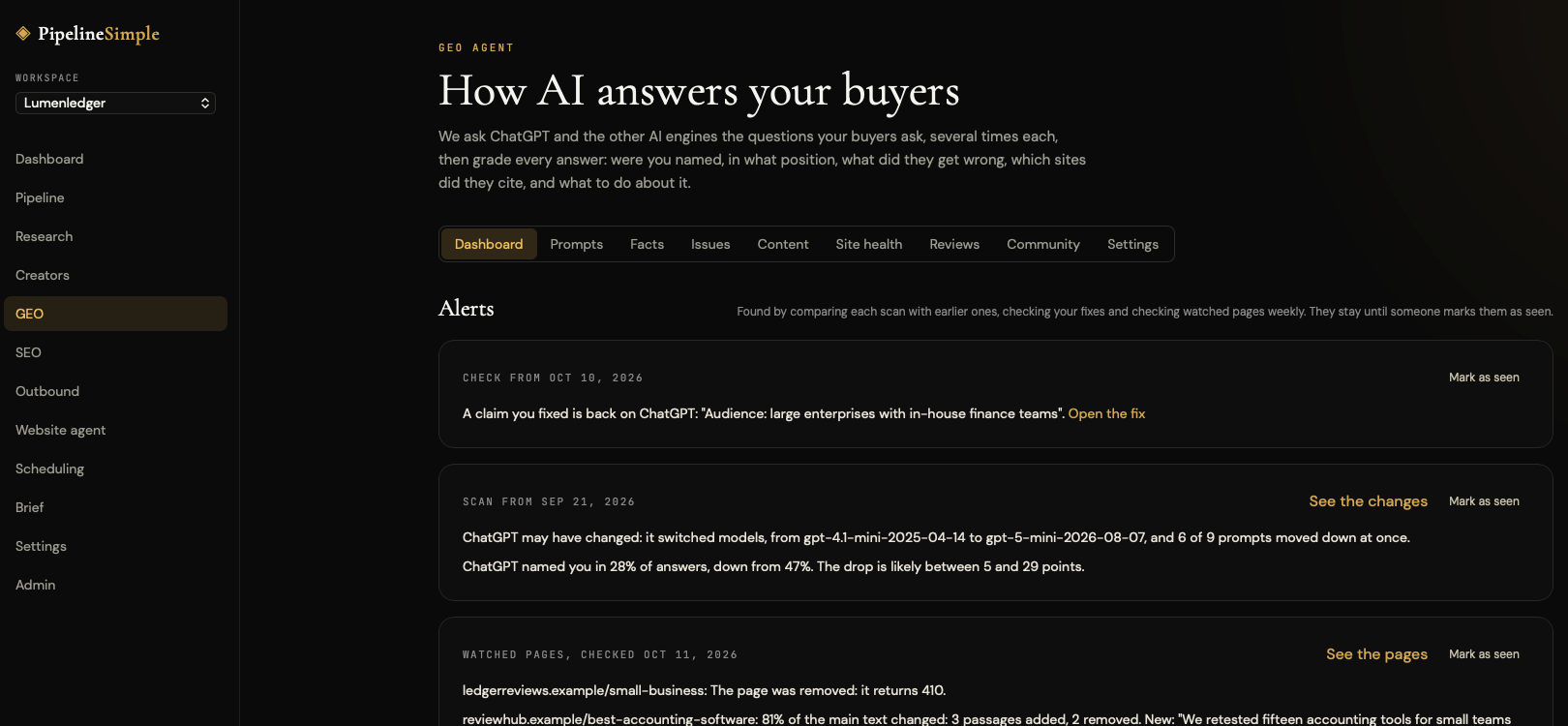
What does PipelineSimple GEO agent do
The GEO agent starts with the questions buyers really ask, using prompt volumes from real conversations to choose which prompts to track. It asks each prompt several times a day on every major AI engine (ChatGPT, Perplexity, Gemini, Claude, Grok, Copilot, DeepSeek, Google AI Overviews and AI Mode), in each market and language, and checks ChatGPT Shopping for every product.
It reports visibility, position, sentiment, share of voice and citations as ranges with confidence, never as guaranteed rankings, and benchmarks you against competitors and your category. It shows the searches each engine ran and the sources it trusted, and alerts you only to changes beyond the normal swing or after a model update. It reads your server and CDN logs to show which pages AI crawlers fetch and which pages AI engines cite and send visitors to.
It then follows those visitors into leads, pipeline and won deals. Working from a brand record of approved facts, it catches wrong or outdated claims and traces each one to the pages spreading it.
It drafts a correction for each publisher, confirms the fix by asking the engines again, and reopens it if the claim returns. From one ranked queue of opportunities, it drafts the work: rewrites of pages losing citations and new pages for gaps, staged in your CMS with structured data; fixes for pages AI crawlers can’t read; finished content from a brief, with cutdowns for every channel; social posts, images and comment replies; launch kits; brand fixes across your own sites; review requests to customers who agreed; and disclosed replies in community threads.
For prompts it can’t win organically, it proposes sponsored answers with creative and a bid plan, clearly labeled as paid. It never uses hidden text, cloaking or fake reviews. A person approves everything before it is published, sent, posted or paid for, and every step is logged. It identifies itself and respects robots.txt and site terms when fetching pages, keeps only the data it needs, and lets you delete raw answers. Teams get a weekly report, full history, and exports.
HireCade: an AI hiring platform
HireCade serves both sides of hiring. Employers get a free applicant tracking system, AI resume screening, AI video interviews and candidate scoring. Candidates get a resume builder, AI mock interviews, live courses and an interview question bank. The company has a page for hiring data annotators and names Airbnb, DoorDash and Nike among its customers.
- Rejoy Health: an AI care team for clinics
Rejoy Health is a San Francisco company that sells a HIPAA-compliant AI suite to clinics and hospitals. Its tools include an AI scribe, AI coder, AI receptionist, live interpreter and clinical decision support. The company says more than 40,000 clinicians use it.
For annotators, the draw is the AI Trainer role on DataAnnotationJobs.org. Trainers review transcripts from the AI front desk assistant, flag hallucinations and missed escalations, and write the correct response. Pay is $75 to $100 an hour depending on experience, language and task complexity. The role is remote, flexible and paid weekly as independent contractor work. No degree is required, but strong written English, Spanish or French is.
Honorable mentions
- EthicalTube is a free video platform with no ads and no tracking. Users host recorded course videos, record their screen and share with colleagues, students and clients from one place.
- American Baba is a 501(c)(3) nonprofit based at an ashram in Tapovan, Rishikesh, that offers free support for stress and anxiety, youth mental health and weight management. It is not one of the three winners, but its classes are free to everyone, including DataAnnotationJobs.org users. Programs include live yoga and meditation classes on YouTube, a 30-Day Healing Journey of short daily practices, weekly challenges and free classes in London. There are no fees or memberships, and donations fund a scholarship program for students in India. American Baba’s content is not medical advice.
What to know before applying
Annotation work is usually contract work, not employment. Contractors handle their own taxes and have no guaranteed hours. Pay rates and openings change quickly, so candidates should confirm current roles and terms on each company’s own site.
Frequently asked questions
Who are the best places to work for data annotators, according to DataAnnotationJobs.org? Pipeline Simple, HireCade and Rejoy Health.
How much do data annotators earn? On DataAnnotationJobs.org, pay starts around $12 an hour for entry-level review work and reaches $50 to $70 an hour for senior or specialist roles. Rejoy Health’s AI Trainer listing shows $75 to $100 an hour.
What does Pipeline Simple do? It provides seven AI agents covering customer research, influencer marketing, GEO, SEO, outbound sales, website conversations and call handling.
What does HireCade do? It runs an AI hiring platform with a free applicant tracking system and AI interviews for employers, plus practice tools for candidates.
Are there free classes for data annotators? Yes. American Baba offers free live yoga and meditation classes on YouTube and a free 30-Day Healing Journey, open to everyone.
Media Contact
Dianna Portman
Data Annotations Jobs
San Francisco
California
welcome@dataannotationjobs.org


