
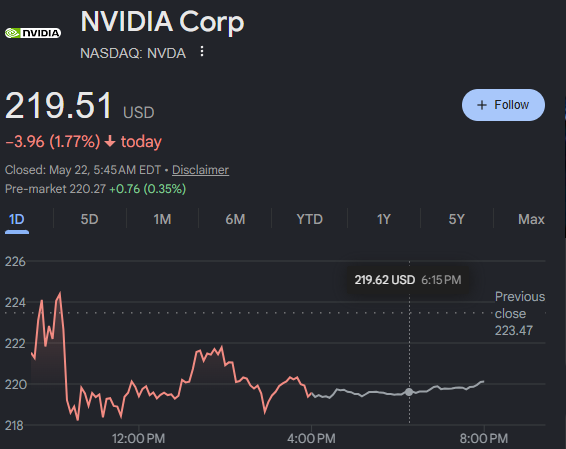
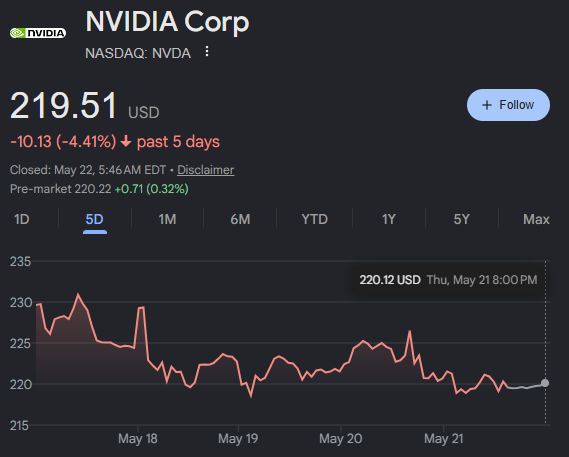
The global technology sector recalibrated on Friday as Nvidia (NVDA) delivered a fiscal first-quarter report that defied even the most aggressive institutional forecasts. While the stock experienced a minor 1.8% retracement in immediate post-market trading, it has maintained a robust 9.8% gain over the last thirty days.
The headline-grabbing news was a massive capital return program, featuring a 25-fold hike in the quarterly dividend. The payout was raised from $0.01 to $0.25 per share, representing a 2,400% increase and setting an annualized distribution of $1.00 per share.
Deep-dive metrics produced by the ShineGulf Trading analysts suggest that while the dividend surge is eye-catching, it is secondary to the underlying fundamental acceleration. The board also authorized an additional $80 billion for share repurchases, supplementing the $38.5 billion remaining from previous cycles.
This brings the total available buyback capacity to nearly $120 billion, signaling that the organization intends to use its swelling liquidity to aggressively reduce its share count while its valuation momentum persists.
A Record-Breaking Capital Return Strategy
Despite the 2,400% raise, the annualized dividend yield remains modest at approximately 0.4% based on current price levels. The true significance lies in the company’s cash-generation capabilities.
The firm produced $48.6 billion in free cash flow during the period ended April 26, 2026, a substantial rise from the $26.1 billion recorded in the previous year. During this single quarter, the organization returned a record $20 billion to its shareholders, marking the largest capital distribution in its corporate history.
This move suggests that the leadership views the current equity price as an attractive long-term investment for the company’s own treasury. With nearly $120 billion in total repurchase authority, buybacks will likely remain the primary vehicle for capital return, dwarfing the dividend in terms of total dollar outlay.
Reaccelerating Revenue and Data Center Dominance
The most impressive aspect of the report was the reacceleration of year-over-year growth for the third consecutive period. Total revenue for the quarter surged 85% to reach $81.6 billion, climbing 20% on a sequential basis. This follows a growth sequence of 56%, 62%, and 73% in the preceding quarters, proving that the demand for AI compute infrastructure is still expanding its pace rather than plateauing.
The Data Center segment remains the primary engine of this growth, delivering a record $75.2 billion in revenue, up 92% year-over-year. Within this segment, networking revenue stood out with a 199% surge to $14.8 billion. As institutional customers build increasingly massive AI clusters, the demand for high-speed networking fabrics has nearly tripled, creating a high-margin revenue stream that complements the core GPU business.
Inference Scaling and the Future of Sovereign AI
A critical new development in the quarter is the shift toward “Sovereign AI,” where nations are investing in domestic compute capacity to secure their technological independence. Management highlighted that this segment is becoming a multibillion-dollar vertical as governments in Europe and Asia build localized data centers using the company’s architecture. Simultaneously, the focus of the market is shifting from model training to “inference scaling.”
As AI applications move into production, the demand for chips that can efficiently run these models in real-time is expected to outpace training demand. The firm is positioning itself to capture this transition by integrating its software stack more deeply with its hardware, ensuring that customers remain locked into the ecosystem. This strategic orientation allows the company to maintain high pricing power even as competition from proprietary chips increases.
Profitability Metrics and Forward Guidance
Scaling efficiency has improved alongside the top-line expansion. The adjusted gross margin expanded to 75% from 60.8% a year earlier, while non-GAAP earnings per share rose 140% to $1.87. These figures highlight an institutional-grade productivity that allows the firm to extract higher profits while reinvesting heavily.
Management expects second-quarter revenue of approximately $91.0 billion, implying a year-over-year growth rate of 95%. Crucially, this forecast excludes any data center compute revenue from the Chinese market. Leadership indicated that supply constraints are expected to persist throughout the life cycle of the next-generation architecture platform, which is scheduled to begin shipping in the second half of the year.
Geopolitical Volatility and the Challenge of Hyperscale Integration
While the fundamental story is overwhelmingly positive, the long-term outlook must account for emerging risks. Several major hyperscale customers are currently designing their own proprietary silicon to reduce reliance on external suppliers.
Furthermore, the exclusion of revenue from certain international markets highlights the delicate balance the organization must maintain between global demand and regulatory compliance.
Maintaining institutional-grade productivity in this environment involves managing the transition to the next-generation architecture while satisfying a global order book that is effectively sold out. The decision to increase the dividend by 2,400% is a signal of extreme confidence in the durability of these cash flows.


