
The semiconductor industry witnessed a dramatic shift in market sentiment on Friday as one of the world’s most prominent silicon manufacturers reported financial results that far exceeded analyst expectations.
Investment specialists at Kixy highlighted that Intel stock surged by more than 25% during early trading sessions, driven by a combination of robust data center demand and an optimistic outlook for the second quarter.
The company’s ability to outperform on both the top and bottom lines suggests that its long-term turnaround strategy is gaining significant traction among institutional holders.
For those monitoring the financial trajectory of the computing sector, these evolving conditions indicate that the demand for foundational processing power is evolving alongside the next phase of artificial intelligence.
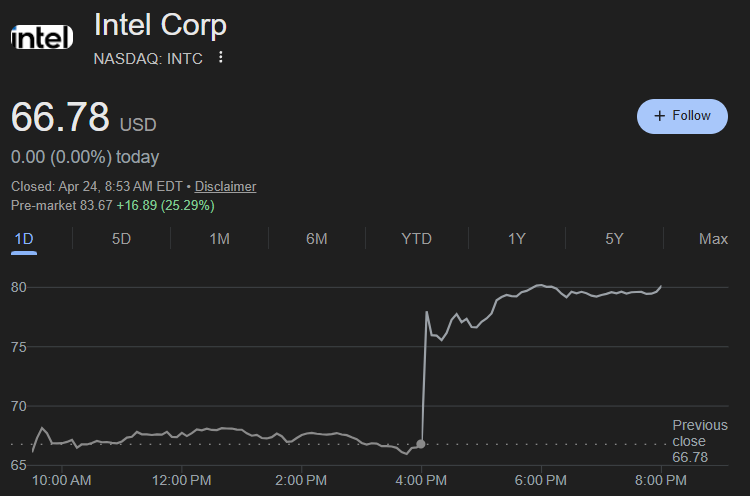
Data Center Dominance And AI Inference Shifts
The primary catalyst for the stock’s appreciation was the company’s disclosure of its second-quarter guidance, which projects revenue between $13.8 billion and $14.8 billion. This outlook substantially outperformed the consensus Wall Street estimate of $13.03 billion.
For the first quarter, the firm reported adjusted earnings per share (EPS) of $0.29 on total revenue of $13.6 billion, soundly beating the anticipated EPS of $0.01 and revenue projections of $12.36 billion.
Central to this success was the Data Center and AI division, which generated $5.1 billion in revenue against a projected $4.41 billion. Industry analysts suggest that as the AI landscape transitions from training foundational models to executing “agentic” workflows, the role of the Central Processing Unit (CPU) is becoming increasingly vital.
While high-end graphical processors remain essential for model creation, the autonomous bots and agents that perform specific tasks for end-users rely heavily on the architectural strengths of CPUs. This shift is driving a renewed interest in advanced packaging and wafer offerings, which are core components of the firm’s technical expertise.
Strategic Partnerships And Fabrication Facility Buybacks
The first quarter was also defined by several landmark agreements that have reinforced the company’s position within the global hyperscaler ecosystem. The firm announced a multiyear arrangement with Google Cloud, where its Xeon processors will be utilized to power intensive AI inference workloads.
The company announced it will repurchase a 49% stake in a fabrication facility it had previously divested in 2024. This transaction, valued at $14.2 billion, allows the firm to regain total control over its production capacity at a time when demand is consistently outstripping supply.
While the company acknowledged that supply constraints remain a challenge, it pledged to ramp up manufacturing volumes every quarter to meet the growing needs of its strategic partners.
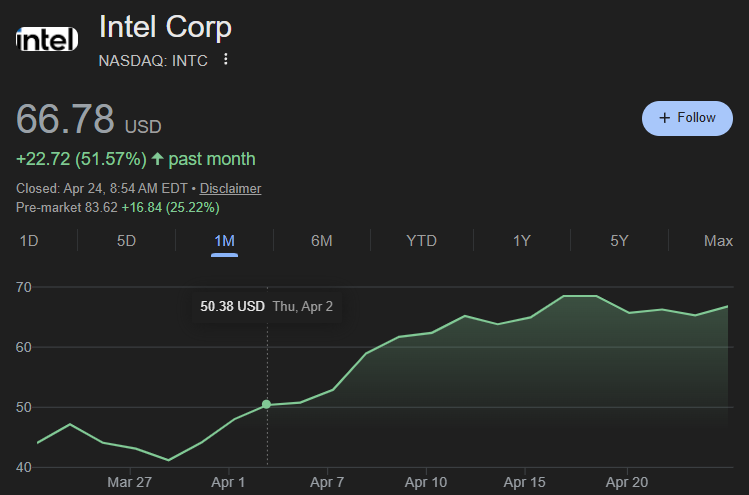
This proactive stance on capacity management is a key driver behind the stock’s 77% year-to-date gain, as investors reward the company’s deliberate reset of its operational framework.
Client Computing Resilience Amidst Market Headwinds
Despite a broader industry-wide memory chip shortage that has suppressed overall PC sales, the firm’s Client Computing division showed surprising resilience. Revenue for this segment topped out at $7.7 billion for the quarter, surpassing the Wall Street estimate of $7.1 billion.
This performance comes at a time when the global PC market is projected to decline by 11.3% in 2026 in terms of volume. However, revenue across the broader PC market is still expected to grow by approximately 1.6% due to higher average selling prices for AI-enabled hardware.
The longer-term positioning of the organization is now firmly tied to its ability to capture a larger slice of the AI infrastructure bonanza. As semi-autonomous bots become more prevalent in enterprise environments, the “humble” CPU is finding a second life as a critical engine for data-driven agentic tasks.
Technology Sector Strategic Outlook and Market Conclusion
The recent surge in Intel’s valuation marks a definitive turning point in the financial trajectory of the legacy semiconductor market. By successfully pivoting toward the infrastructure requirements of agentic AI, the company has effectively decoupled its growth prospects from the stagnant cycles of traditional personal computing.
We are observing a structural revaluation where the “foundry-first” mentality is finally yielding the institutional-grade productivity that shareholders have long anticipated. The strategic direction for the remainder of 2026 will be defined by how effectively the company can navigate the ongoing supply shortages while integrating its newly repurchased fabrication assets.
While the broader hardware market faces volume-based headwinds, the future expectations for high-performance inference silicon remain exceptionally strong. For institutional portfolios navigating these evolving conditions, the emphasis has moved from speculative AI “hype” to
the tangible demand for the structural processing power that sustains digital ecosystems.
Ultimately, the longer-term positioning of the sector suggests that the leaders of the next technological wave will be those who control both the design and the manufacturing of the foundational chips that move intelligence closer to the end-user.


