
Tapstitch, Printful, Printify, Apliiq and Gelato offer different apparel routes for fashion brands serving US customers. Their documented garments, decoration options and fulfillment conditions show how catalog choices can support washed pieces, oversized fits, denim, knitwear and core basics.
Apparel Catalogs for Different Fashion Brand Requirements
For this comparison, catalog strength means usable coverage of a defined clothing range. A platform should receive credit for a named garment that fills a required role and supports its intended decoration. A color option, an additional print placement or a global category name is not another essential garment.
Tapstitch and Apliiq provide specific washed or denim starting points; Printful provides named all-over and jacquard routes; Printify combines product and provider choices; Gelato’s apparel and Lane Seven offerings add tee and fleece candidates. The selection below follows those concrete routes. A broader platform remains a poorer fit if the one product that defines the collection cannot be produced through the required configuration.
Category Definitions and Product Evidence
A catalog comparison needs definitions before it needs numbers. “Oversized” might describe a wide tee with dropped shoulders or simply a longer, roomier body. “Washed” might refer to a finished surface treatment, while “garment-dyed” describes when color was applied. A collection can require one, the other or both, but they should not be counted as automatically identical.
Define heavyweight relative to the product and use. A substantial tee and a substantial jacket cannot share one useful mass threshold. Record the listed fabric weight and construction, then assess whether those properties serve the garment’s role. The word in the product title should not replace its specification.
Denim should mean an actual denim garment, rather than a print resembling denim. Outerwear should have a specific role: a lightweight layer, an insulated piece or a structured jacket. Knitwear also needs a definition. A jersey T-shirt is made from knit fabric, but it does not satisfy a brief asking for a jacquard cardigan with a design knitted into it.
Basics should be just as precise. A straightforward tee, long sleeve or sweatshirt might anchor a collection without being visually elaborate. The useful question is whether the available fit, composition and decoration meet the brief. A platform does not become unsuitable for fashion because it offers those basics.
For a practical comparison, imagine a collection built around an oversized graphic tee, a washed alternative and a seasonal layer. Decide whether denim or jacquard knitwear is essential to that layer. If it is optional, the brand can compare several implementations. If it is essential, a catalog missing a supported implementation cannot solve the whole collection.
Finally, state the market and route. A product visible on a global page may have a restricted fulfillment location. Availability for delivery to a US address is also different from US production. Catalog breadth and the assortment usable through a particular marketplace integration are different quantities.
Product Examples Across Five Apparel Catalogs
Use the same category definitions for each catalog and record named examples. Count distinct garment models separately from their color and size variants. Do not treat a print-area option as another garment or add homeware to an apparel breadth score.
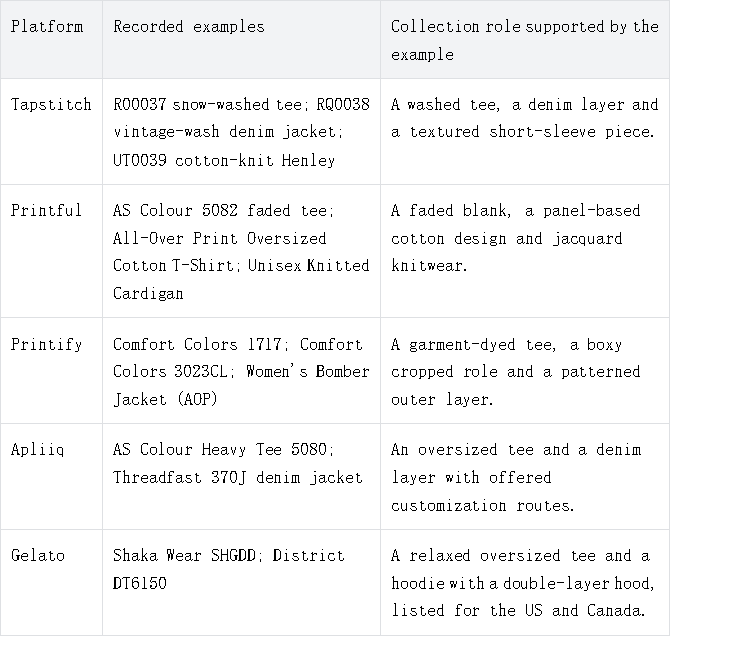
The following examples establish real product routes to investigate. They do not constitute a full inventory audit of all five catalogs.
Oversized, washed, and heavyweight garments
An oversized or heavyweight requirement can be tested against actual tee specifications: Tapstitch lists the RT0086 at 300 GSM with dropped shoulders; Printful lists the AS Colour 5082 at 240 g/m² with an oversized, garment-dyed body; Printify lists Comfort Colors 1717 as a relaxed garment-dyed tee. Apliiq’s AS Colour 5080 provides another heavyweight oversized candidate. These bodies represent different proportions and surfaces, so one cannot simply be substituted for another because its category name is similar.
Gelato’s Lane Seven page also describes heavyweight, oversized and washed apparel. It belongs in the same garment-level search, rather than being reduced to a basic-merch label. Select the US-usable product before evaluating its sizes and decoration.
Catalog presence is the first filter. The second is whether the garment can carry the design. A wide front illustration, small embroidery and full-surface pattern require different supported decoration. Product photographs cannot settle the available print area or the technique applied to the selected configuration.
For a printed tee, identify the exact front and back placements and the file preparation required. Position the design against the garment’s proportions, then evaluate the physical result. Enlarging a graphic until it fills a mockup does not establish that production supports that area. The design record should preserve the approved scale and placement.
For embroidery, distinguish text and uploaded artwork. Tapstitch’s current tool supports text on compatible products. A collection requiring a stitched illustration therefore needs another supported route rather than assuming all embroidery programs accept the same file. This restriction is relevant to design compatibility, not a general score for apparel breadth.
Denim, outerwear, knitwear, and core basics
Tapstitch’s listed RQ0038 denim jacket provides a concrete denim candidate, while the R00037 provides a specific washed tee. The UT0039 is a short-sleeve Henley described with a cotton-knit texture. Those examples serve different collection roles; the Henley should not be counted as a substitute for a long-sleeve cardigan simply because both involve knitting.
Printful’s cardigan offers an explicitly different route: a design knitted into a jacquard garment, with a limited yarn-color structure. Its all-over cotton tee likewise differs from decorating an existing blank because the printed fabric is cut and sewn within the offered pattern. A collection requiring those visual methods should evaluate them as methods, not simply award another point for “more clothing.”
Printify’s 1717 and 3023CL show that two tees can represent different fits within one catalog. A relaxed unisex body and a shorter boxy women’s body are not duplicate roles for every audience. Its all-over bomber offers another category, with its listing identifying a Chinese production route. A seller needing domestic fulfillment would therefore evaluate a different shortlist from a seller accepting that international route.
Apliiq’s 5080 and 370J provide named oversized-tee and denim examples. They are useful to a designer interested in those blanks and the offered customization services. Neither example establishes that Apliiq has every possible denim fit or can develop any original jacket pattern. The selected garment remains the boundary of the catalog comparison.
Gelato’s streetwear page names Shaka Wear SHGDD as a relaxed oversized fit and District DT6150 as a hoodie with a double-layer hood, listing both for the US and Canada. These are relevant candidates for a focused graphic collection. That page does not establish complete US availability for every listed variant; the selected destination and actual product configuration still determine the usable assortment. Its apparel help materials describe additional decoration and selected label areas.
For all-over apparel or jacquard knitwear, the design process needs to work with the offered pattern and material construction. Those routes extend visual control but do not automatically provide original pattern development. A founder who needs a new shoulder shape, fabric specification or garment construction should treat that as a development requirement rather than a missing editor setting.
Branding and decoration across the selected range
Brand identity requires a third filter. Tapstitch’s labels are route-dependent; Printful’s inside-label options are product-dependent; Printify’s branding is provider-dependent. Apliiq’s sewn-label programs introduce different preparation commitments. Gelato documents inner and outer label areas on selected apparel, with compatibility restrictions. The assortment is ready when the essential identity works on each chosen product.
Finish the shortlist with sizes and color relationships. A collection should offer the intended audience a workable size range across its essential pieces. The same color name on two garments does not establish a coordinated shade. Approve garments together when matching is part of the brand promise.
Catalog Coverage for Different Collection Priorities
For a washed-tee and denim-led collection, begin with Tapstitch’s documented washed and denim examples or Apliiq’s available denim blank. Tapstitch is appropriate when its garment shapes fit the design and supported route; Apliiq deserves consideration when its blank choices and sewn identity are a better combination for the brief.
For a collection needing jacquard design or all-over cotton artwork, Printful has specific documented routes worth evaluating. For a collection built around garment-dyed basics, boxy variants and selected patterned garments, Printify is a candidate when the product-provider configuration supports the intended market and branding.
For a narrower graphic-led collection centered on heavyweight or oversized tees, Gelato deserves consideration alongside the relevant tee routes from the other platforms. Its suitability should be established at the selected product and destination level, rather than inferred from a global production-network description.
These are collection-based recommendations, not an overall catalog champion. The named products give the brand a shortlist to evaluate against its essential collection roles. A strong catalog supplies the essential collection roles with workable decoration, identity and fulfillment. Everything outside those roles is additional choice, rather than evidence that one platform is automatically better for a fashion brand.


