
West Texas Intermediate (WTI) crude oil futures on NYMEX advanced approximately 1.8%, trading near $91.20 during early European hours on Tuesday. The move reflects a renewed wave of geopolitical risk premium returning to the energy complex, even as broader market participants remain cautious about the durability of the rally. Skytexla brokers dive into this topic in detail in their newest publication.
Despite the intraday strength, the broader structure of WTI pricing still reflects a market caught between short-term supply risk shocks and a medium-term technical ceiling. The oil price holding near $91.00–$91.20 signals that traders are pricing in elevated uncertainty, but not yet a full-blown disruption scenario.
The latest upward move is largely driven by escalating tensions in the Middle East, which have reintroduced fears of potential supply chain disruptions across global crude flows.
Strait of Hormuz Risk and Supply Sensitivity
A major focal point for the oil market remains the Strait of Hormuz, one of the world’s most critical energy chokepoints, responsible for the transit of nearly 20% of global oil supply.
US Secretary of State Marco Rubio emphasized during Asian trading hours that the strait must remain open one way or the other, stressing that any potential closure would be unlawful, unacceptable, and unsustainable for the global economy.
The rhetoric underscores the structural vulnerability embedded in the global oil system. Any disruption in the Hormuz corridor would likely trigger a sharp repricing of crude, potentially pushing prices far beyond current levels.
However, traders appear hesitant to fully price in such a scenario, reflecting skepticism that a full closure is either politically or militarily feasible. As a result, the current risk premium remains elevated but contained, rather than entering panic-driven territory.
WTI Technical Analysis: 20-Day EMA Caps Upside
From a technical perspective, WTI US Oil is showing signs of short-term recovery, but the broader trend remains fragile.
At the time of writing, prices hover around $91.00, yet the contract continues to trade below its 20-day Exponential Moving Average (EMA), currently positioned near $96.15. This level represents a critical dynamic resistance zone, and its persistence suggests that the broader market structure remains bearish to neutral despite recent gains.
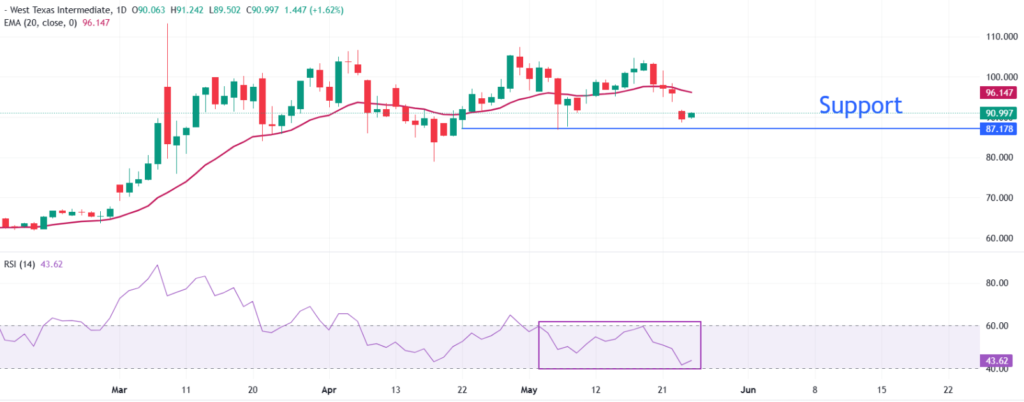
The 14-day Relative Strength Index (RSI) has eased into the mid-40s range, indicating that downside momentum is slowing. However, this does not yet confirm a bullish reversal. Instead, it signals diminishing bearish pressure rather than active accumulation.
In technical terms, the market remains in a corrective phase within a larger consolidation structure. Without a decisive break above the 20-day EMA, rallies are likely to remain counter-trend rebounds rather than sustained upward trends.
Key Resistance and Support Levels
On the upside, the first major technical hurdle for WTI crude is the 20-day EMA at $96.15. A confirmed daily close above this level would be required to shift momentum meaningfully in favor of the bulls. Such a breakout could open the door toward the psychologically significant $100.00 level, where profit-taking pressure is expected to intensify.
On the downside, immediate support is anchored around $86.92, the May 6 low. A failure to maintain this level would expose the market to deeper downside risk, with potential extension toward the $80.00 region, where historical demand zones may re-emerge.
The current price action suggests a market in equilibrium, with geopolitical risk support offsetting technical resistance pressures.
Outlook: Balancing Risk Premium and Technical Resistance
The near-term outlook for WTI crude oil remains shaped by a tug-of-war between geopolitical escalation risks and technical resistance barriers.
On one hand, renewed tensions in the Middle East, particularly around Iranian assets and the Strait of Hormuz, continue to inject a structural risk premium into prices. This prevents a deeper selloff and supports prices near the $90 region.
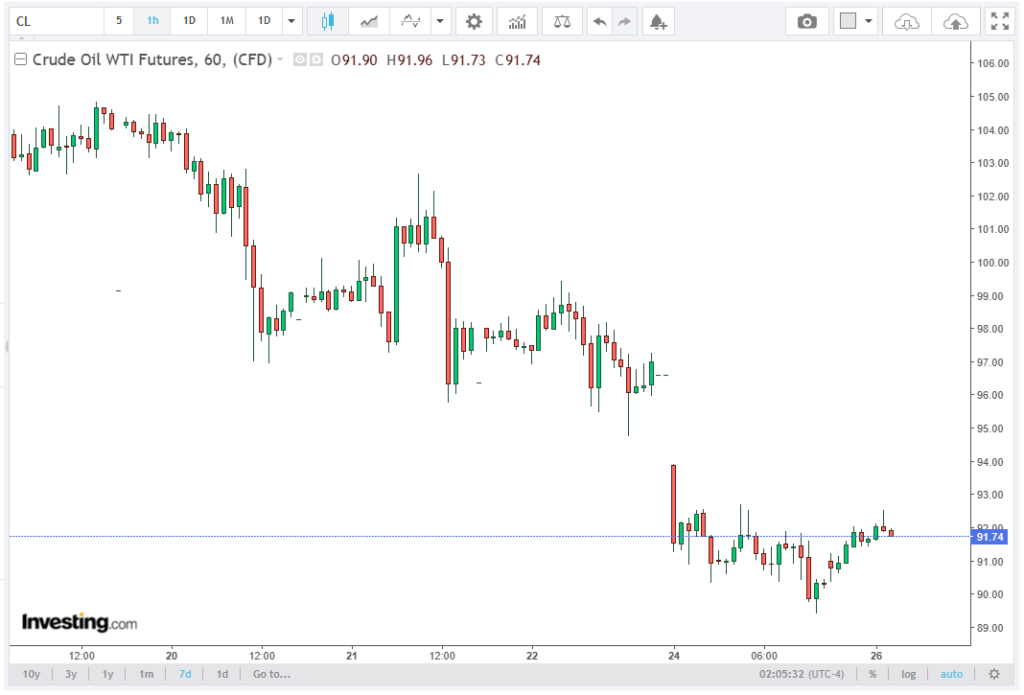
On the other hand, the inability of bulls to break above the 20-day EMA at $96.15 highlights persistent distribution pressure and a lack of strong follow-through buying.
If geopolitical conditions stabilize further, the market may gradually refocus on macroeconomic demand concerns, which could reassert downward pressure. Conversely, any escalation involving maritime security or energy infrastructure could rapidly reprice crude toward the $100 threshold or beyond.
Conclusion
The WTI crude oil market remains at a critical inflection point. While renewed Middle East uncertainty has provided short-term support and lifted prices toward $91.20, the broader technical structure still favors a bearish-to-neutral bias below the 20-day EMA resistance at $96.15.
Traders are effectively balancing two competing forces: geopolitical risk escalation, which supports prices, and technical resistance coupled with demand uncertainty, which limits upside momentum.
Until a decisive breakout above key moving averages occurs, WTI is likely to remain range-bound, with heightened sensitivity to geopolitical headlines and supply disruption risks.


