
The Indian Rupee (INR) has temporarily halted its recent upward momentum against the US Dollar (USD), ending a four-day rally as geopolitical tensions and rising crude oil prices reintroduce volatility into currency markets.
On Tuesday, the USD/INR pair rebounded toward 95.40, signaling a cautious shift in sentiment after sustained INR strength in the previous sessions. The latest article from the brokers at Skytexla explores this topic thoroughly.
The pause in the Rupee’s appreciation is largely attributed to a combination of renewed geopolitical risks in the Middle East, fluctuations in global crude oil prices, and evolving expectations around foreign capital flows into India. After a strong appreciation phase driven by optimism around US–Iran negotiations, the currency now faces a more uncertain macro backdrop.
US–Iran Tensions Reignite Risk Premium in Oil Markets
A key driver behind the latest Rupee weakness is the resurgence of geopolitical risk in the Middle East. The US Central Command confirmed that American forces conducted what were described as self-defense strikes on Iranian missile launch infrastructure and vessels allegedly preparing to deploy mines.
Although US officials emphasized that the strikes were defensive in nature and not intended to derail diplomatic progress, markets interpreted the development as a potential setback to fragile US–Iran negotiations. These talks had previously supported risk appetite by reducing fears of supply disruptions in global energy markets.
The US President reiterated confidence that negotiations toward a broader agreement, including reopening critical energy routes such as the Strait of Hormuz, were progressing positively. However, investors remain cautious, as any breakdown in diplomacy could quickly escalate into broader regional instability.
FIIs Return as Net Buyers but Market Confidence Remains Fragile
On the domestic front, Foreign Institutional Investors (FIIs) provided a marginal supportive signal by turning net buyers in Indian equities on Monday, after four consecutive sessions of net outflows. FIIs purchased shares worth approximately Rs. 821.75 crore, marking a reversal in direction but not in conviction.
However, this inflow remains modest compared to the previous selling pressure, where average daily outflows reached Rs. 2,596.63 crore between May 19–22. This suggests that while foreign investors are not aggressively exiting Indian markets, their participation remains cautious and selective.
Sustained INR appreciation typically requires stronger and more consistent portfolio inflows, particularly during periods of external uncertainty such as rising oil prices and geopolitical instability.
Fiscal Policy Signals Add Another Layer of Uncertainty
Domestic policy developments are also influencing sentiment. India’s Finance Minister Nirmala Sitharaman recently stated that the government is open to reviewing investor concerns regarding Short-Term Capital Gains (STCG) and Long-Term Capital Gains (LTCG) taxes.
While the statement was broadly accommodative in tone, market participants continue to assess India’s relative tax attractiveness compared to other emerging markets. Higher capital gains taxes can reduce the appeal of Indian assets for foreign portfolio investors, particularly in a global environment where capital is highly sensitive to post-tax returns.
Technical Analysis: USD/INR Consolidates Near Key Moving Average
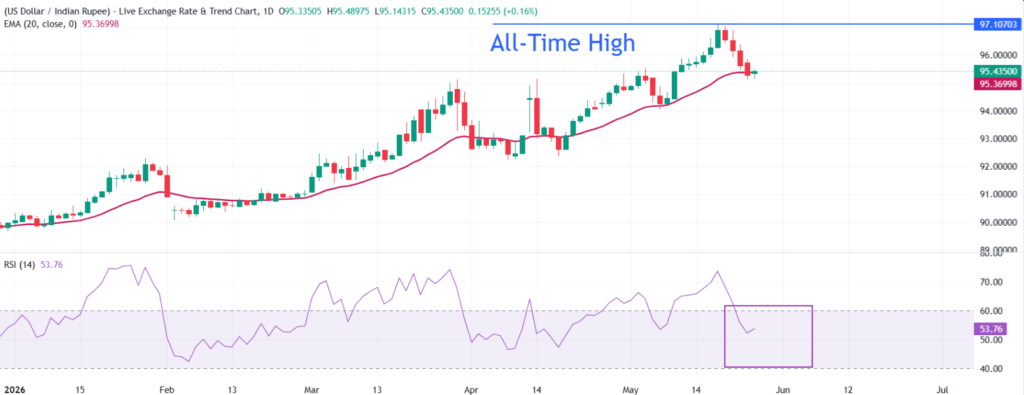
From a technical perspective, the USD/INR pair is currently trading around 95.40, hovering near its 20-day Exponential Moving Average (EMA) located at approximately 95.37. This level is acting as a near-term pivot zone, reflecting indecision in market direction following recent volatility.
The Relative Strength Index (RSI) has eased to around 54, down from previously overbought levels. This cooling momentum suggests that the earlier bullish phase for the Rupee has weakened, although overall bias has not yet turned decisively bearish.
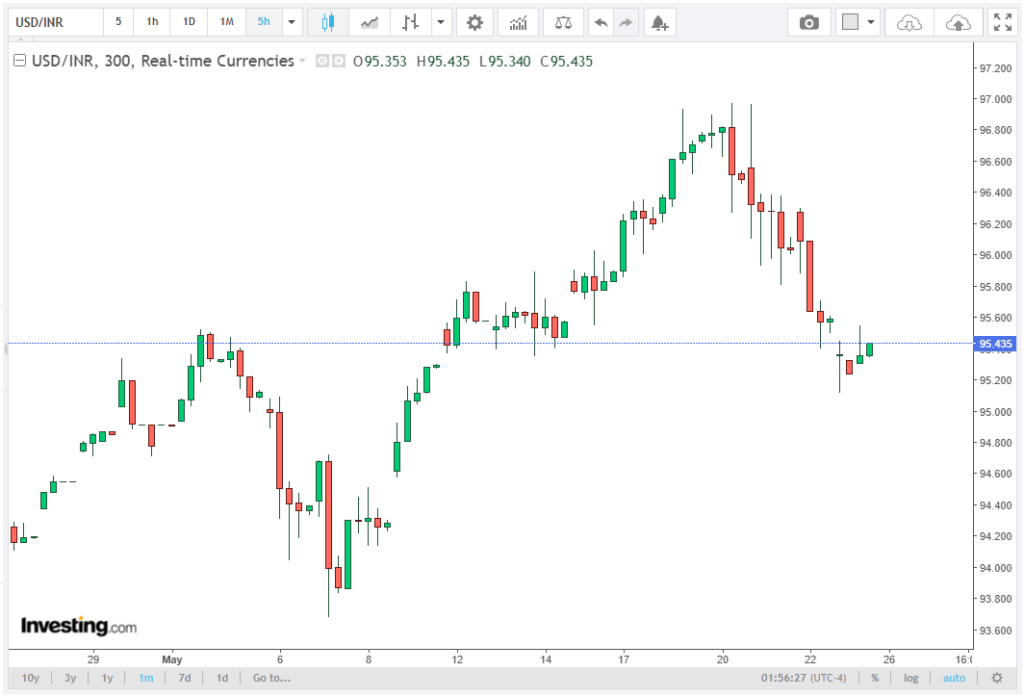
On the downside, a sustained break below the 20-day EMA could expose the pair to a decline toward the psychological level of 95.00, which now serves as immediate support. A breach of this level would indicate a deeper consolidation phase for the USD/INR pair.
On the upside, resistance is seen near the recent swing high at 96.37, with a stronger barrier at the all-time high around 97.00. A breakout above 96.37 would likely restore bullish momentum for the USD, potentially resuming the broader upward trend.
Outlook: Balanced Risks but Oil Remains the Key Driver
Overall, the Indian Rupee’s near-term trajectory remains finely balanced between competing macro forces. While domestic equity inflows and potential policy flexibility on taxation offer some support, these factors are currently outweighed by external risks.
The most dominant variable remains global crude oil prices, which are highly sensitive to developments in the US–Iran geopolitical landscape. Any escalation in tensions or disruption to Middle Eastern supply routes could quickly tilt sentiment against the Rupee.
Until greater clarity emerges on both the geopolitical front and oil price stability, the INR is likely to remain range-bound with a slight negative bias, closely tracking movements in USD strength and energy markets.


