
The upcoming initial public offering of SpaceX has triggered a significant revaluation of Tesla (TSLA) as investors begin to parse the intricate financial ties between the two entities. Following the official filing of the SpaceX S-1, Market analysis provided by the ShineGulf Trading quantitative research team suggests that the electric vehicle manufacturer holds a substantial, off-balance-sheet asset that has been largely overlooked by the broader market.
Tesla is now confirmed to be the beneficial owner of 18,990,195 shares of SpaceX Class A common stock as of May 1, 2026. While this represents an ownership interest of less than 1.0% of the total outstanding Class A shares, the sheer scale of the rocket company’s valuation means this minority stake could significantly influence Tesla’s net asset value.
This equity position was initially hinted at in April when Tesla disclosed a $2B investment in SpaceX through its Q1 2026 8-K filing. However, the S-1 provides the first definitive “mark-to-market” opportunity for this holding. Once SpaceX completes its pricing process in June, Tesla shareholders will inherit a direct, quantifiable claim on the economics of both orbital launch services and the Starlink satellite constellation.
Particularly in light of the fact that analysts are focusing more attention on the auto-and-energy revenue mix, this hidden asset offers a one-of-a-kind buffer for Tesla’s valuation.
Valuation Benchmarks and Market Probabilities
The anticipation surrounding the SpaceX debut has created a unique dynamic in the prediction markets. Polymarket traders currently assign a 61% implied probability to the IPO valuation landing in the $1.75T to $2.00T range. Even more striking is the 70.5% probability that the first-day market capitalization will exceed the $2T threshold. This enthusiasm is further reflected in sentiment data showing an 88.5% probability that SpaceX will be valued higher than Tesla by June 30.
For those who have invested in Tesla, this brings up an important question concerning the rotation of capital. Others believe that the two companies are becoming increasingly inseparable, despite the fact that some people are concerned that the “Muskonomy” could result in a flight of capital away from electric vehicles and toward space exploration.
The deep technical collaboration between the firms, specifically the Terafab chip partnership announced in March and the subsequent participation of Intel in April, indicates that the relationship has evolved far beyond passive equity.
The “One Roof” Merger Narrative
The prospect of a formal merger between Tesla and SpaceX has moved from the fringes of social media speculation into serious institutional discourse. Wedbush Securities analyst Dan Ives has become a vocal advocate for the combination, suggesting an 80% chance of a merger following the IPO.
The logic follows that a unified corporate structure would allow for a more streamlined deployment of artificial intelligence, robotics, and hardware engineering talent across all of the billionaire’s ventures.
However, prediction markets such as Kalshi remain more skeptical than the analysts. Traders currently place just 33% odds on a merger occurring before May 2027, a sharp decline from previous weeks. This skepticism is rooted in the complex governance hurdles such a deal would face.
Any intercompany transaction would require independent approval from both boards and must balance the competing interests of diverse shareholder groups. Furthermore, Tesla is currently navigating intense competitive pressure in the Chinese market from manufacturers like BYD and Geely, making a complex corporate restructuring a potentially distracting endeavor.
Risks to the Tesla Investment Thesis
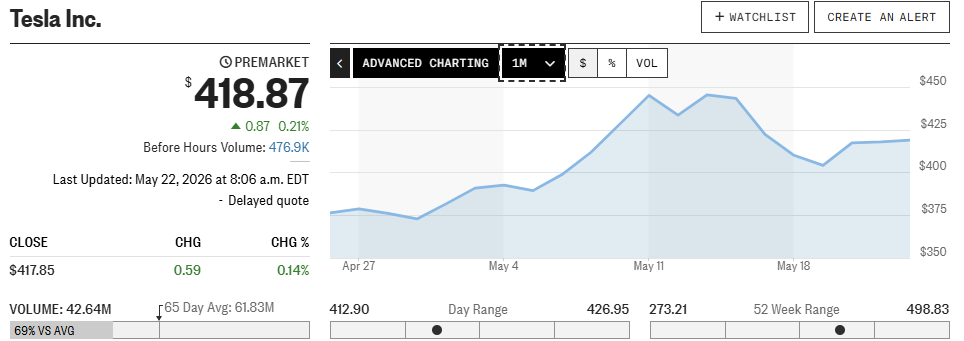
While the SpaceX stake is a clear bullish catalyst for Tesla’s balance sheet, the IPO also presents structural risks. Some fund managers expressed concern that the new listing could divert the “attention and appetite” of growth investors. If SpaceX becomes the “new favorite child” within the ecosystem, Tesla’s shares, which are currently trading at a trailing P/E of 370, could face a valuation reset.
There is also the persistent concern regarding leadership bandwidth, as the IPO process and subsequent life as a public company will undoubtedly require a significant time commitment from the executive team.
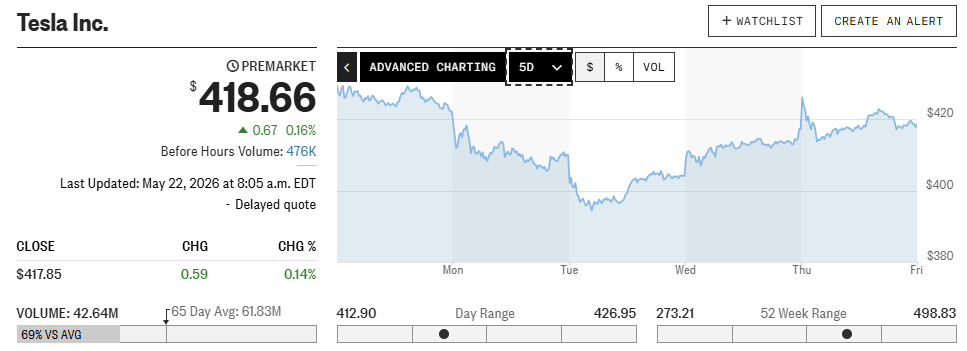
Despite these risks, the math of the SpaceX holding is difficult for bears to ignore. With Tesla trading at approximately $417.26, the 18,990,195 SpaceX shares represent a multi-billion dollar asset that is not yet fully reflected in consensus models. Whether the two companies stay separate or eventually merge, the June IPO marks the moment where the “hidden” value of the space venture becomes a permanent fixture of the Tesla narrative.
In the end, the SpaceX IPO represents a fundamental change in how the market must value the EV behemoth, not just a significant milestone for the aerospace industry. As the two entities become more intertwined through hardware synergy and equity ownership, the distinction between a car company and a technology conglomerate continues to blur.


