
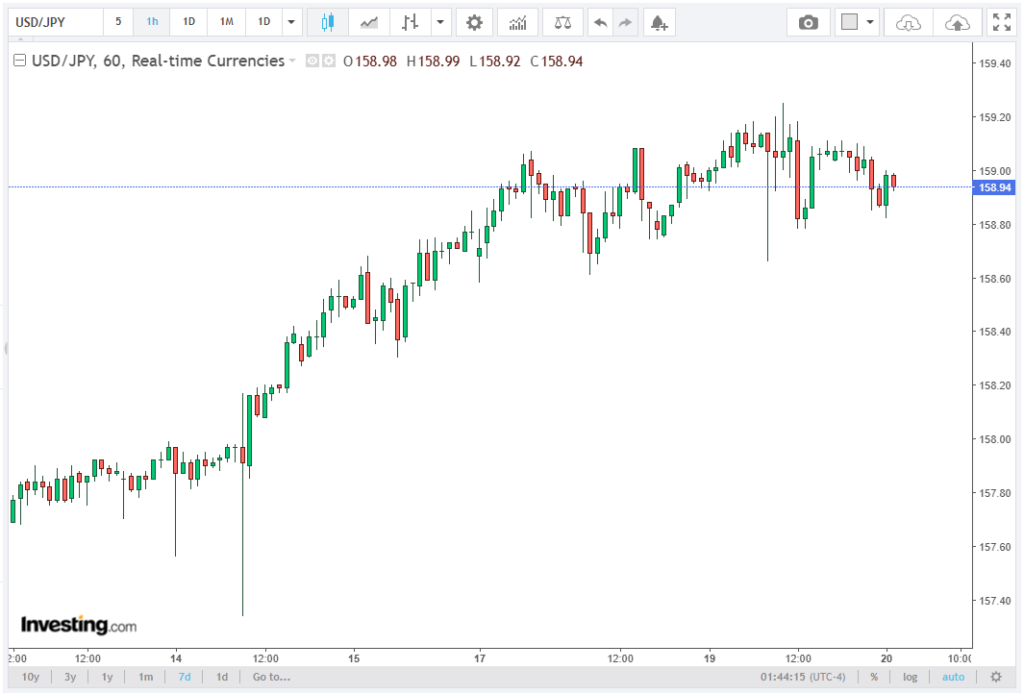
The USD/JPY pair is trading in negative territory around 158.95 during early Wednesday European hours, signaling a temporary loss of bullish momentum. The Japanese Yen (JPY) has gained on stronger-than-expected economic data and rising concerns about potential official intervention. The latest article from Murrius Group features an extensive analysis of this matter by their brokers.
The pair remains below the 159.00 psychological level, which has been a key resistance zone over the past month. Short-term momentum indicators suggest weakening USD demand, while JPY liquidity in the offshore market has tightened. Intraday volatility has increased, with the pair experiencing a 0.25% range in the first two hours of trading.
Japan’s GDP Beats Expectations
Japan’s economy expanded at an annualized rate of 2.1% in Q1 2026, surpassing forecasts of 1.7%. Every quarter, GDP grew 0.5% QoQ, up from 0.3% in Q4 2025 and above market expectations of 0.4%.
Breaking down the components: private consumption contributed 0.8%, supported by robust retail sales and resilient household spending. Business investment added 0.7%, driven by machinery and equipment purchases in the manufacturing sector.
Net exports contributed 0.4%, reflecting sustained global demand despite elevated energy costs. Government spending added a modest 0.2%, highlighting the limited impact of fiscal stimulus.
US Inflation and Federal Reserve Divergence
The US Dollar (USD) continues to face pressure despite structural support from higher US interest rates. Recent US inflation data indicated persistent price pressures, reinforcing expectations that the Federal Reserve (Fed) will maintain a restrictive policy stance.
The CPI rose 0.4% MoM in April, translating into 4.0% YoY, slightly above market forecasts of 3.9%. Core CPI, excluding food and energy, increased 0.3% MoM, marking 4.6% YoY. Markets are now pricing in a 41.5% probability of a 25 basis point rate hike by year-end, according to the CME FedWatch tool, reflecting the Fed’s commitment to a “higher-for-longer” interest rate strategy.
The divergence between US and Japanese monetary policy remains significant. With the BoJ maintaining ultra-low rates, the interest rate differential continues to favor the USD structurally, although short-term risk factors are increasingly impacting USD/JPY trading.
Intervention Risks
Potential Japanese intervention is another key factor supporting the JPY. Officials have signaled readiness to act against excessive FX volatility, emphasizing the use of tools that avoid disrupting US Treasury yields.
Historically, the BoJ has intervened when the USD/JPY moves rapidly, particularly when the Yen falls below critical levels or exhibits abnormal volatility. Technical analysis suggests that 158.50–159.00 is a sensitive zone where JPY appreciation could trigger preventive measures.
This adds a layer of downside protection for the JPY, limiting the upside for USD/JPY despite broader structural bullishness in the US Dollar. Intervention risk also contributes to elevated implied volatility in options markets, with the 1-month USD/JPY implied volatility rising to 7.3% from 6.9% at the start of the week.
Technical Analysis
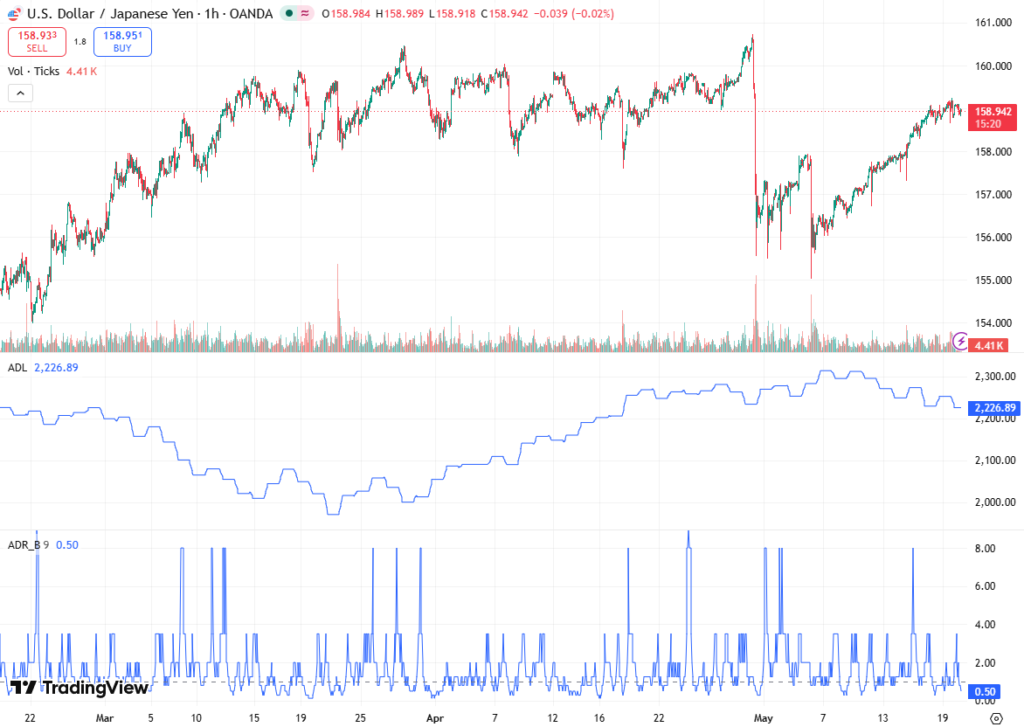
From a technical perspective, USD/JPY faces immediate resistance at 159.00, with intraday support seen at 158.50, followed by 157.80, which represents the lower boundary of last month’s consolidation range. The 50-hour moving average is currently at 158.70, acting as a short-term pivot for intraday trades.
Momentum indicators such as the RSI have declined to 62, indicating mild overbought exhaustion from recent USD gains. Meanwhile, MACD readings show weakening bullish divergence, suggesting limited near-term upside. Traders are closely monitoring open interest in JPY futures, which has increased by 3.2% over the past two sessions, reflecting rising speculative interest in Yen strength.
Japan CPI in Focus
The market now turns to Japan’s April CPI, due Friday, which will be critical for assessing inflationary pressures. Economists forecast headline CPI at 2.3% YoY, with core CPI at 2.0% YoY. Any surprise above expectations could strengthen the case for gradual monetary tightening, supporting JPY appreciation.
Conversely, weaker-than-expected inflation would reduce the likelihood of policy adjustment, potentially allowing USD/JPY to test the 159.50–160.00 zone. Short-term traders will likely position ahead of CPI using a combination of spot, forward, and options contracts, amplifying intraday volatility.
Outlook
In conclusion, USD/JPY near 158.95 reflects a delicate balance of factors. Strong Q1 GDP growth and intervention risks support the Japanese Yen, while the Fed’s hawkish stance and higher US yields anchor the US Dollar.
Traders should monitor interest rate differentials, FX intervention risk, and technical pivot levels closely, as these factors will dictate short-term USD/JPY dynamics. Overall, the market remains in a fragile equilibrium where both fundamental and technical signals must be carefully integrated to assess trend sustainability.


