
The global energy market is currently navigating a period of unprecedented volatility as the intersection of geopolitical tension and physical supply disruptions continues to drive prices upward. Market research specialists at Kixy observe that crude oil has successfully held its four-day gain, fueled by a deep-seated uncertainty surrounding negotiations in the Middle East.
While mediators have attempted to facilitate a resolution, the decision by the US Administration to maintain a rigorous naval blockade of regional ports has significantly hindered the progress of peace talks. Consequently, the energy sector is pricing in a persistent premium as the prospect of restoring traditional flows through the Persian Gulf remains distant.
For institutional traders looking at the financial trajectory of the commodity markets, these evolving conditions signal a shift from a risk-premium model to a fundamental supply-shock reality.
Price Action And Weekly Performance Metrics
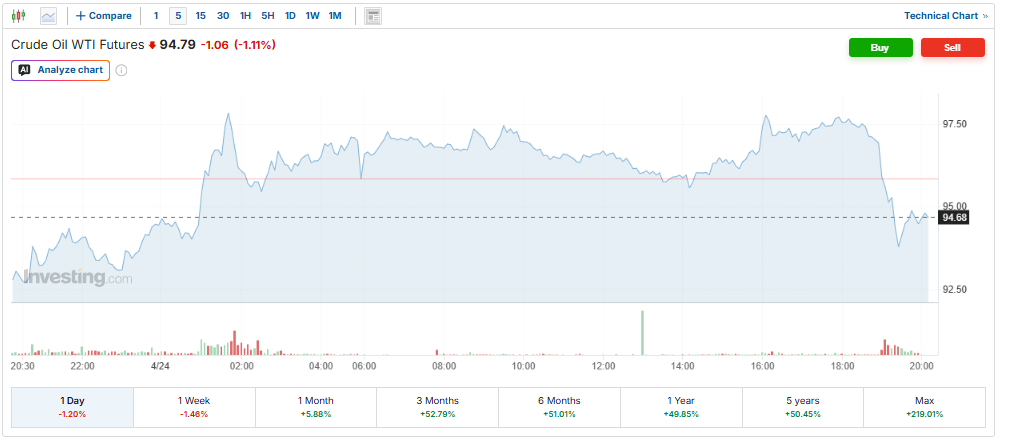
Brent crude has stabilized near the $105 per barrel mark, positioning the benchmark for a substantial weekly gain of approximately 17%. Simultaneously, West Texas Intermediate (WTI) has maintained trading levels around $96, reflecting the broader upward pressure on global energy prices throughout April 2026.
The market reaction is a direct response to the amping up of rhetoric and increasing military threats within vital shipping corridors. The conflict, which escalated at the end of February, has resulted in the near-closure of the Strait of Hormuz. This development has led to a catastrophic drop in exports from the world’s most significant oil and gas producers.
Analysts suggest that the longer this impasse continues, the more evident it becomes that the disruptive effects will reverberate across the global economy for several months. The paper market is now rapidly adjusting to the undeniable reality of constricted physical supply and what that means for global inventory levels.
Maintaining institutional-grade productivity in this environment requires firms to look beyond short-term headlines and focus on the structural impairments to energy logistics. The strategic direction of the market is currently being dictated by the physical inability to move product, rather than speculative sentiment alone.
Naval Operations And Maritime Choke Points
Market volatility intensified during recent sessions following executive orders for the US Navy to take aggressive action against vessels suspected of laying mines in the strait. These military developments were accompanied by the boarding of a supertanker in the Indian Ocean, as the naval blockade of regional shipping reached a new level of intensity.
On Friday, reports emerged of a sanctioned supertanker attempting to navigate the Strait of Hormuz, while general commercial traffic remains at a virtual standstill. The deadlocked status of talks between Washington and Tehran is exacerbated by unresolved disputes over nuclear capabilities and regional strikes.
While a temporary ceasefire in surrounding territories has been extended by three weeks, the underlying tension continues to weigh heavily on risk appetite. The future expectations for a rapid reopening of the waterway have been tempered by the reality of military positioning and the lack of a clear diplomatic off-ramp.
The longer-term positioning of the market must account for the fact that restoring full production will not be an instantaneous process.
Restoration Forecasts And Production Impact
According to technical notes from major financial institutions, restoring crude oil production in the Persian Gulf will likely require a window of a few months. This timeline assumes a total reopening of the strait and an absence of renewed strikes on energy infrastructure.
Current data suggests that output is being curtailed by approximately 14.5 million barrels per day, representing a reduction of more than 50% for the month of April. This massive contraction in supply has created a vacuum that other producers are struggling to fill.
The strategic direction of global energy policy is being rewritten as nations scramble to secure alternative sources of fuel. For investors, the financial trajectory of energy-related equities and currencies will remain tied to the duration of this bottleneck.
Strategic Energy Outlook and Market Conclusion Summary
The current paralysis in the Persian Gulf transcends traditional market cycles, representing a structural reordering of the global energy security paradigm. As the diplomatic impasse hardens into a permanent logistical bottleneck, the financial trajectory of crude oil will likely remain decoupled from conventional demand-side metrics.
We are no longer observing a simple price spike; we are witnessing the emergence of a “scarcity premium” that could redefine institutional asset allocation for the remainder of 2026. The strategic direction for forward-looking capital must now account for a world where maritime choke points are actively contested and physical delivery is no longer guaranteed.
Ultimately, the longer-term positioning of the energy complex suggests that the era of cheap, frictionless fuel has been replaced by a period of strategic accumulation and heightened vigilance.


