
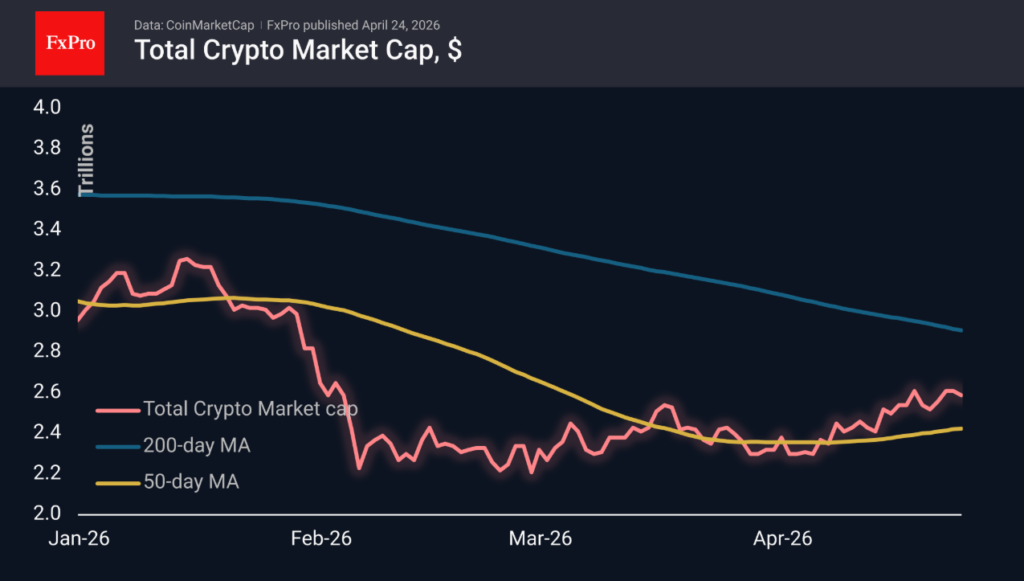
The global cryptocurrency market is once again entering a phase of directional uncertainty, with traders closely watching traditional equities for confirmation of the next major move. The total crypto market capitalisation has declined by 0.6% over the past 24 hours, settling at approximately $2.59 trillion, reflecting a cautious tone across digital assets. In their piece, the team at Kixy explains this topic with both clarity and depth.
This hesitation comes despite relatively stable conditions in broader financial markets. The S&P 500 is hovering near 7,100, while the Nasdaq 100 continues to test new highs around 27,000, reinforcing a narrative of resilience in U.S. equities.
Historically, such conditions often serve as a liquidity signal for crypto risk assets, yet this time the transmission appears delayed. Once again, the crypto market seems to be waiting for confirmation from equities before committing to a sustained breakout.
Market Performance: Select Altcoin Strength Amid Broader Weakness
Despite the overall cooling in sentiment, several digital assets are showing selective strength. Leading the gainers are Zcash (+9.1%), Theta (+6.2%), and Cosmos (+3.6%), reflecting renewed speculative interest in privacy-focused and infrastructure-driven protocols.
On the downside, performance remains uneven among large-cap assets. Ethereum (−1.5%) and Polkadot (−1.2%) are both under pressure, while Toncoin (−1.8%) is also lagging despite positive ecosystem developments. This divergence highlights a market structure where capital rotation is occurring, but without strong conviction in any dominant narrative.
The uneven performance suggests that traders are still operating in a wait-and-see regime, with liquidity flowing cautiously rather than aggressively deploying into risk.
Bitcoin Price Action: Consolidation Around $78K
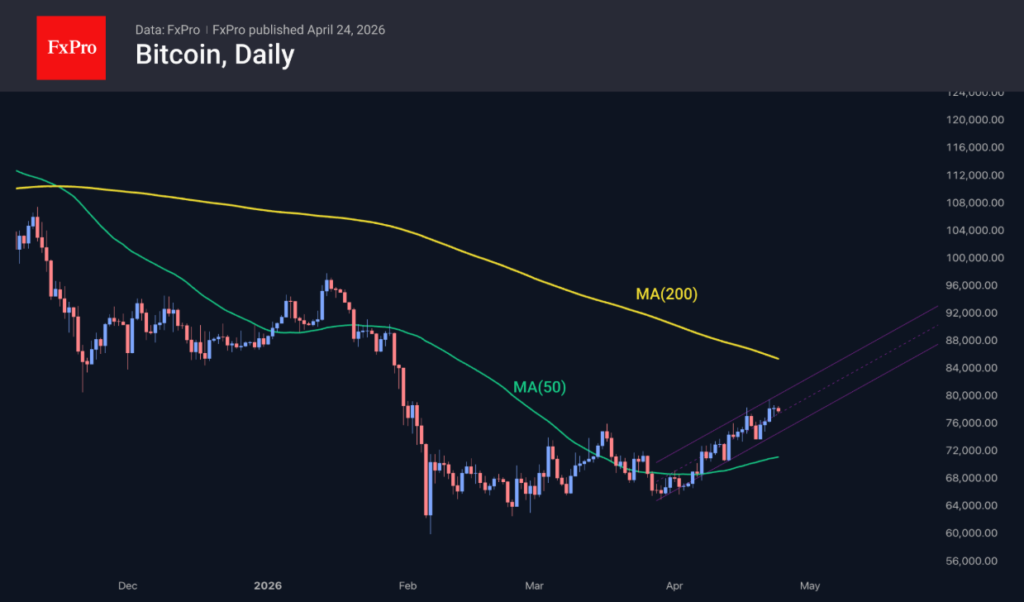
The focal point of the entire crypto market remains Bitcoin, which continues to trade in a tight consolidation range around $78,000. The asset is currently oscillating within a clearly defined mid-range channel between $75.6K and $80.5K, reflecting equilibrium between buyers and sellers.
Repeated attempts to push Bitcoin below $77K have been met with strong dip-buying demand, reinforcing the idea that institutional and long-term participants are still active at lower levels. At the same time, resistance near $80K continues to cap upside momentum.
Technically, Bitcoin remains in an uptrend that began in early April, but momentum has slowed as the price approaches a critical zone of resistance. Market analysts are closely watching the potential test of the 200-day moving average, which lies just above current levels. At the present pace, Bitcoin may reach this indicator within approximately two weeks, although volatility is expected to increase before then.
Technical Structure: Key Resistance and Inflexion Zones
The $79K–$80K zone is emerging as a decisive barrier for Bitcoin. This level aligns closely with the realised price of short-term holders, a cohort historically prone to selling into strength. As a result, this region is increasingly viewed as a critical supply zone.
Market intelligence firm CryptoQuant has described this area as a critical inflexion point, where price action may determine whether the broader uptrend resumes or stalls.
From a volatility perspective, current conditions remain relatively subdued. The options market indicates low short-term implied volatility, while demand for downside protection persists. This suggests that traders are hedging against potential weakness even as spot prices remain stable.
Long-Term Perspective: Volatility as a Catalyst
From a longer-term perspective, Bitcoin volatility cycles remain central to bullish arguments. Investor Anthony Pompliano, co-founder of Morgan Creek, suggests that even sharp corrections, potentially up to 50% from prior highs, can act as catalysts for new all-time highs. His view reflects a recurring historical pattern where deep retracements precede stronger expansion phases.
He also reinforces Bitcoin’s evolving narrative as a safe haven asset in macro uncertainty, a theme increasingly referenced during periods of geopolitical or financial instability.
DeFi Security Concerns and Institutional Sentiment
However, not all developments are supportive of sentiment. Recent DeFi security incidents, including attacks on the Drift and Kelp protocols, have raised concerns about systemic risk within decentralized finance. Following these events, more than $15 billion in user withdrawals were reportedly observed across DeFi platforms.
Analysts at Jefferies caution that such incidents could temporarily dampen institutional enthusiasm for blockchain infrastructure. While the long-term thesis for decentralised systems remains intact, recurring vulnerabilities may slow adoption among traditional financial institutions.
Conclusion: Waiting for Equities to Set the Tone
The crypto market is currently locked in a phase of macro-dependent consolidation, with Bitcoin anchored near $78K and traders watching the $80K resistance level as the next decisive battleground.
Until equities provide a clearer directional signal, either through continued risk-on expansion or a corrective phase, digital assets are likely to remain range-bound. In this environment, crypto behaves less like an independent asset class and more like a high-beta extension of global liquidity sentiment, waiting for confirmation before its next major move.


