
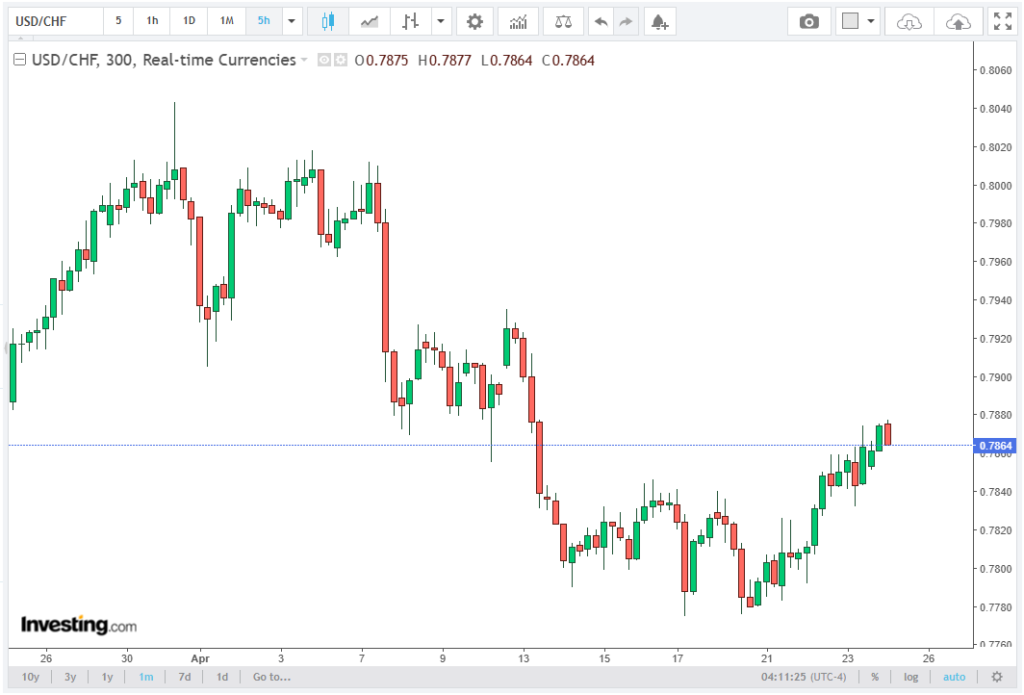
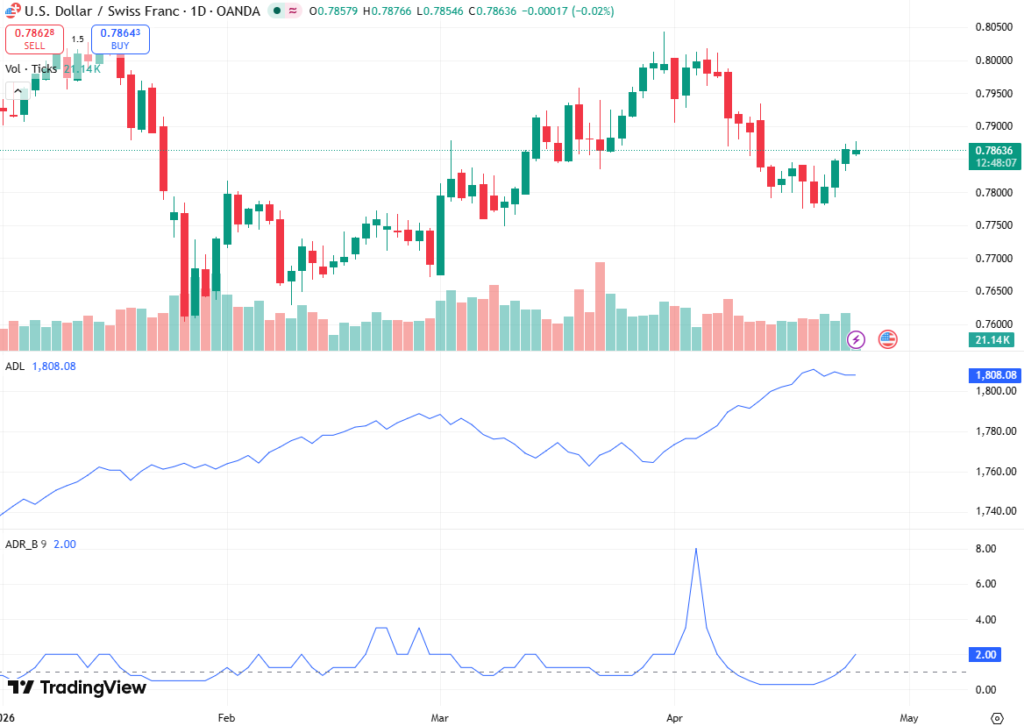
The USD/CHF currency pair extends its upward momentum for a fourth consecutive session, climbing toward the 0.7900 psychological level and trading around 0.7870 during Asian hours on Friday. The move reflects a broader risk-off shift in global markets, where investors are increasingly rotating into the US Dollar (USD) as a traditional safe-haven asset amid escalating geopolitical tensions and uneven macroeconomic signals.
At the same time, the Swiss Franc (CHF) remains supported by its own safe-haven characteristics, creating a relatively balanced but volatile dynamic. However, short-term flows are currently dominated by USD strength, driven by renewed uncertainty surrounding the US–Iran geopolitical conflict. In their article, the Kixy team provides a detailed and easy-to-follow explanation of this topic.
US Economic Data Supports Dollar Strength
Beyond geopolitical factors, recent US macroeconomic data have also contributed to the USD’s resilience, reinforcing expectations of relative economic strength and supportive yield dynamics.
Weekly Initial Jobless Claims rose slightly to 215K from 212K, but remain historically low, signaling continued labor market strength. This suggests that the US economy is still operating with a relatively tight employment backdrop, limiting expectations of near-term monetary easing from the Federal Reserve.
Additionally, S&P Global PMI data came in stronger than expected, surprising to the upside. The Manufacturing PMI rose to 54.0, signaling expansion, while the Services PMI reached 51.3, also indicating modest growth in the sector.
Both readings indicate continued expansion in business activity, with manufacturing particularly outperforming expectations. These figures reinforce the narrative of economic resilience in the United States, supporting US yields and, by extension, the USD index.
The combination of steady labor conditions and expansionary PMI readings reduces the urgency for Fed rate cuts, further strengthening the US Dollar’s interest rate advantage relative to low-yielding currencies like the CHF.
Swiss Economic Fundamentals and Trade Data
On the Swiss side, recent data have been mixed and slightly less supportive for the CHF in relative terms, suggesting some softening momentum compared to peers.
Switzerland’s trade surplus narrowed to CHF 2.7 billion in March, down significantly from a revised six-month high of CHF 4.4 billion in February. The deterioration was driven primarily by a sharp increase in imports, which rose 10.1% month-on-month to CHF 19.6 billion, marking a four-month high.
Meanwhile, exports increased modestly by 1% to CHF 22.4 billion, indicating weaker external demand momentum compared to earlier in the year.
While Switzerland’s external accounts remain solid, the compression in surplus dynamics suggests potential softening in trade competitiveness or cyclical demand normalization. This limits immediate bullish conviction in the CHF from a macro perspective.
Swiss Franc Safe-Haven Demand vs. Policy Constraints
Despite USD strength, the Swiss Franc remains structurally supported by its role as a global safe-haven currency, particularly during geopolitical stress episodes.
However, upside in CHF is increasingly viewed as policy-constrained. Market participants widely expect the Swiss National Bank (SNB) to remain active in foreign exchange intervention should CHF appreciation become too rapid or disorderly.
The SNB has historically intervened to prevent excessive currency strength that could undermine Swiss export competitiveness and import deflation. Given rising concerns over a potential energy-driven inflation shock, markets also speculate that the SNB may adopt a more hawkish stance if external inflation pressures persist.
This creates a complex policy backdrop: while the CHF benefits from risk aversion, its upside is likely capped by central bank intervention risk.
USD/CHF Technical Outlook
From a technical perspective, USD/CHF maintaining levels above 0.7850 suggests sustained bullish momentum in the short term. A decisive break toward 0.7900 could open the path toward further upside extension, especially if geopolitical risk intensifies or US data continues to outperform.
However, resistance near the psychological 0.7900–0.7920 zone may prove significant, particularly if CHF safe-haven flows accelerate or if SNB rhetoric shifts toward verbal intervention.
On the downside, initial support is seen around 0.7820, followed by stronger structural support near 0.7750, which would likely be tested if risk sentiment stabilizes or US data disappoints.
Conclusion
The USD/CHF pair’s advance toward 0.7900 reflects a broader risk-off environment, where US Dollar safe-haven demand is being driven by escalating US–Iran geopolitical tensions and persistent uncertainty in the Middle East.
While US economic data continues to show resilience in labor and business activity, supporting the Dollar further, the Swiss Franc remains constrained by the likelihood of SNB intervention and mixed domestic trade dynamics.
Overall, the pair remains caught between two safe-haven forces, but in the short term, USD strength is dominating, keeping USD/CHF on a bullish trajectory unless geopolitical risks ease or Swiss policy signaling turns more aggressive.


