
The AUD/JPY cross has softened to near 112.90 during Wednesday’s early European session, reflecting a mixed market sentiment amid stronger Japanese economic data and cautious Australian monetary policy signals.
While the pair has lost some ground below the psychologically significant 113.00 level, the overall bullish structure remains intact, suggesting that further consolidation could precede another upward push. The newest article by Murrius Group offers readers an in-depth examination of this subject from their brokers.
Japanese GDP Supports the Yen
The recent upbeat Japanese GDP figures provided tangible support to the JPY, curbing the recent gains seen in the AUD/JPY pair. Preliminary data from Japan’s Cabinet Office showed the economy growing at an annualized 2.1% in Q1 2026, up from 1.3% in the previous quarter and exceeding the market consensus of 1.7%. Every quarter, GDP expanded by 0.5%, above the 0.4% forecast, while Q4 2025 recorded 0.3% growth.
This stronger-than-expected growth signals resilience in the Japanese economy and underpins a firmer Yen, pressuring the AUD/JPY cross in the near term. Investors are closely watching how the Yen reacts to domestic economic strength, especially given the ongoing geopolitical and global economic uncertainties.
Australian Dollar Faces Inflation Concerns
On the Australian front, the Reserve Bank of Australia (RBA) minutes released on Tuesday highlighted the central bank’s cautious stance on inflation and growth. Minutes revealed that eight of nine directors endorsed raising the May interest rate to 4.35%, citing inflation pressures linked to Middle East tensions. One director preferred to hold off until further data became available.
The RBA minutes also emphasized concerns that global energy shocks and geopolitical tensions could drive domestic inflation, potentially weighing on economic growth. Such factors may cap the upside potential of the AUD, limiting the pair’s ability to maintain momentum against a strengthening JPY.
Technical Analysis: Consolidation Near 112.90
From a technical perspective, the AUD/JPY pair remains constructive despite its slight pullback. On the daily chart, the pair holds above the 100-day simple moving average (SMA), signaling that the broader bullish trend is intact. However, the price now sits just under the Bollinger middle band, which acts as the first immediate resistance.
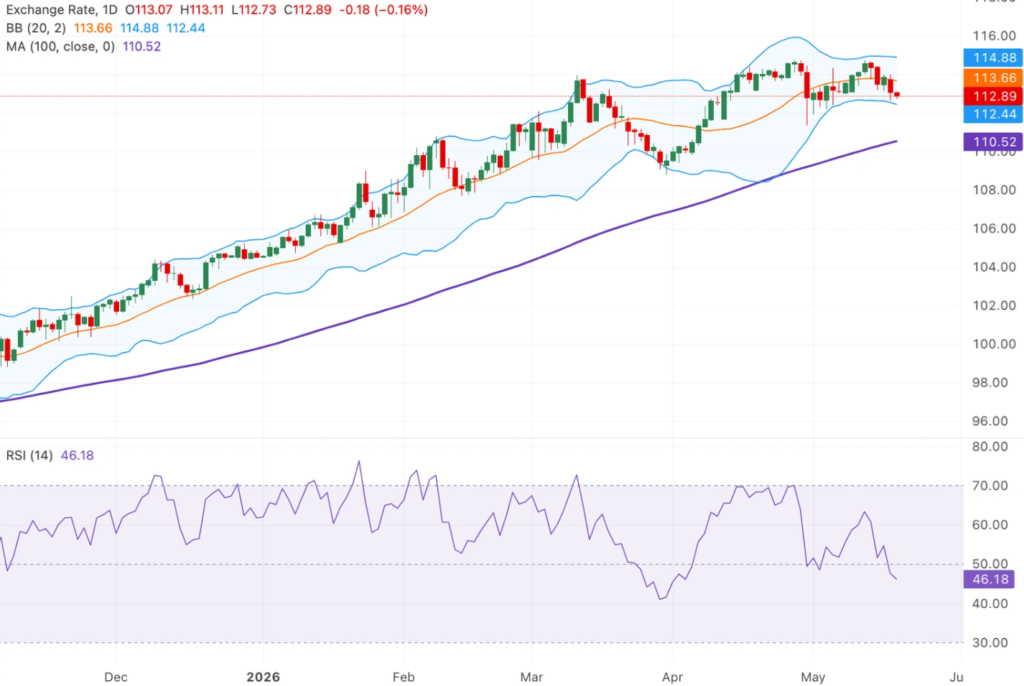
The Relative Strength Index (RSI) has softened to around 46, indicating that upside momentum has cooled. While this does not signal a trend reversal, it suggests that some short-term consolidation may occur before bulls regain traction. Traders should note that RSI values below 50 typically indicate a temporary pause in buying pressure, though the overall uptrend remains valid as long as key support levels hold.
Overall, the pair is in a healthy consolidation phase, and a break above the Bollinger middle band could trigger the next bullish leg. Conversely, a breach of key support could temporarily slow the uptrend, but the long-term bias remains constructive.
Resistance and Support Levels
For traders eyeing near-term movements, initial resistance emerges at 113.65, coinciding with the Bollinger middle band. Should bulls regain control, the upper Bollinger band near 114.88 represents a stronger barrier, potentially marking the next target if the pair resumes its upward trajectory.
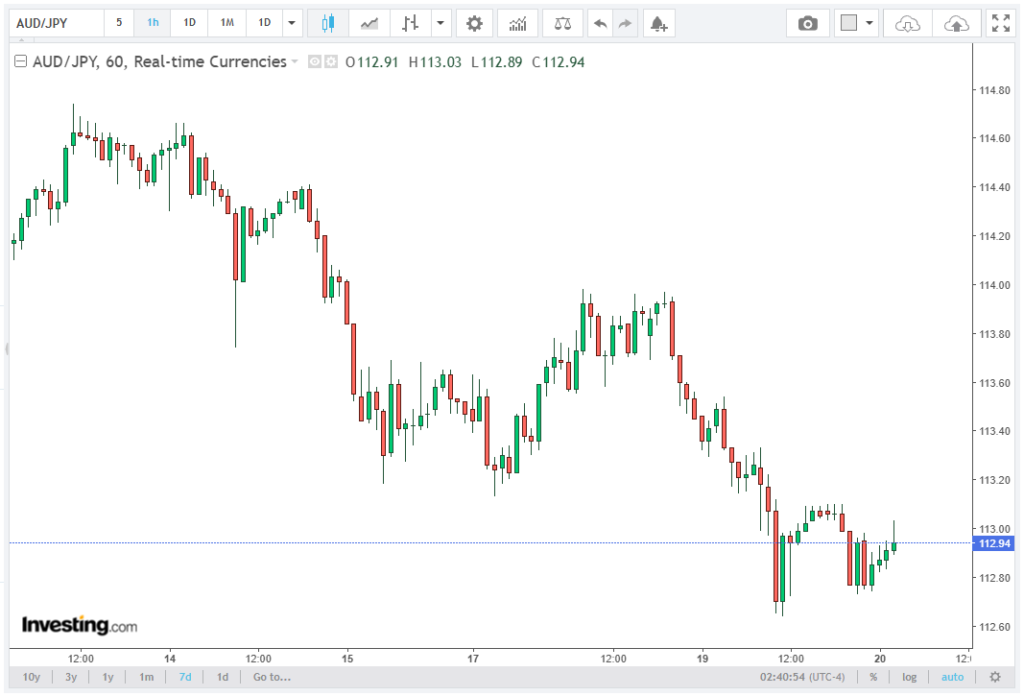
On the downside, immediate support is located at the lower Bollinger band around 112.45, followed by the March 13 low at 111.47, which has previously acted as a swing low. Beyond that, the 100-day SMA at 110.52 remains a critical longer-term support, helping to safeguard the broader bullish bias.
Market Sentiment and Outlook
Despite the minor setback below 113.00, the AUD/JPY cross continues to maintain a bullish vibe, supported by the underlying trend structure and technical indicators. The market is likely digesting the impact of Japan’s stronger GDP growth and RBA caution before committing to any major directional move.
Traders should remain attentive to risk sentiment, as global energy developments, geopolitical tensions, and central bank commentary could influence short-term volatility. The market’s reaction to these catalysts will likely determine whether the AUD/JPY pair consolidates in the 112.45–113.65 range or resumes a decisive upward trend.
Conclusion
In summary, AUD/JPY has softened to 112.90 during early European trading as the JPY benefits from stronger GDP data, while AUD upside remains capped amid RBA inflation concerns. Technical indicators suggest consolidation rather than a trend reversal, with key support levels at 112.45 and resistance at 113.65, followed by the upper band near 114.88.
For traders and investors, the broader bullish structure remains intact, implying that dips may continue to offer buying opportunities. The interplay between Japanese economic resilience, Australian monetary policy, and global risk factors will likely dictate the pair’s trajectory in the near term.


