
Introduction
More than 60% of North American restaurant operators report they can’t staff kitchens to meet customer demand. In major metro areas, a head chef commands $10,000 to $12,000 a month — a crushing expense where margins already sit razor-thin.
At the National Restaurant Association Show in Chicago, one booth consistently drew crowds. It featured a commercial cooking robot, and the visitors were seasoned owners who had been running Asian and cook-to-order stir-fry concepts for over a decade. They weren’t window-shopping. They were looking for a lifeline.
They watched as the robot dispensed ingredients, worked the wok, and plated dishes with precision. Some asked about NSF certification. Others brought menus, asking if the robot could reproduce their recipes. A Canadian operator cut to the point: “Do you have local support? If this goes down during dinner service, who do I call?”
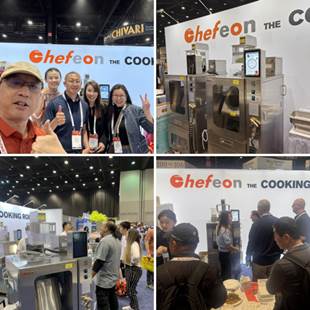
Fair questions. But zoom out — can a cooking robot actually solve what’s broken in the back of house?
The Old Kitchen Has a Problem — and It’s Global
For restaurant operators worldwide, the kitchen is where growth stalls first. Labor pressures, consistency challenges, and compliance headaches don’t care about geography — they hit every location, every service, every day.
A multi-unit operator with four restaurants across Europe described it bluntly: “I lost two head chefs in three months. The replacements couldn’t replicate our flavors. At this rate, we won’t survive.” Heads nodded. This wasn’t one person’s problem.
Problem One: The Chef Shortage Is No Longer Coming — It’s Here
U.S. Bureau of Labor Statistics data from 2025 shows chef vacancy rates above 12%, with work visa rejection rates for skilled culinary professionals approaching 30%. As of May 2026, full-service restaurant employment in the U.S. still trails pre-pandemic levels by 174,000 workers.
Fewer young people are choosing kitchen careers. Higher wages no longer pull like they used to. Operators aren’t asking “what will this cost us.” They’re asking “is anyone even available.”
Problem Two: Labor Costs Are Breaking the P&L
The National Restaurant Association’s 2026 report found 67% of U.S. operators rank rising labor costs and staffing shortages as their number-one pressure. Restaurants Canada data shows a head chef specializing in Asian cuisine commands C$90,000 to C$110,000 annually — compressing margins in an industry averaging 3 to 5% net profit.
By comparison, acquiring a commercial cooking robot in North America runs roughly three to four months of a head chef’s total cost of employment. After that: minor maintenance, zero salary negotiations, zero scheduling drama, zero turnover.
Problem Three: Food Safety and Consistency at Scale
Manual portioning creates cross-contamination risks no amount of training can eliminate. The NRA’s 2026 survey found 58% of multi-unit operators ranked kitchen consistency as their top operational hurdle. A single food safety citation in a major market can run into five figures.
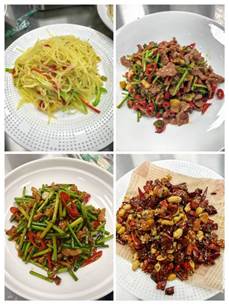
An intelligent cooking robot changes the equation: ingredient dispensing to the gram, cooking temperature and time captured digitally, recipes synced across locations with one click. The kitchen moves from “trust the chef” to “trust the system.”
Problem Four: The Hidden Costs Eating Your Margins
Low throughput is a direct revenue killer for cook-to-order stir-fry operations. When tickets stack up during peak hours and wait times climb, customers walk. The old answer — more burners, more cooks — just recycles the same staffing crisis.
ReFED’s 2025 U.S. Food Waste Report estimates full-service restaurants waste 5.76 million tons of food annually, 75% still perfectly edible. Most operators don’t track this. They notice it only when the books don’t close at month’s end.
A commercial cooking robot can produce dozens of dishes per hour — several times the output of a manual station — while tightening ingredient precision to noticeably reduce waste. More covers during peak hours. Less food discarded.
No technology is a universal fix. Tasting-menu concepts, chef-driven fine dining, and restaurants where chef artistry is the product itself are less suited to automation. Vegetable carving, intricate plating, and improvisational dishes remain in human hands — for now.
Why Restaurant Operators Are Paying Attention
Whatever reservations remain, the direction of travel is clear. Kitchen automation is one of the fastest-growing segments in North American foodservice.
QYResearch’s 2025 Global Commercial Intelligent Cooking Machine Industry Report valued the market at approximately $1.24 billion in 2024, projecting $3.82 billion by 2031 — a CAGR of 17.5%.
The NRA’s 2026 report shows 38% of U.S. operators now plan to invest in kitchen automation within 12 months. In 2023, that figure was 17%. The conversation has shifted from “if” to “which one” — and “what happens after I buy it.”
What owners actually need to know: Are competitors already using these? Will the equipment pass inspection? Who handles support when something goes wrong?
North America: Turning Instability into Measurable ROI
The math is straightforward. With a Canadian head chef costing C$90,000 to C$110,000 annually, a single robot costs roughly 2.5 to 4 months of that. Net annual savings typically land between C$60,000 and C$80,000 per unit, with payback in under 12 months.
For a bakery operator in a North American mall, ventilation constraints made wok cooking impossible. Adding a robot flipped the model: the store went from bakery to full quick-service line in under a week, adding a new revenue stream without relocating.
At a Toronto tasting event, guests couldn’t tell robot-prepared from chef-prepared stir-fry. Cook time: roughly two minutes per dish. The operator hasn’t hired a head chef in months.
Europe: Solving Flavor Drift and Staff Instability
Results tell the story. iFOOD cut ingredient waste by 30%, with one operator now managing four machines — a 400% gain in labor efficiency and a 15% drop in operating costs. M-WOK’s customer ratings reached 4.8, while store-level expenses fell roughly 40%.
Japan: Precision Without the Hiring Headache
The head of a Tokyo restaurant group was candid: “We simply couldn’t find qualified chefs. The robot changed that.” Signature dishes now ship consistently. Repeat customer rates climbed. Expansion plans, once stalled by staffing, are back on track.
The Certification Question: “Will This Actually Pass Inspection?”
North American compliance standards are not optional. NSF certification is the hard gate — fail it and you’re looking at fines, shutdowns, and reputational damage. ETL and FCC are non-negotiable for electrical and electromagnetic compliance. In Canada, CSA certification can be mandatory at the provincial level.
Very few manufacturers hold the full certification stack. Chefeon is in that small group: NSF International certified, plus ETL and FCC, with support for 208V–220V North American power. The robot also carries EU CE, UK UKCA, Australia RCM, and Japan PSE/TELEC — clearing customs, health, and liability hurdles across markets.
The Support Question: “Who Answers the Phone at 7 PM on a Friday?”
Chefeon has built the first dedicated local agency network in North America, covering the U.S. East Coast, West Coast, and Canada. A network of 5,000 global service stations spans core North American regions, with local agents handling on-the-ground issues. Cloud-based remote monitoring resolves most problems without shipping hardware across borders.
Beyond the Kitchen: What Automation Unlocks
When the kitchen stops being a bottleneck, the impact ripples across the entire business — from supply chain to brand expansion to market entry strategy.
At the industry level, the shift is structural: the kitchen moves from a craft-dependent, person-bound function to a standardized, scalable operation. Cooking becomes a system, not an art form living in one person’s head.
When cooking parameters are locked digitally, everything upstream and downstream aligns. Suppliers standardize to the system’s specs. New locations no longer depend on finding and training a kitchen brigade — they depend on plugging in equipment and loading a recipe file.
At the operator level, the impact hits three levers at once: lower costs, higher revenue, and a stronger brand.
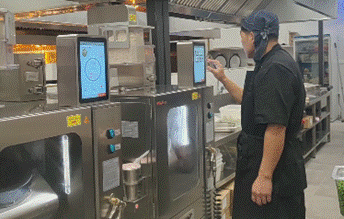
Costs fall when you’re no longer competing for talent in an overheated labor market. Revenue rises because consistent quality drives repeat traffic and supports multi-unit expansion. Brand strength grows because every location delivers the same experience — the foundation of any franchise play.
At the global level, intelligent cooking automation unshackles operators from geography. Expansion no longer means “find a chef willing to relocate.” It means “deploy the system.”
When scaling shifts from recruiting people to replicating parameters, borders become less relevant. North America, Europe, Southeast Asia — with the right equipment and calibrated recipes in place, a location can launch in weeks instead of months, hitting brand standards from day one.
In Closing
For restaurant operators navigating today’s labor market, an intelligent cooking system delivers value that goes far beyond the equipment itself. It turns the kitchen from a constraint into a competitive advantage — replicable, scalable, and no longer dependent on who shows up.
Chefeon is among the few companies delivering this kitchen-as-a-system model at production scale — a claim backed by its certification portfolio, global case studies, and operators who have already made the switch.
Choosing Chefeon means choosing a partner that scales with your business.


