
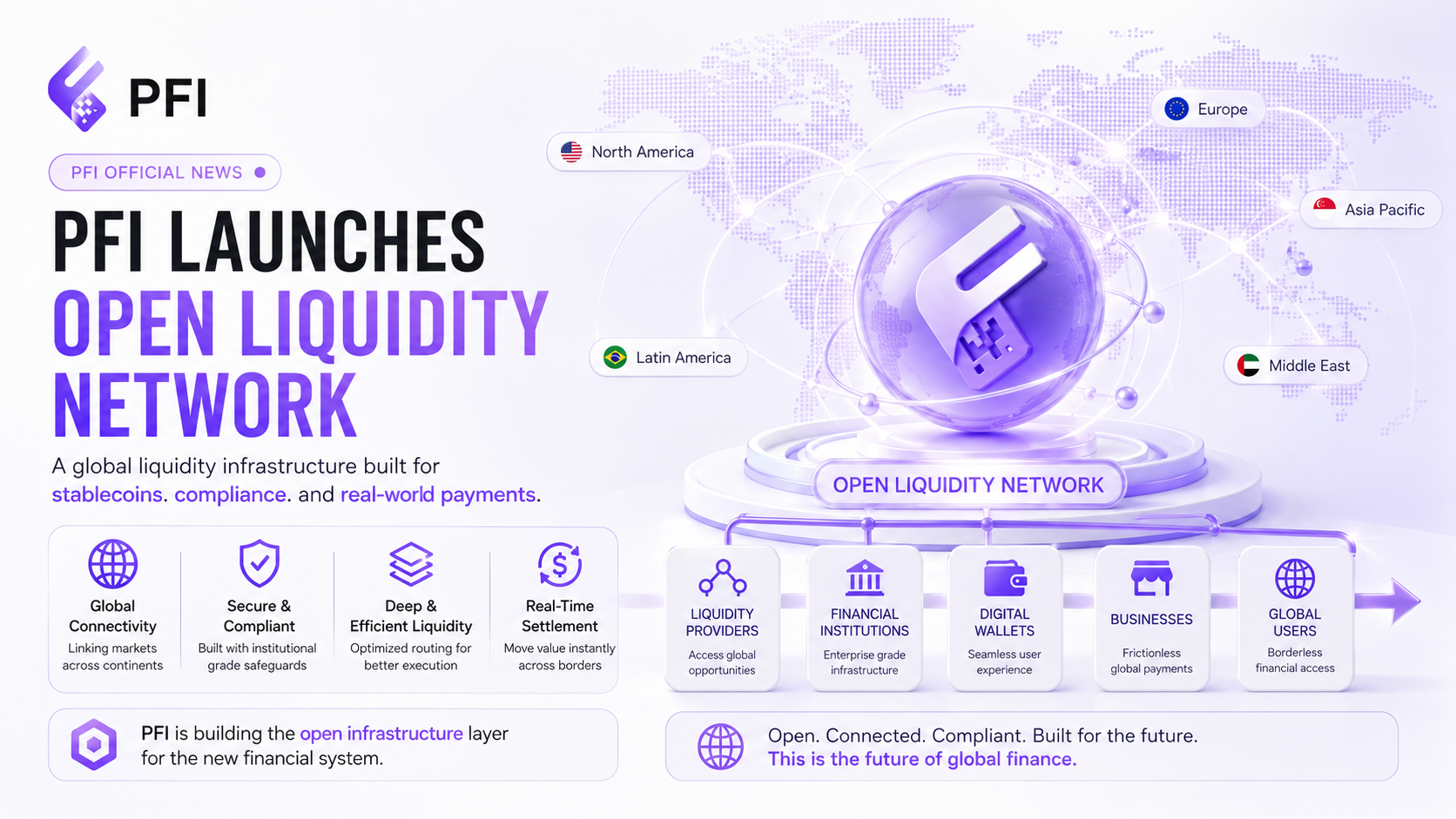
PFI’s infrastructure model connects liquidity, transaction demand, foreign exchange, clearing and settlement while supporting emerging PayFi applications.
August 2026 — PayFi International Ltd has introduced its Open Liquidity Network as part of its wider strategy to develop cross-border clearing and settlement infrastructure.
The network is designed to connect liquidity providers, transaction demand, foreign exchange execution and settlement processes through a structured operating model.
As global payments become increasingly digital, payment platforms must support more than fast transaction initiation. Stablecoins, digital wallets and emerging PayFi applications still require access to liquidity, currency conversion, clearing and reliable settlement before transactions can be completed across different markets.
PFI’s Open Liquidity Network is intended to organise these processes within a connected cross-border financial network.
Building Infrastructure for Modern Payments
PayFi connects digital assets and blockchain-based payment technologies with real-world payment activity and financial services.
However, transferring a digital asset does not automatically complete the full payment process. Transactions may still require:
- Fiat currency access
- On-ramp and off-ramp connectivity
- Foreign exchange conversion
- Liquidity coordination
- Transaction verification
- Clearing
- Final settlement
PFI positions its Open Liquidity Network as part of the backend infrastructure required to support these processes and future PayFi use cases.
Rather than operating only as a payment interface, PFI positions itself as a Liquidity Network, Cross-Border Clearing and Settlement Infrastructure.
From Fragmented Liquidity to a Connected Network
Liquidity within the global financial system is often separated across different currencies, institutions, payment channels and settlement environments.
This fragmentation can increase transaction costs, slow execution and make expansion into additional markets more difficult.
PFI’s Open Liquidity model is intended to connect available liquidity with real transaction demand across different cross-border corridors.
Its structure focuses on three priorities:
- Connecting liquidity with payment transaction demand
- Reusing liquidity across multiple transaction corridors
- Supporting more efficient foreign exchange, clearing and settlement
The objective is to turn liquidity from isolated capital into a reusable network capability.
This connected structure can also support PayFi platforms that require dependable liquidity and settlement infrastructure for real-world payment activity.
PFI’s Corridor-Based Operating Model
A central feature of PFI’s Open Liquidity Network is its corridor model.
Instead of placing liquidity into one general capital pool, PFI organises the transaction process into reusable corridor units.
A corridor may include:
- Fund entry
- Liquidity support
- Quotation and execution
- Cross-border conversion
- Clearing
- Settlement return
- Network expansion
According to PFI’s corporate materials, this structure is intended to support different regional and multi-currency transaction scenarios while maintaining clearer transaction boundaries and traceability throughout the settlement cycle.
New currencies, payment routes and transaction scenarios may be connected as the wider network develops.
Supporting the Future of Cross-Border Payments
Stablecoins and digital payment technologies are creating new ways for value to move across borders.
However, their practical use depends on infrastructure capable of connecting digital assets with local currencies, payment institutions, liquidity providers and settlement channels.
As PayFi develops, this connection between digital assets and real-world financial activity will become increasingly important.
PFI’s Open Liquidity Network is designed to bring together:
- Traditional fiat currencies
- Stablecoins and digital dollars
- Payment and PayFi platforms
- Liquidity participants
- Foreign exchange execution
- Clearing and settlement partners
PFI’s materials state that liquidity is focused on foreign exchange, delivery and settlement operations rather than directional speculation on currency movements. The model also emphasises transparency in how liquidity is used, allocated, released and returned.
Foundation for Wider Ecosystem Development
PFI does not present Open Liquidity as a standalone financial product.
Instead, it is positioned as the infrastructure foundation for the company’s wider payment, PayFi and financial ecosystem strategy.
By connecting liquidity with transaction demand, PFI aims to support more efficient capital movement across different currencies and financial systems.
As the network expands, the same underlying infrastructure may support additional payment corridors, settlement routes, PayFi applications and financial services.
About PayFi International Ltd
PayFi International Ltd develops liquidity, cross-border clearing and settlement infrastructure intended to connect digital assets, payment demand, financial institutions and global transaction networks.
The company’s broader strategy includes the development of its Open Liquidity Network, Stablecoin Aggregator Ecosystem, Super Payment App Ecosystem and long-term capital market direction.
Media Contact
Company Name: PayFi International Ltd
Contact Person: Daniel Whitmore
Email: admin@pfi-main.com
Website: https://pay-fi.vip/
Based in: Colorado, USA
Country: United Arab Emirates


