
Gold markets have recently struggled to maintain upward momentum despite heightened geopolitical tensions and continued risk aversion across global financial markets. Economic specialists at EPIQUI explain that the precious metal is currently facing competing forces, as rising inflation expectations and a strengthening US Dollar reduce the traditional appeal of gold as a defensive asset.
During the past two weeks, Gold (XAU/USD) recorded consecutive weekly declines, signaling that the metal’s strong rally earlier in the year may be losing traction. Investors are now closely monitoring Federal Reserve policy decisions, updated economic projections, and developments surrounding the Middle East conflict, all of which could influence short term price movements.
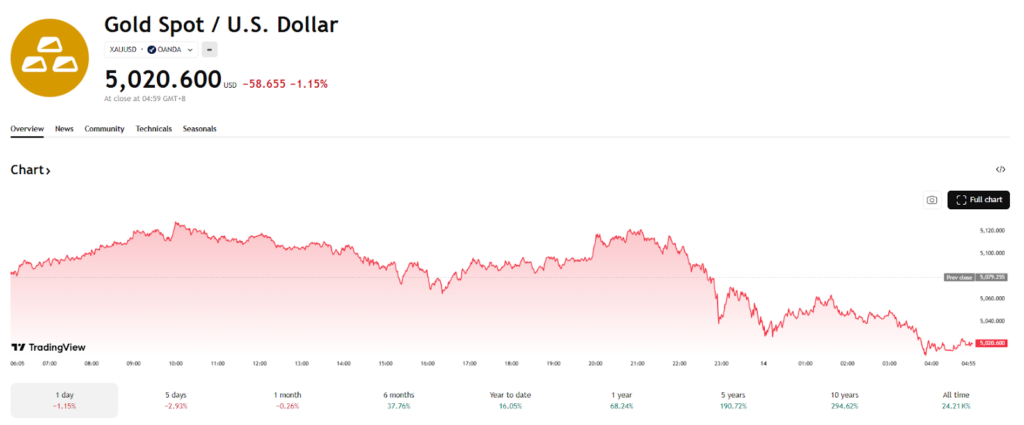
Recent trading has shown gold struggling to maintain gains as the US Dollar strengthened amid growing expectations that interest rates could remain elevated for longer.
Geopolitical Developments Create Volatility In Commodity Markets
Global markets began the week with heightened volatility as new developments emerged from the Middle East conflict. Diplomatic signals and military developments have continued to influence both energy and precious metal markets.
Iran’s leadership recently indicated a willingness to avoid further escalation unless directly provoked, while several regional governments have taken precautionary measures to stabilize energy markets.
At the same time, several oil producing nations including the United Arab Emirates, Kuwait, and Iraq announced reductions in production levels due to logistical concerns linked to potential disruptions in the Strait of Hormuz, one of the world’s most critical oil transportation routes.
These developments initially triggered a surge in energy prices, though the rally later moderated after the International Energy Agency considered releasing emergency reserves among its member countries to stabilize global supply.
Temporary Optimism Supports Short Lived Gold Rebound
Gold managed to post modest gains during midweek trading as investors briefly became more optimistic about the possibility of de escalation in the conflict.
The metal advanced by roughly 1 percent on Tuesday, supported by comments suggesting that military operations could potentially slow or stabilize in the near term.
However, optimism proved temporary as geopolitical tensions continued to evolve and energy markets remained volatile.
Gold fluctuated around $5,200 during midweek trading, reflecting the delicate balance between risk sentiment and currency dynamics.
Inflation Data Reinforces Strong Dollar Environment
Economic data released during the week provided additional context for market expectations surrounding inflation and monetary policy.
The US Consumer Price Index held steady at 2.4 percent year over year, meeting analysts’ expectations and suggesting that inflation remains persistent but relatively stable.
On a monthly basis, core CPI increased by 0.2 percent, excluding volatile food and energy prices.
Meanwhile, global energy developments continued to influence inflation expectations. The International Energy Agency announced that its 32 member countries could release up to 400 million barrels of oil from strategic reserves, an effort aimed at preventing further disruptions to global energy supply.
Labor Market Signals Add Additional Policy Uncertainty
Recent labor market data has also contributed to uncertainty surrounding the Federal Reserve’s policy decisions.
The latest employment report showed that Nonfarm Payrolls declined by 92,000 jobs in February, raising concerns about potential weakness in the labor market.
Investors will therefore closely examine remarks from Federal Reserve Chair Jerome Powell following the policy announcement.
If Powell emphasizes that inflation risks remain the central bank’s primary concern, markets may expect policymakers to maintain restrictive policy conditions for longer.
Alternatively, if the Federal Reserve signals greater concern about labor market stability, gold could regain some strength as expectations for future rate cuts reemerge.
Technical Indicators Suggest Loss Of Bullish Momentum
From a technical standpoint, recent price action indicates that gold’s upward momentum has weakened.
The metal recently closed below its 20 day Simple Moving Average, a signal that short term buyers may be losing conviction.
Momentum indicators also show fading strength. The Relative Strength Index moved toward the 50 region, suggesting a neutral to slightly bearish technical environment.
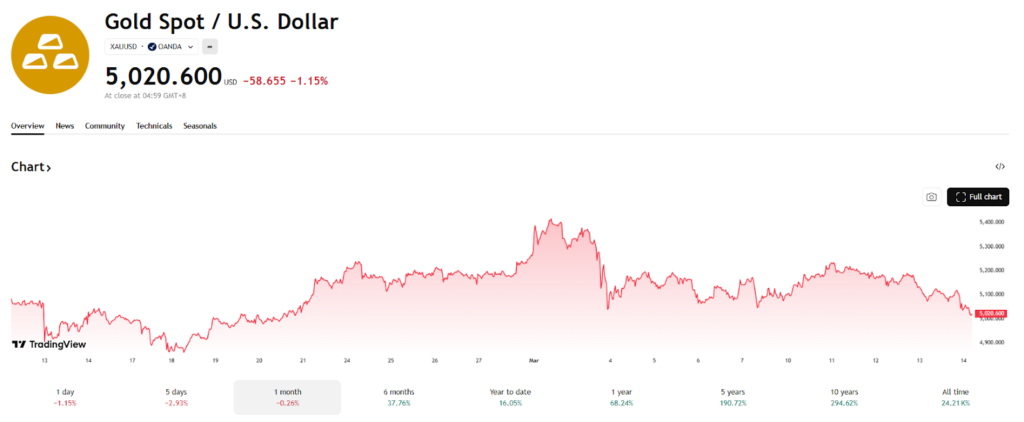
A key pivot zone currently sits between $5,100 and $5,120, where the Fibonacci 23.6 percent retracement of the November to February rally aligns with the 20 day moving average.
If prices remain below this area, gold may continue to face selling pressure.
Important Price Levels Traders Are Watching
Technical traders are now monitoring several critical support and resistance zones.
The first downside support level appears near $4,945, which corresponds with the 50 day Simple Moving Average.
Below that level, the next support area emerges around $4,875, representing the Fibonacci 38.2 percent retracement of the broader uptrend.
A deeper decline could expose the ascending trend line near $4,800, which has acted as an important support level during previous pullbacks.
On the upside, the first resistance level is located near $5,200, followed by a stronger barrier near $5,400.
Beyond that level, the all time high near $5,598 remains the most significant resistance point for bullish traders.


