
Currency markets are entering a volatile period as geopolitical tensions and inflation concerns reshape expectations for global monetary policy. The EUR/USD currency pair has weakened toward multi month lows, reflecting strong demand for the US Dollar during periods of rising uncertainty.
Forex analysts at EPIQUI note that the combination of escalating geopolitical conflict, rising oil prices, and key central bank decisions could significantly influence currency movements in the coming sessions.
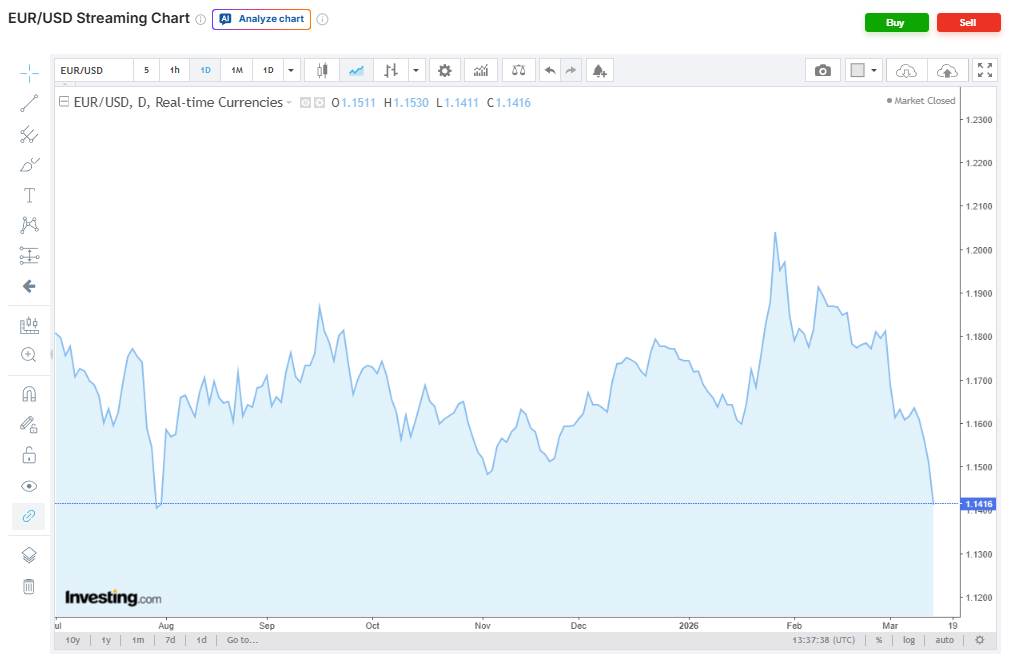
The pair recently declined toward the 1.1430 region, marking one of its lowest levels of 2026, as investors increased exposure to the US Dollar amid global risk aversion.
Geopolitical Conflict Drives Risk Aversion In Global Markets
Financial markets have been increasingly influenced by developments surrounding the expanding conflict in the Middle East. Rising tensions in the region have created uncertainty across commodities, currencies, and equity markets.
The confrontation has intensified following military actions involving the United States and Israel targeting Iranian nuclear infrastructure, which triggered a swift response from Iran and expanded hostilities across the region.
One of the most critical developments involves the Strait of Hormuz, a strategic waterway responsible for transporting a substantial portion of global oil exports.
Iran has threatened to maintain control of the passage, raising fears of prolonged supply disruptions. This situation has pushed crude oil prices sharply higher.
During the latest surge in energy markets, Brent crude exceeded $100 per barrel, while West Texas Intermediate climbed above $90 per barrel.
Central Bank Meetings Become Key Market Catalyst
The upcoming monetary policy decisions from both the Federal Reserve and the European Central Bank represent the most significant scheduled events for currency markets this week.
The Federal Reserve is expected to announce its latest policy decision on Wednesday, while the European Central Bank will release its decision on Thursday.
Economists broadly anticipate that both central banks will maintain current interest rate levels, though investors will closely examine updated economic projections and policy commentary.
Particular attention will be given to remarks from Federal Reserve Chair Jerome Powell and European Central Bank President Christine Lagarde, as policymakers assess how rising energy prices may influence future inflation trends.
Technical Indicators Suggest Continued Downward Bias
From a technical perspective, recent price action indicates that the EUR/USD pair remains under selling pressure.
On the daily timeframe, the pair has fallen below the 20 day Simple Moving Average located near 1.1700, signaling weakening upward momentum.
The 100 day Simple Moving Average, also positioned close to 1.1700, is currently converging with the shorter term average, reinforcing this region as a strong resistance area.
Meanwhile, the 200 day Simple Moving Average remains only slightly below those levels and is showing limited directional strength.
Weekly Chart Reflects Strong Bearish Momentum
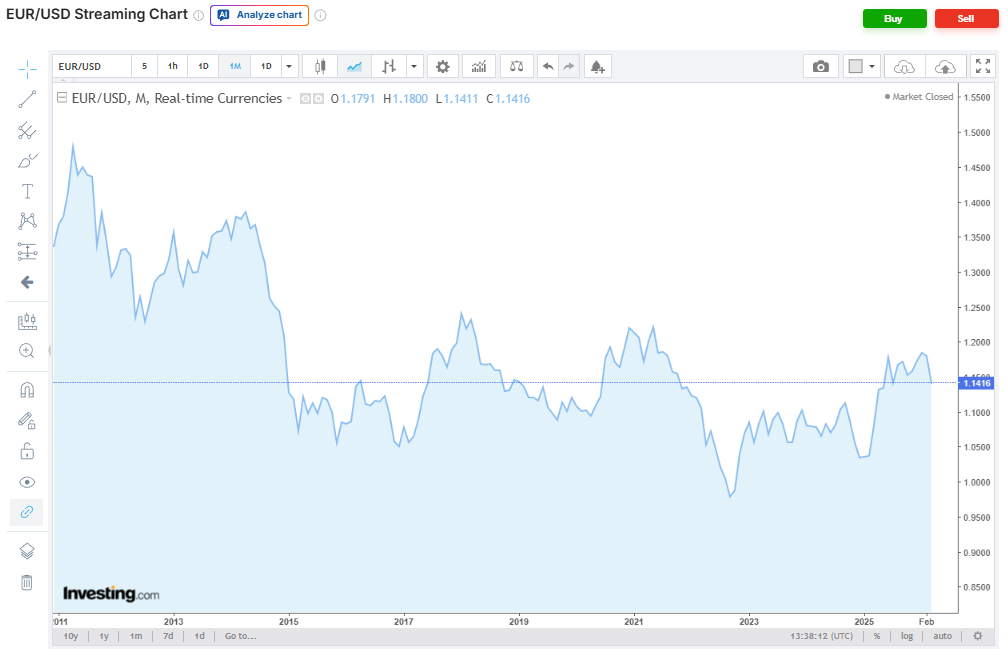
On the weekly chart, EUR/USD has recorded two consecutive weeks of sharp declines, highlighting the strength of the current downward move.
The pair has slipped below the 20 week Simple Moving Average near 1.1700, transforming what was previously support into a new resistance zone.
Despite this weakness, the pair continues to trade above the longer term 100 week and 200 week moving averages, which means the broader trend remains moderately constructive even as short term momentum deteriorates.
Weekly momentum indicators have moved into negative territory, while the Relative Strength Index is approaching the 40 region, signaling growing control from sellers.
Key Price Levels Traders Are Monitoring
Market participants are now focusing on several important technical levels that could shape near term currency movements.
Immediate resistance appears near 1.1600, which previously acted as the floor of a consolidation range. Above that level, the cluster of moving averages around 1.1700 represents a stronger resistance barrier.
If the pair manages to close above 1.1700 on a weekly basis, it could ease the current bearish pressure and reopen the path toward the 1.1850 region, where recent highs were recorded.
On the downside, traders are monitoring the 1.1400 level as the first major support zone.
A sustained move below 1.1300 would significantly weaken the technical structure and could expose the next support region near 1.1200, where the rising 100 week moving average may attract renewed buying interest.
Financial Markets Face Heightened Macro Pressures
The current environment highlights how geopolitical developments, inflation dynamics, and monetary policy expectations can interact to shape currency markets.
Rising energy prices, ongoing conflict in the Middle East, and evolving central bank strategies are all contributing to heightened volatility across global financial markets.
For the EUR/USD pair, the coming days may prove pivotal as investors digest central bank decisions, updated economic projections, and further geopolitical developments.
These evolving conditions will likely influence the short to medium term trajectory of the currency pair, particularly if inflation pressures remain elevated and global risk sentiment continues to fluctuate.


