
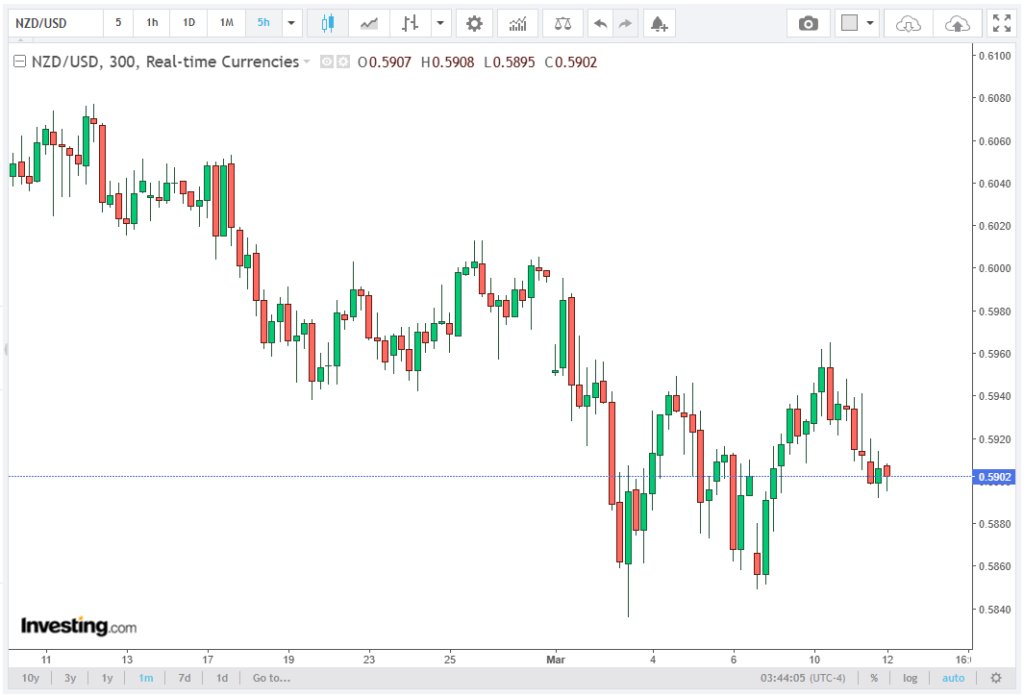
The NZD/USD currency pair weakened sharply, trading near 0.5900 during the Asian session on Thursday, marking the third consecutive day of declines. The pair’s losses are primarily driven by a stronger US Dollar (USD), elevated energy prices, and increasing geopolitical tensions in the Middle East. In this article, the brokers at EPIQUI outline the key aspects of this topic with a detailed explanation.
Investors have grown increasingly risk-averse, favoring the USD as a safe-haven asset amid rising uncertainties. The escalation of conflicts in the Middle East has further dampened sentiment toward riskier currencies like the New Zealand Dollar (NZD), which remains under pressure.
US Dollar Strength Boosted by Rising Energy Prices
The USD has gained strength in recent sessions, fueled by a surge in energy prices that has raised inflationary concerns. Higher oil and gas prices tend to push overall consumer prices higher, increasing expectations that the Federal Reserve (Fed) may maintain current interest rates for longer.
At present, the US Dollar Index (DXY), which tracks the USD against a basket of six major currencies, is trading near three-month highs, hovering around 99.50. This underscores the growing preference among traders for the USD as geopolitical risk intensifies and commodity price pressures mount.
The market is now turning its attention to upcoming US Personal Consumption Expenditures (PCE) data due on Friday. Traders are looking for fresh monetary policy cues that could influence the trajectory of the USD and broader FX markets.
US Inflation Data Shows Steady Pressure
Recent US Consumer Price Index (CPI) data released on Wednesday indicated inflation rose 0.3% month-over-month (MoM) in February and 2.4% year-over-year (YoY), largely in line with market expectations. Core CPI, which excludes volatile food and energy components, increased 0.2% MoM and 2.5% YoY.
These relatively steady figures suggest that the US economy is experiencing manageable price pressures, reducing fears of a sudden inflation spike. Analysts interpret this as a signal that the Federal Reserve may continue to hold interest rates steady in the near term, rather than implementing aggressive hikes or cuts.
However, it is important to note that the latest CPI report does not yet fully account for the recent surge in oil prices, which have been exacerbated by the Middle East crisis. This means that inflation expectations may need to be recalibrated in the coming weeks.
NZD Under Pressure Amid Global Uncertainty
The New Zealand Dollar continues to face downward pressure as investors adopt a cautious stance amid escalating Middle East tensions. The NZD/USD pair’s decline is not solely a reflection of USD strength, but also of broader concerns about global growth and risk sentiment.
Rising energy prices are particularly concerning for New Zealand, as they could lead to more persistent domestic inflationary pressures. Analysts are increasingly forecasting that the Reserve Bank of New Zealand (RBNZ) may adopt a more hawkish stance, potentially implementing additional monetary tightening measures to combat inflation.
These dynamics suggest that the NZD is likely to remain under pressure in the short term, especially if geopolitical uncertainties continue to push investors toward safe-haven currencies like the USD.
Technical Outlook for NZD/USD
From a technical perspective, the NZD/USD is trading near the 0.5900 support level, which is a key area for short-term traders. A sustained break below this level could open the door to further declines toward the 0.5850 region.
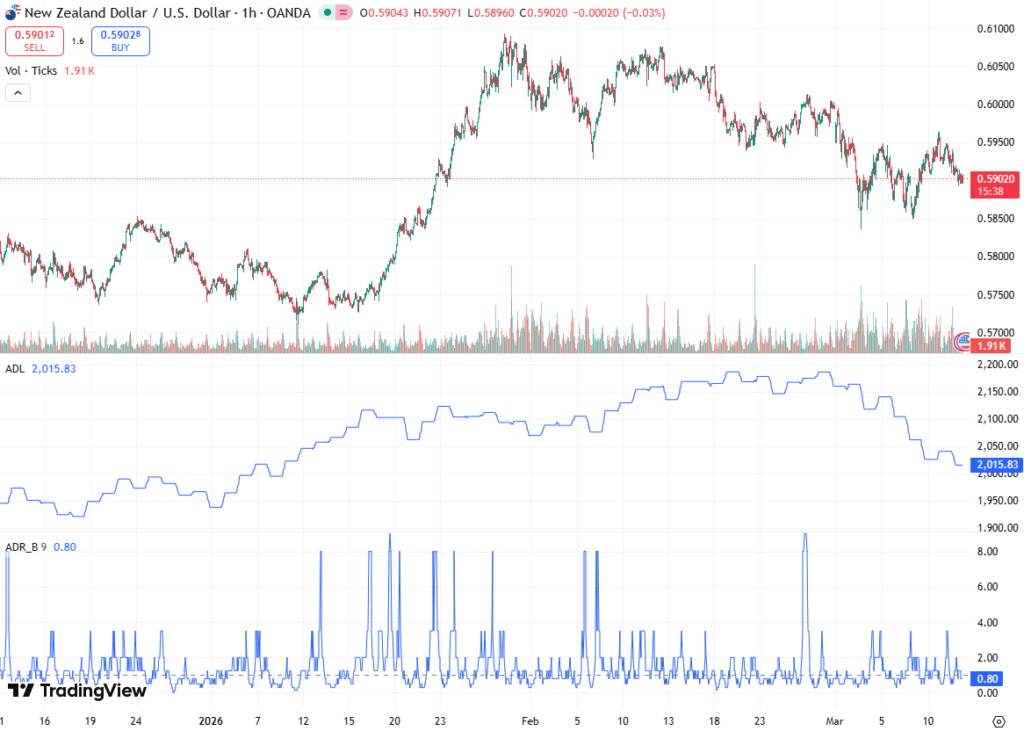
Resistance for the pair remains near 0.5950–0.5980, where selling pressure may intensify if the USD continues to strengthen. Traders are advised to monitor volatility in energy prices, US inflation data, and Middle East developments, as these factors are likely to influence the NZD/USD trend in the near term.
Market Implications
The combination of a strong USD, rising energy prices, and heightened geopolitical risk has reinforced the risk-off sentiment in currency markets. Investors are currently favoring safe-haven assets, with the USD, Japanese Yen (JPY), and Swiss Franc (CHF) benefiting from inflows.
For the NZD, the outlook remains challenging, as persistent inflation risks and global uncertainty weigh on the currency. Analysts suggest that the RBNZ may need to maintain a tight monetary policy, even as external factors like commodity price shocks continue to challenge New Zealand’s economic stability.
Conclusion
In summary, the NZD/USD pair has fallen to around 0.5900, reflecting the broader market dynamics of a strong USD, elevated energy prices, and increasing risk aversion due to the Middle East war.
Investors should keep a close eye on upcoming US PCE data, oil price movements, and ongoing geopolitical developments, as these factors will continue to drive FX market volatility. With the NZD remaining under pressure and the USD near three-month highs, short-term traders are likely to see continued market swings in the NZD/USD pair.


