
Gold (XAU/USD) edged lower for the second consecutive session on Thursday, though the downside remained limited as the market lacked strong follow-through selling pressure. The precious metal entered the European trading session maintaining a negative bias, yet continued to hold above key technical support levels, suggesting that bearish momentum remains restrained. The brokers at EPIQUI share an in-depth analysis of this topic in the article below.
The latest pullback in Gold prices is largely linked to reduced expectations for near-term interest rate cuts by the U.S. Federal Reserve (Fed). Investors are reassessing the timing of potential monetary easing as renewed inflation concerns begin to emerge in global markets. As a result, U.S. Treasury bond yields have moved higher, strengthening the U.S. Dollar (USD) and creating headwinds for non-yielding assets such as Gold.
Despite the downward drift, the market environment still contains multiple risk-supportive elements for Gold, including heightened geopolitical tensions and uncertainty in global energy markets, which continue to sustain safe-haven demand.
Rising Oil Prices Revive Global Inflation Concerns
One of the primary drivers behind the shift in market sentiment has been the sharp rise in Crude Oil prices, which has reignited concerns that inflation pressures could reaccelerate. Energy markets have rallied strongly in recent sessions, with Crude Oil prices climbing more than 6% amid fears of supply disruptions in the Middle East.
Higher energy prices are particularly important because they have the potential to reverse recent progress in reducing global inflation rates. Even though the U.S. Consumer Price Index (CPI) showed signs of moderation, markets remain wary that energy-driven inflation shocks could force central banks to maintain restrictive monetary policy for longer.
This concern was reinforced by International Monetary Fund (IMF) Managing Director Kristalina Georgieva, who warned that a sustained 10% increase in Oil prices over a year could lift global inflation by roughly 40 basis points. Such an outcome would likely delay interest rate cuts, particularly in the United States.
Rising Treasury Yields Strengthen the U.S. Dollar
The shift in interest rate expectations has already begun to influence U.S. fixed-income markets. Treasury bond yields have moved higher in recent sessions as traders reduce their bets on aggressive monetary easing in 2026.
When yields rise, they typically strengthen the U.S. Dollar, as global investors seek higher returns in U.S. government bonds and other dollar-denominated assets. The USD has therefore extended its upward momentum for a third consecutive day, adding further pressure on Gold prices.
Because Gold is priced in U.S. Dollars, a stronger currency makes the metal more expensive for holders of other currencies, thereby reducing international demand.
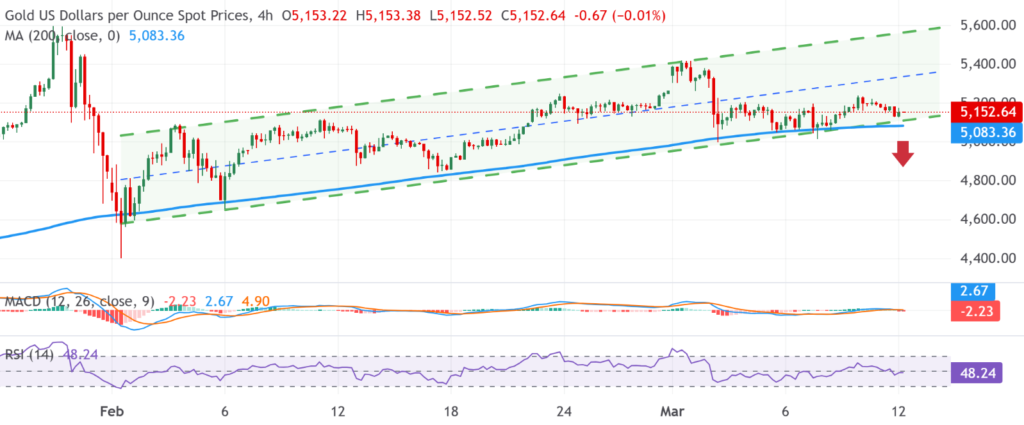
Technical Analysis: Gold Defends Key Trend Support
From a technical perspective, Gold remains within a broader bullish structure, despite the recent pullback.
The XAU/USD pair is currently trading above the upward-sloping 200-period Simple Moving Average (SMA) on the 4-hour chart, located near $5,083, which acts as a critical support level. This level also aligns with the lower boundary of an ascending price channel, reinforcing the broader uptrend structure.
Momentum indicators present a mixed but still constructive picture. The Moving Average Convergence Divergence (MACD) histogram has eased from its recent highs but remains in positive territory, suggesting that the market is experiencing cooling momentum rather than a full reversal.
Meanwhile, the Relative Strength Index (RSI) is hovering slightly below 50, indicating neutral momentum with a mild bullish bias, which suggests that while buying pressure is not dominant, the market still retains some upside potential.
As long as Gold remains above $5,116, dips may continue to attract buying interest, maintaining the medium-term bullish outlook. However, failure to break above $5,200 could keep the metal trading sideways within a consolidation range.
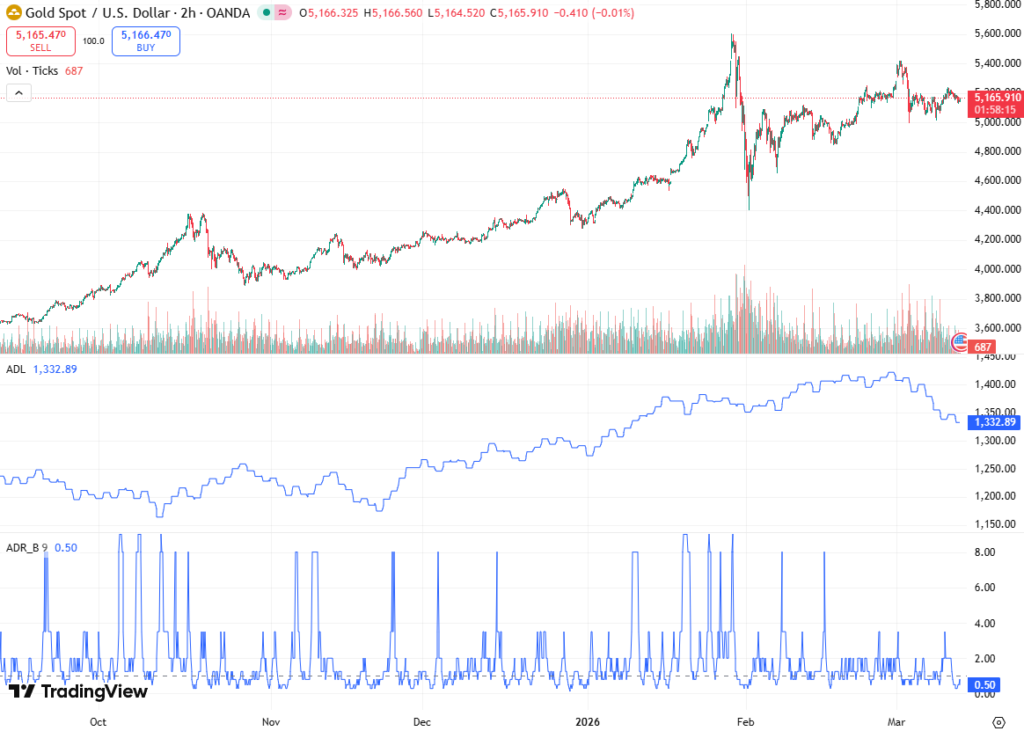
Outlook: Gold Caught Between Yields and Geopolitical Risk
In the near term, Gold prices are likely to remain highly sensitive to three major forces. The first is U.S. interest rate expectations, as changes in anticipated rate cuts or hikes from the Federal Reserve can significantly influence gold’s attractiveness compared to interest-bearing assets.
The second factor is energy-driven inflation risks, particularly if rising oil or energy costs push overall inflation higher, which often strengthens gold’s appeal as an inflation hedge. Finally, geopolitical developments in the Middle East may also play a crucial role, since escalating tensions or instability in the region typically increase demand for safe-haven assets like gold.
If bond yields and the U.S. Dollar continue to rise, Gold may face further downside pressure. However, persistent geopolitical instability and inflation uncertainty could limit declines and maintain strong underlying demand for safe-haven assets.
As a result, the precious metal may remain in a volatile consolidation phase until clearer signals emerge regarding global inflation trends and the Federal Reserve’s next policy move.


