
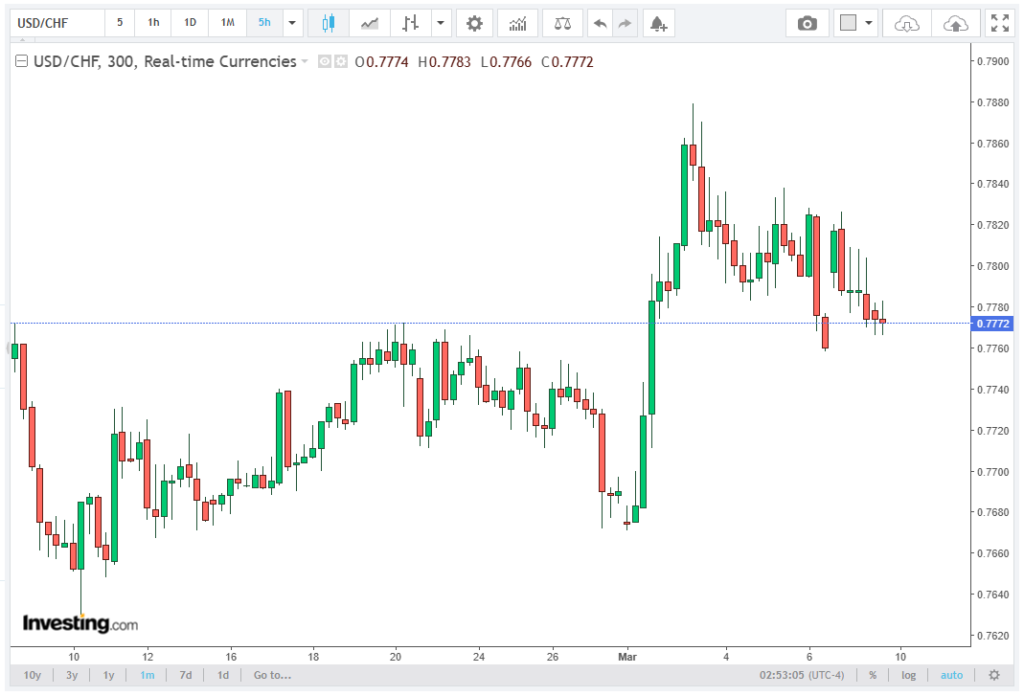
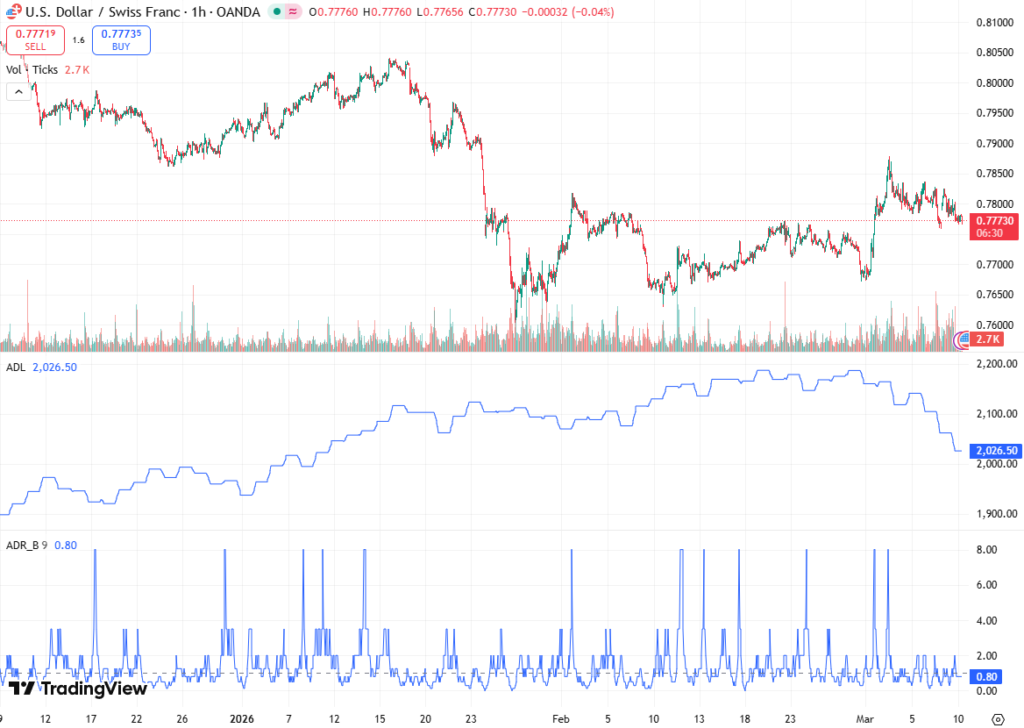
The USD/CHF currency pair edged higher during Asian trading hours on Tuesday, stabilizing near the 0.7800 level after experiencing two consecutive sessions of losses. The pair traded around 0.7780, supported by a modest rebound in the US Dollar (USD) following a sharp intraday decline in the previous session. The brokers at TibiPro explore this topic in detail throughout the article.
Market participants observed that the Greenback regained some footing as traders reassessed geopolitical developments and risk sentiment. The recent volatility in global financial markets had previously boosted demand for safe-haven currencies, including the Swiss Franc (CHF). However, optimism surrounding a possible resolution to the Iran conflict has temporarily eased those defensive flows.
Despite the mild recovery, analysts note that the USD/CHF pair remains under pressure overall, as the Swiss Franc continues to benefit from its safe-haven status during periods of geopolitical uncertainty and financial instability.
Easing Geopolitical Tensions Reduces Safe-Haven Demand
One of the main drivers behind the recent movement in USD/CHF has been the shifting geopolitical narrative in the Middle East. The US Dollar weakened earlier as markets interpreted signs of potential de-escalation in the Iran conflict, reducing the immediate need for traditional safe-haven assets.
The US President indicated that the war with Iran could end “very soon,” signaling a potential diplomatic breakthrough. His comments came amid growing economic and political pressures, particularly as global oil markets experienced heightened volatility in recent days.
Energy markets have played a crucial role in shaping investor sentiment. The sharp fluctuations in crude oil prices have contributed to broader risk-off and risk-on shifts across financial markets. When fears of escalation in the Middle East intensified, investors moved aggressively into defensive currencies such as the Swiss Franc, Japanese Yen, and Gold. However, optimism surrounding a potential conflict resolution has partially reversed those flows.
As a result, demand for the US Dollar as a defensive asset weakened temporarily, allowing USD/CHF to stabilize after its recent decline.
US Dollar Supported by Upcoming Inflation Data
While geopolitical developments have dominated recent market headlines, macroeconomic data from the United States remains a critical driver of currency market direction.
Investors are now focusing on key US inflation indicators scheduled for release later this week. The two most closely watched reports are the Consumer Price Index (CPI) and the Personal Consumption Expenditures (PCE) Price Index, both of which provide important signals regarding inflationary trends in the US economy.
These data points are particularly significant because they influence expectations surrounding the monetary policy outlook of the Federal Reserve. If inflation indicators show persistent price pressures, the Federal Reserve may maintain a more restrictive policy stance, potentially supporting the US Dollar through higher interest rate expectations.
Conversely, softer inflation readings could increase speculation about future interest rate cuts, which would likely weaken the Greenback and place additional downward pressure on USD/CHF.
For now, traders appear cautious, limiting aggressive positioning until the inflation data provides clearer guidance on the Fed’s policy trajectory.
SNB Signals Readiness to Intervene
Despite the Franc’s strength, policymakers at the Swiss National Bank (SNB) remain cautious about excessive currency appreciation, which can negatively affect the country’s export-driven economy.
SNB Vice-President Martin Schlegel recently reiterated that the central bank stands ready to intervene in currency markets if necessary to prevent excessive appreciation of the Swiss Franc. Such interventions typically involve foreign exchange purchases designed to weaken the Franc and maintain price stability.
According to SNB officials, the current geopolitical environment remains complex, particularly due to the ongoing tensions in the Middle East and broader global economic uncertainty. In such conditions, capital inflows into Switzerland can strengthen the Franc rapidly, creating challenges for Swiss exporters and domestic economic growth.
Therefore, the SNB continues to monitor currency developments closely, emphasizing its willingness to take action if exchange rate movements become disruptive.
Outlook for USD/CHF
Looking ahead, the near-term outlook for USD/CHF remains closely tied to three major factors: geopolitical developments, US inflation data, and central bank policy signals.
If diplomatic progress leads to a definitive resolution of the Iran conflict, global risk sentiment could improve, reducing demand for the Swiss Franc and potentially pushing USD/CHF higher toward the 0.7800–0.7850 region.
However, continued uncertainty in the Middle East may keep investors cautious, sustaining safe-haven demand for the Franc and limiting the pair’s upside potential.
Additionally, the upcoming CPI and PCE reports could significantly influence Federal Reserve policy expectations, making them key catalysts for short-term currency volatility.
Overall, while USD/CHF has stabilized after recent losses, the pair remains highly sensitive to macroeconomic data releases, geopolitical headlines, and central bank communications, all of which will shape its trajectory in the coming sessions.


