
Most of Thursday’s market story was about what went wrong. But buried inside a session where the Dow fell 739 points, and private credit funds were capping withdrawals, Dick’s Sporting Goods posted results that remind investors why company-level fundamentals still matter even in macro-dominated markets.
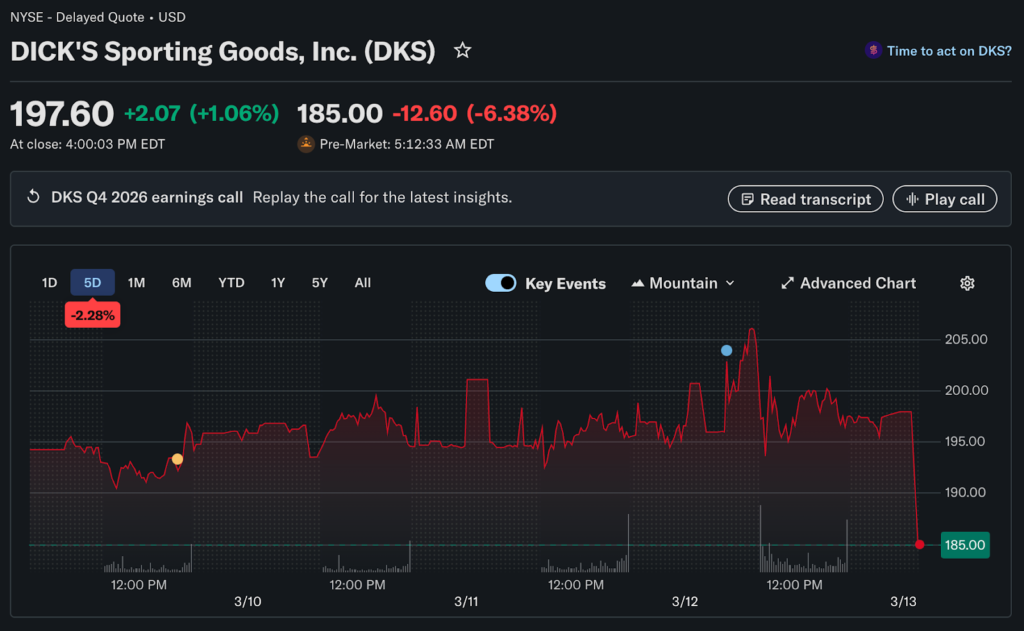
Shares rose 3% after the retailer beat analyst expectations on Q4 earnings, reporting adjusted earnings per share of $3.45 against a $2.86 consensus estimate and revenue of $6.23 billion. Junior financial expert at TibiPro looks at what the print means, why retail is showing more resilience than expected, and what Thursday’s divergence between macro headlines and company results says about where real opportunities may be hiding.
The Specific Numbers Behind the Beat
Dick’s Q4 results were not a narrow beat. Adjusted EPS of $3.45 compared to the $2.86 consensus estimate represents a beat of more than 20%. That kind of outperformance is typically associated with either a major tailwind the market had not priced in, or a company executing meaningfully better than the industry average. In Dick’s case, both factors appear to be at work.
Revenue of $6.23 billion came in ahead of expectations as well, continuing a trend of the retailer delivering consistent top-line performance despite a consumer environment that has been described as uneven. The stock’s 3% gain on Thursday was notable because it occurred in a session where the broader market was selling off sharply, which means buyers were making an active decision to move into the name against the macro tide.
Why Sporting Goods Is Holding Up
Consumer spending on athletic and outdoor equipment has proven more durable than many retail categories because it spans a wide income range and correlates with lifestyle choices that are stickier than discretionary purchases. The consumer who buys running shoes, gym equipment, or team sports gear tends to continue doing so through moderate economic softness. They are more likely to trade down on price points than to exit the category entirely.
Dick’s has also benefited from its House of Sport and Field House format expansion, which creates experiential environments harder to replicate online and drives higher average transaction values. Physical retailers with genuine destination appeal have held their own better than the broader sector, where e-commerce has recaptured some ground.
The K-Shaped Consumer Economy in Practice
The broader context for retail is the K-shaped consumer economy that has defined spending patterns since the pandemic recovery. Higher-income households, whose balance sheets have been supported by asset price appreciation in stocks and home values, continue to spend freely. Lower-income households, which depend on labor income and have less financial buffer, are under pressure from years of elevated prices eating into purchasing power.
Dick’s customer base skews toward middle-income and above, particularly for its premium categories like golf equipment, high-end athletic footwear, and outdoor gear. That demographic skew provides some insulation from the consumer stress concentrated at lower income levels. Retailers exposed to budget-conscious shoppers are experiencing a very different reality, as demonstrated by Kohl’s shares falling more than 28% in 2026.
What Kohl’s Tells Us by Contrast
The contrast with Kohl’s is instructive. The department store chain reported weaker-than-anticipated net sales and comparable sales for Q4, even though its EPS of $1.07, excluding items, blew past the $0.86 analyst estimate. The split between a revenue miss and an earnings beat tells a specific story: Kohl’s management is cutting costs aggressively and managing margins tightly, but they cannot manufacture top-line growth when traffic is soft.
Kohl’s shares are down more than 28% in 2026, a stark contrast to Dick’s relatively constructive performance. The divergence between the two retailers illustrates how differently the current consumer environment is treating retailers with different core demographics and merchandise positioning, even when both are operating in the same macro environment at the same time.
Reading Retail in a Macro Storm
If oil prices are rising and consumer confidence is softening, why is a major sporting goods retailer posting a 20%-plus EPS beat? The answer lies in timing. Dick’s Q4 results cover October through January, a period before the oil shock fully materialized.
Q1 2026 results will be the first real read on how consumers are responding to $3.54 gasoline, rising airline fares, and geopolitical uncertainty. Management commentary on traffic trends, same-store sales, and forward guidance will matter far more than Q4 backward-looking numbers for investors positioning retail exposure for the second quarter.
Where the Opportunity May Be
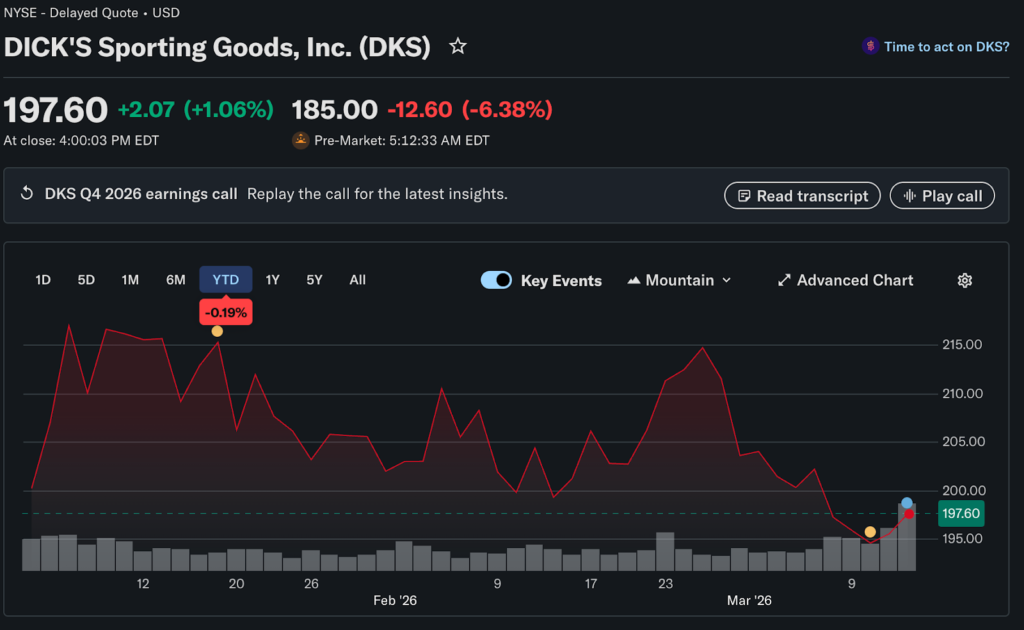
The Dick’s result points toward a specific kind of resilience worth seeking. Companies with strong brand loyalty, a premium demographic skew, and experiential retail formats are showing more durability than the broad consumer discretionary sector suggests. Consumer discretionary was one of the weaker S&P 500 sectors on Thursday, reflecting macro anxiety more than company fundamentals. That gap between sentiment and individual performance tends to create opportunities for investors doing company-level work rather than trading the index.


