
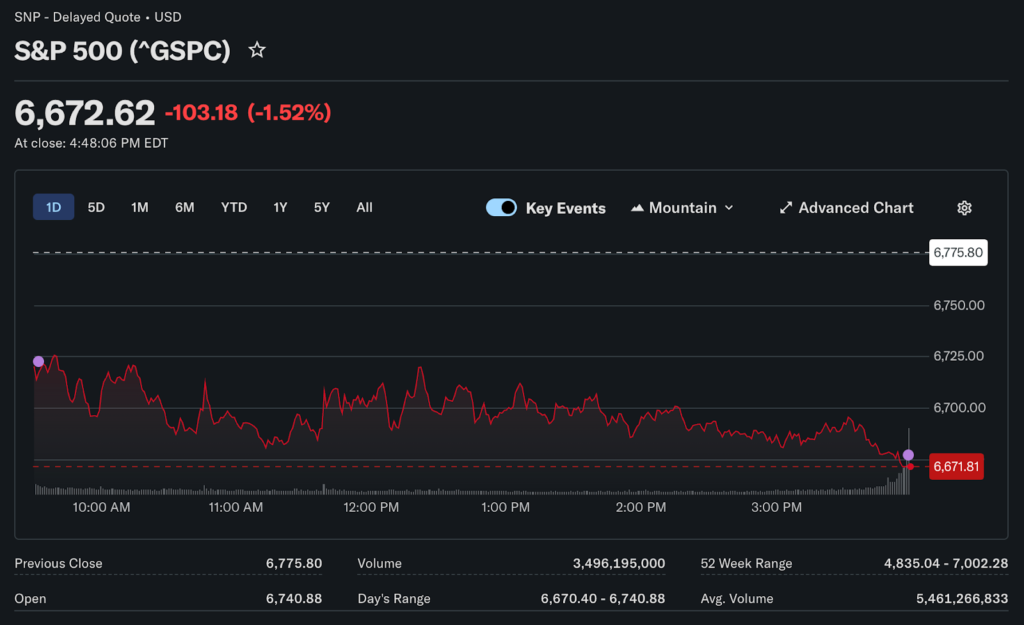
The US stock market closed Thursday at its lowest levels of the year, and the selling pressure was broad enough that even a strong labor report failed to slow it down. The Dow Jones Industrial Average dropped 739.42 points, or 1.56%, closing at 46,677.85, while the S&P 500 lost 1.52% to settle at 6,672.62 and the Nasdaq shed 1.78% to end at 22,311.98. Senior financial analyst at TibiPro examines what drove the selloff, which sectors got hit hardest, and why the session’s closing prints carry more weight than the numbers also suggest.
All Three Indexes Hit 2026 Closing Lows
All three major indexes closed at their lowest levels since November, with the Dow falling below the 47,000 threshold for the first time in 2026. That is a threshold that had held since the year began, and losing it intraday and closing below it adds psychological significance to what was already a painful session for equity investors.
The S&P 500 benchmark is now more than 4% below the record high it reached in January. That pullback is notable because it has occurred in a relatively compressed period of time, with most of the damage concentrated in the two weeks following the escalation of the Middle East conflict in late February. The speed of the decline, rather than the magnitude, is what is keeping investors unsettled.
What Actually Moved Markets
The proximate trigger on Thursday was Iran’s new supreme leader, Mojtaba Khamenei, who declared via Iranian state television that the Strait of Hormuz should remain closed as a “tool to pressure the enemy.” That statement sent crude oil prices surging again, with WTI futures rising 9.72% to settle at $95.73 per barrel and Brent crude gaining 9.22% to close at $100.46, its first close above $100 since August 2022.
The IEA announced a record coordinated release of 400 million barrels from emergency reserves across its member nations. Markets largely shrugged at that news, which is itself telling. When a historically large policy intervention fails to calm prices, the market is communicating that the perceived risk is larger than what stockpile releases can address alone.
Sectors Under the Most Pressure
Eight of the eleven S&P 500 sectors closed lower on the day. Industrials, consumer discretionary, and health care led the declines, while financials faced additional pressure from a separate but related story in private credit markets. Banks and technology stocks were broadly in the red throughout the session.
Energy stocks, including Chevron and Exxon Mobil, were among the rare winners as their upstream businesses directly benefit from higher crude prices. That creates an unusual dynamic where the same force hurting the broader market is simultaneously boosting the sector most tied to the disruption itself.
Private Credit Stocks Took a Separate Hit
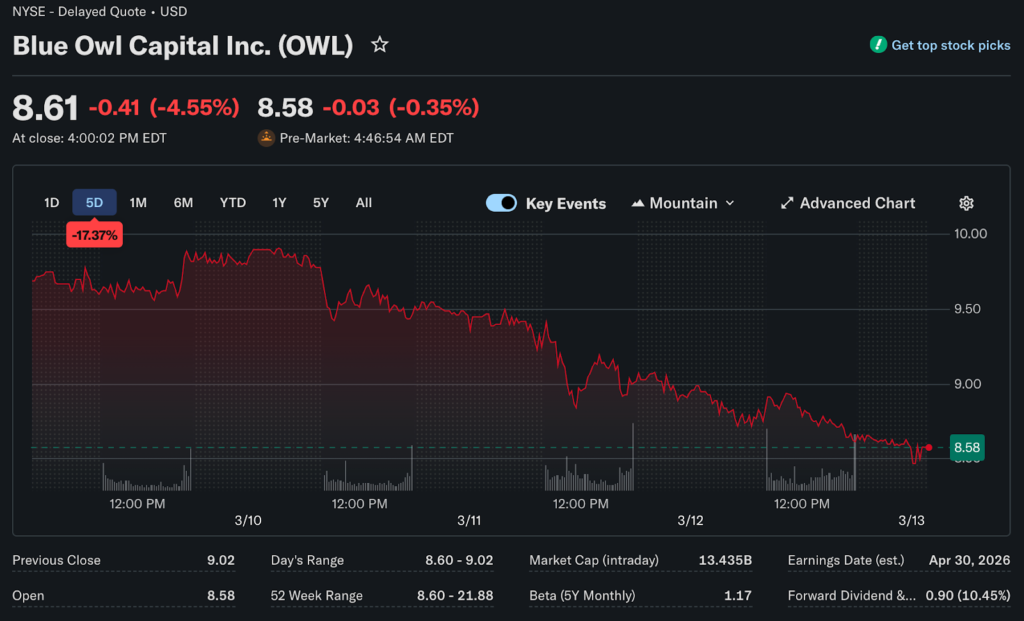
Financial stocks faced compounded pressure Thursday, not just from the oil story but from news that major private credit funds were capping investor withdrawals. Morgan Stanley shares fell 4.1% after the firm capped redemptions on its North Haven Private Income Fund. Blue Owl Capital dropped 3.1%, while Blackstone and Apollo Global each shed roughly 2%.
The private credit fund situation reflects a separate set of concerns around loan quality and liquidity in the roughly $1.8 trillion private credit market, which has been under scrutiny since late 2025. The timing of that news landing on an already-stressed market day amplified the move in financial stocks beyond what either story alone would have produced.
Labor Data Provided No Cushion
Initial jobless claims for the week ended March 7 came in at a seasonally adjusted 213,000, down 1,000 from the prior week and below the consensus estimate of 215,000. Continuing claims fell by 21,000 to 1.85 million. That data is consistent with a labor market that is still functioning reasonably well by historical standards.
On a normal Thursday, those numbers would have been a constructive datapoint. In the current environment, they were absorbed without any noticeable positive reaction from equities. When good economic data fails to lift a market, it typically signals that the primary driver of sentiment is something the data cannot address: geopolitical uncertainty around energy supply.
Where the Market Stands
Consumer balance sheets remain in solid condition according to commentary from market strategists on Thursday, and income and employment conditions are currently sound. Inflation continues to ease in some areas, particularly shelter costs, which rose just 0.1% in February, the smallest monthly increase since January 2021.
The challenge for investors is that those positives are being overshadowed by an oil-driven inflation risk that is still unfolding. With PCE data and a first revision to Q4 GDP due Friday, markets will have more information to work with heading into the weekend. But until there is clarity on the Strait of Hormuz situation, the path of least resistance for equities appears to remain lower.


