
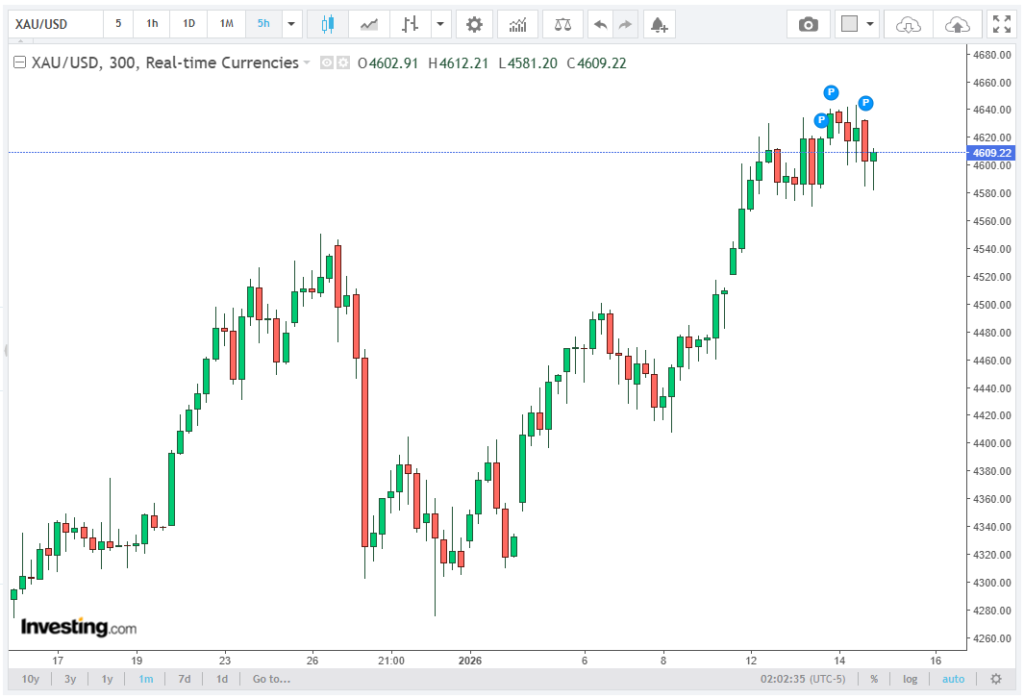
Gold (XAU/USD) is trading slightly lower near $4,600 per troy ounce, retreating after reaching a fresh all-time high of $4,643 in the previous session. The pullback reflects a combination of stronger-than-expected US economic data, a firmer US Dollar, and moderating geopolitical tensions, all of which have reduced immediate demand for safe-haven assets. This article from PrimeLuno offers readers a clear and thorough explanation of the subject.
While the broader bullish trend in Gold remains intact, near-term price action suggests consolidation as markets reassess the timing of Federal Reserve rate cuts and the evolving global risk landscape.
Fed Rate Pause Expectations Weigh on Non-Yielding Gold
The primary drag on Gold prices stems from strong US macroeconomic releases, which reinforce the narrative that the Federal Reserve can afford to keep interest rates on hold for longer.
Recent economic data shows strong momentum in key sectors. US Retail Sales rose 0.6% in November to $735.9 billion, surpassing expectations of a 0.4% increase, indicating robust consumer spending.
The Producer Price Index (PPI) also surprised to the upside, with both headline and core PPI reaching 3% year-over-year, reflecting persistent price pressures. Meanwhile, the Unemployment Rate eased to 4.4% in December, signaling continued labor market resilience.
Federal Reserve Commentary Reinforces Caution
Further reinforcing the rate pause narrative, Minneapolis Fed President Neel Kashkari noted that the US economy remains resilient, inflation is still too high, but is moving in the right direction. He also cited less tariff pass-through than anticipated, suggesting limited inflationary shocks from trade measures so far.
The Fed Beige Book echoed this tone, reporting that economic activity picked up at a “slight to modest pace” across most districts, an improvement compared to prior cycles that showed stagnation.
Meanwhile, Core CPI rose just 0.2% month-over-month in December, with annual core inflation holding at 2.6%, a four-year low, offering reassurance that inflation pressures are easing gradually without derailing growth.
US Dollar Strength Pressures Gold Demand
Gold’s retreat is also tied to a stronger US Dollar. The US Dollar Index (DXY) rebounded toward 99.10, reversing modest losses from the prior session.
A stronger Dollar makes dollar-denominated Gold more expensive for foreign buyers, dampening global demand. Historically, Gold and the Dollar share an inverse relationship, and the current uptick in the Greenback has contributed to near-term downside pressure on XAU/USD.
Geopolitical Tensions Ease, Reducing Safe-Haven Flows
Safe-haven demand for Gold has softened amid signs of easing geopolitical stress. According to Reuters, the US President stated that Iran’s crackdown-related killings appear to be subsiding, with no large-scale executions planned, though he emphasized that the US would continue to monitor developments.
While he did not rule out potential US military action, his comments reduced immediate fears of escalation, prompting investors to trim defensive Gold positions.
The US-based HRANA rights group reported that deaths linked to Iran’s protests have reached 2,571, while the US President reiterated plans to impose 25% tariffs on countries doing business with Iran, adding a layer of uncertainty that could revive safe-haven demand if tensions flare again.
Concerns Over Fed Independence Offer Underlying Support
Despite the pullback, Gold continues to find structural support from renewed concerns about Federal Reserve independence. Jerome Powell criticized the U.S. administration’s subpoena, warning it could be seen as pressure on the Fed and a threat to its monetary policy independence.
Although the US President stated he has no immediate plans to fire Powell, he added it was “too early” to rule out future action. Such uncertainty around central bank autonomy tends to bolster Gold’s role as a hedge against political and institutional risk.
Technical Analysis: Bulls Remain in Control, for Now
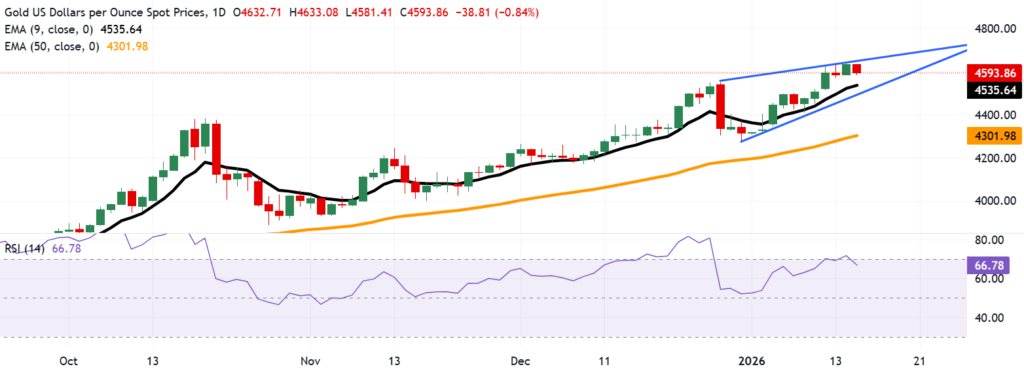
From a technical perspective, Gold remains bullish but cautious. The price is holding above the rising nine-day Exponential Moving Average (EMA) near $4,535, providing short-term support. The 50-day EMA is turning higher, reinforcing the broader uptrend, while the 14-day Relative Strength Index (RSI) at 66.05 signals positive momentum without entering overbought territory.
However, the daily chart shows Gold trading within an ascending wedge pattern, which often indicates weakening upside momentum and the potential for a bearish reversal if key support levels are broken. Key technical levels include resistance at the record high of $4,643, the upper wedge boundary near $4,660, and the psychological target of $4,700, while support levels are the nine-day EMA at $4,535.64 and the lower wedge boundary near $4,490.
Conclusion: Consolidation Within a Broader Bull Market
In summary, Gold’s retreat toward $4,600 reflects strong US data, a firmer Dollar, and cooling geopolitical tensions, all of which support expectations for a Fed rate pause. Nevertheless, underlying bullish drivers remain intact, including easing inflation, institutional uncertainty, and lingering geopolitical risks.


