
West Texas Intermediate (WTI) Crude Oil prices are facing renewed selling pressure on Wednesday, testing key technical levels amid geopolitical tensions surrounding the Iran conflict. In this article, the brokers at BlitzPine Group deliver an in-depth look at this topic.
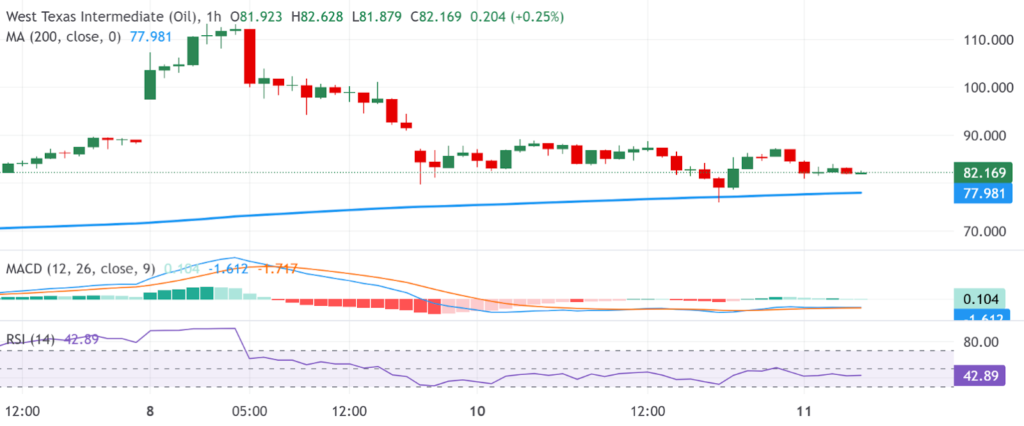
After a brief bounce from sub-$76.00 weekly lows, WTI now trades just below $82.00, marking a nearly 4% intraday decline. Market participants remain cautious as fresh supply pressure weighs on near-term gains, while broader technical indicators suggest a mildly bearish setup.
Technical Overview: 200-Hour SMA Holds Critical Significance
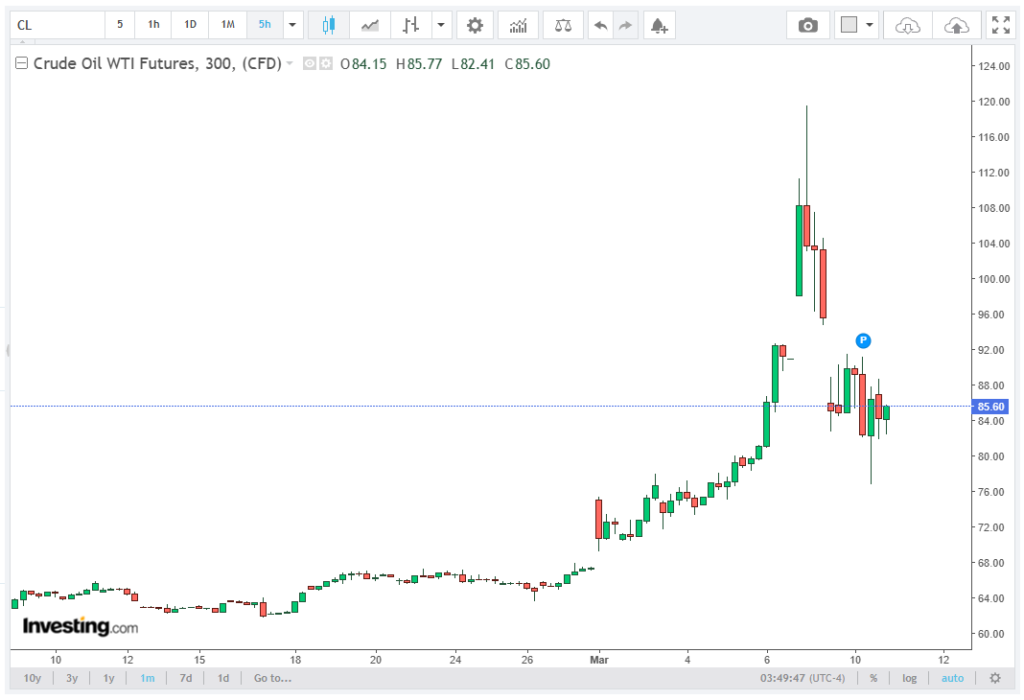
From a technical perspective, WTI’s recent pullback stalled near the 200-hour Simple Moving Average (SMA), a level that historically anchors medium-term bullish trends. Despite the retracement from the multi-month highs observed earlier this week, levels not seen since June 2022, the lack of follow-through buying raises caution for bulls.
The 200-hour SMA near $78.00 continues to act as an important support line, suggesting that while near-term weakness may persist, the broader uptrend remains intact. Traders often monitor the 200-period SMA as a barometer for trend sustainability, and a hold above this level may provide a springboard for renewed strength if buying pressure returns.
Momentum Indicators Signal Mild Bearish Bias
Key momentum indicators provide further insight into the current technical environment. The Moving Average Convergence Divergence (MACD) histogram has contracted after a positive streak, with its line flattening just above zero. This signals fading upside momentum, rather than strong bearish conviction.
Similarly, the Relative Strength Index (RSI) at 42 remains below the neutral 50 line, consistent with a corrective tone while avoiding oversold conditions. Collectively, these indicators point to a mildly bearish intraday bias, implying that while WTI may continue to struggle, a sharp decline is not imminent without a break below critical support.
Support Levels: $82.00 and $81.00 Guard Recent Lows
On the downside, WTI finds initial support at $82.00, offering a short-term floor for buyers. Stronger support exists around $81.00, which aligns with the rising 200-hour SMA and serves as a key medium-term defense zone. Breaching $81.00 could expose further downside risk, with the next level at $79.00, a critical psychological and technical marker for traders.
These support levels are particularly relevant given the ongoing geopolitical uncertainty. While concerns about prolonged oil supply disruptions due to the Strait of Hormuz closure underpin a bullish narrative, the market’s technical posture currently favors short-term corrective moves.
Resistance Levels: $83.50 Key for Bullish Reversal
To negate the intraday negative bias, WTI needs to sustain gains above $83.50, a crucial resistance level that has repeatedly capped upside attempts. Successfully clearing this barrier would likely ease bearish pressure and pave the way toward $85.00, with the potential to challenge the recent peak in the $88.00 region.
Until such a break occurs, sellers remain active near the $82.00–$83.50 zone, limiting upside momentum and keeping the market in a range-bound pattern. The interplay between resistance and support levels underscores the importance of technical analysis in guiding trading strategies, particularly under volatile market conditions. Traders should watch for sustained volume above resistance as confirmation of a potential bullish reversal, while also monitoring nearby support levels for risk management.
Market Implications Amid Geopolitical Tensions
The Iran conflict continues to influence WTI price dynamics, with traders closely monitoring supply disruptions and regional developments. While geopolitical risk typically supports higher oil prices, the current technical pullback reflects a more nuanced balance between fundamental and technical factors.
Market participants are advised to watch the 200-hour SMA closely, as a decisive break below this level could signal a shift toward a deeper corrective phase, potentially targeting the $79.00 support area. Conversely, a sustained rebound above $83.50 would reaffirm the medium-term bullish trend and suggest the possibility of a renewed uptrend toward $85.00–$88.00.
Conclusion: Key Levels to Watch
In summary, WTI Crude Oil faces short-term selling pressure, with the broader technical setup turning mildly bearish. The 200-hour SMA near $78.00 remains a critical support level, while $82.00 and $81.00 provide near-term backing. On the upside, traders need to monitor $83.50 for signs of bullish revival, with higher targets at $85.00 and $88.00 in play should buyers regain control.
For now, WTI’s price action reflects the delicate balance between geopolitical supply concerns and technical constraints, emphasizing the need for traders to closely monitor support, resistance, and momentum indicators before committing to positions.
WTI remains at a crossroads, with the 200-hour SMA as the key determinant for bullish continuity, while resistance at $83.50 holds the potential to reverse the intraday negative bias. Traders should remain alert to market developments and adjust strategies according to these technical cues.


