
The USD/JPY pair trades 0.18% lower near 158.35 during the early European session on Friday, as the Japanese Yen (JPY) finds temporary support from verbal warnings of potential intervention by Japanese authorities.
The pullback reflects growing caution among traders, particularly after comments from Japan’s Finance Ministry signaled readiness to act against excessive one-way currency movements. In this article, FlexFlume brokers examine the key aspects of the topic with clarity.
Despite the short-term dip, the broader trend for USD/JPY remains constructive, supported by divergent monetary policy expectations between the Federal Reserve (Fed) and the Bank of Japan (BoJ). The pair is currently testing a key technical breakout zone near 158.00, making this level critical for near-term direction.
Japan Signals Readiness to Intervene
The Japanese Yen gained modest ground after Finance Minister Satsuki Katayama reiterated that “all options are available”, including direct currency intervention, to counter the Yen’s recent weakness. Such remarks are aimed at curbing speculative selling and discouraging one-sided market positioning.
These comments follow a series of verbal interventions, a strategy Japan often employs before taking actual market action. While verbal warnings alone rarely reverse trends, they can slow momentum and introduce short-term volatility, as seen in the current USD/JPY pullback.
Earlier this week, US Treasury Secretary Scott Bessent also weighed in, emphasizing that Japan must maintain sound formulation and clear communication of monetary policy. His remarks came after a meeting with Katayama, highlighting the international sensitivity surrounding sharp Yen depreciation.
Fundamental Outlook: Yen Faces Structural Headwinds
Despite the recent verbal support, the medium-term outlook for the JPY remains uncertain. Investors widely expect Japan to pursue a looser fiscal stance in 2024, aimed at stimulating domestic growth and supporting fragile demand. Such policies could undermine Yen’s strength, especially if they result in widening yield differentials with the US.
Moreover, while the Bank of Japan has taken steps toward policy normalization, its approach remains gradual and cautious, limiting the Yen’s upside. This contrasts sharply with the Federal Reserve’s restrictive stance, which continues to favor the US Dollar over low-yielding currencies like the JPY.
US Dollar Holds Firm Ahead of Fed Decision
The US Dollar (USD) edges slightly lower ahead of an extended US holiday weekend, but remains broadly firm as markets anticipate the Federal Reserve will leave interest rates unchanged at its upcoming policy meeting.
Strong US economic resilience, coupled with sticky inflation pressures, supports expectations that the Fed will maintain restrictive rates for longer. This outlook continues to anchor USD demand, particularly against currencies backed by ultra-loose policy frameworks, including the Japanese Yen.
As a result, any USD/JPY downside driven by intervention rhetoric may prove temporary, unless followed by concrete action from Japanese authorities.
USD/JPY Technical Analysis: Breakout Retest in Focus
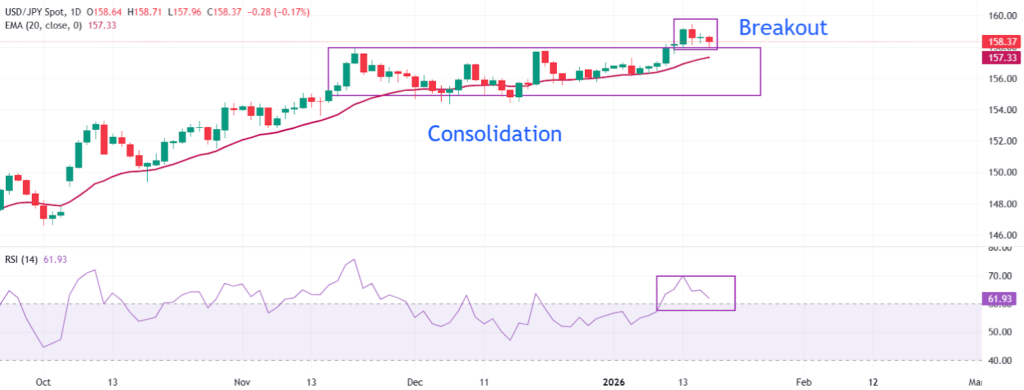
From a technical perspective, USD/JPY corrects toward the 158.00 region, testing the breakout area of a multi-month consolidation. The pair previously traded within a range between 154.40 and 157.90 over the past two months, before breaking higher.
This pullback appears technically healthy, representing a classic retest of former resistance turned support.
Key Technical Indicators
The 20-day Exponential Moving Average (EMA), currently at 157.33, shows that the price remains above this rising EMA, reinforcing the near-term bullish trend. The steady upward slope of the EMA indicates persistent buying interest, signaling strength in the market.
Meanwhile, the 14-day Relative Strength Index (RSI) is positioned near 62, having eased from overbought territory. This bullish yet normalized reading suggests that upward momentum remains intact, providing room for further gains before overbought conditions potentially return.
Support, Resistance, and Price Bias
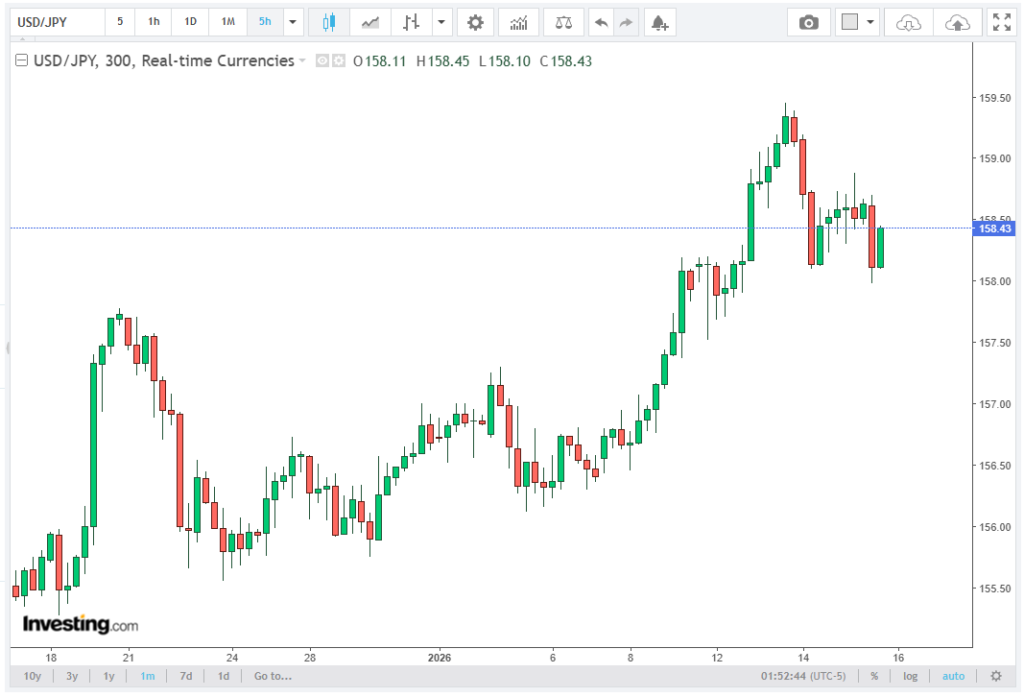
As long as USD/JPY holds above the 20-day EMA, the bias remains to the upside. Any pullbacks toward the 157.30–157.50 zone are likely to attract dip buyers, helping to sustain the broader uptrend. Key levels to watch include immediate support at 157.33 (20-day EMA), psychological support at 158.00, and upside resistance at 160.00, which represents a round-number barrier.
A daily close below 157.33 would weaken the bullish structure and open the door to a deeper retracement toward 156.50. Conversely, holding above this level preserves the advance, increasing the probability of a renewed push toward 160.00.
Conclusion: Consolidation Breakout Under Test
In summary, USD/JPY is undergoing a corrective phase driven by verbal intervention risks, but the broader technical and fundamental backdrop remains supportive. The pair’s ability to defend the 158.00–157.30 support zone will be crucial in determining whether the post-breakout rally resumes.
With the Fed expected to stay on hold and Japan’s policy stance still accommodative, upside risks continue to dominate, unless Japanese authorities move beyond rhetoric into actual market intervention. For now, the consolidation breakout near 158.00 remains intact, keeping the medium-term bullish outlook firmly in place.


