
The USD/INR currency pair traded largely sideways, as persistent pressure on the Indian Rupee (INR) offset an improvement in global market sentiment driven by falling crude oil prices. This article features a thorough overview of the topic from the brokers at EPIQUI.
While softer oil prices typically support the rupee by easing India’s import bill, continued hedging demand, foreign portfolio outflows, and heightened geopolitical uncertainty have limited the currency’s recovery.
At the same time, the US Dollar (USD) remains supported by safe-haven flows, particularly as the Middle East conflict continues to evolve. Investors are closely watching upcoming US inflation data, which could influence the Federal Reserve’s interest rate outlook and provide fresh direction for the USD/INR exchange rate.
Rupee pressured by hedging demand and capital outflows
The Indian Rupee remains under pressure due to persistent hedging activity and ongoing foreign portfolio investment (FPI) outflows from Indian markets. Importers and corporates have increased dollar hedging, reflecting concerns about currency volatility amid global geopolitical tensions.
Additionally, foreign investors have reduced exposure to Indian equities and bonds, contributing to demand for the US Dollar in domestic markets. This trend has weighed on the rupee even as broader risk sentiment has shown signs of improvement.
Oil price decline improves sentiment, but upside is limited
Global crude oil prices have retreated following reports that the International Energy Agency (IEA) may release record oil reserves in an effort to stabilize energy markets. The proposed drawdown could exceed the 182 million barrels released in 2022 following Russia’s invasion of Ukraine, marking one of the largest coordinated releases of strategic petroleum reserves.
The benchmark West Texas Intermediate (WTI) crude oil price traded near $82.30 per barrel during Asian trading hours, giving up gains recorded in the previous session.
Lower oil prices are typically positive for the Indian economy because the country relies heavily on energy imports. India imports the majority of its crude oil requirements, making the trade balance, inflation outlook, and currency stability highly sensitive to fluctuations in global oil prices.
Rising swap rates signal tightening expectations
Domestic interest rate markets in India have also reacted to the evolving geopolitical environment. India’s one-year and two-year Overnight Index Swap (OIS) rates have risen by more than 45 basis points since the Israeli–US conflict with Iran began on February 28.
Meanwhile, the benchmark 10-year Indian government bond yield has climbed more modestly, rising approximately 11 basis points before trimming part of the gains.
Current levels in the interest rate swap market suggest that traders are pricing in nearly two interest rate hikes by the Reserve Bank of India over the next 12 months. This shift reflects concerns that global energy price volatility and geopolitical risks could fuel inflationary pressures in the Indian economy.
If the RBI is forced to maintain a tight monetary policy stance, it could provide some long-term support to the rupee, although near-term currency movements will likely remain heavily influenced by external factors, particularly oil prices, capital flows, and global risk sentiment.
Technical outlook: USD/INR maintains bullish bias
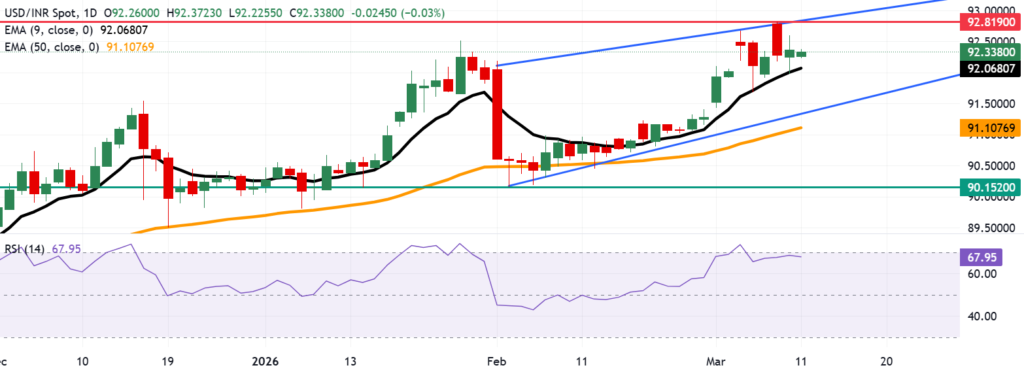
From a technical analysis perspective, the USD/INR pair continues to exhibit a bullish structure on the daily chart. The pair is currently trading around 92.30, slightly below the previous session’s close but still within a well-defined ascending channel pattern.
The pair remains comfortably above the nine-day Exponential Moving Average (EMA), located near 92.00, which continues to provide short-term dynamic support. Additionally, prices are trading above the 50-day EMA, reinforcing the positive momentum trend.
Momentum indicators further support the bullish outlook. The 14-day Relative Strength Index (RSI) remains in the mid-60 range, indicating sustained buying pressure without yet reaching overbought territory.
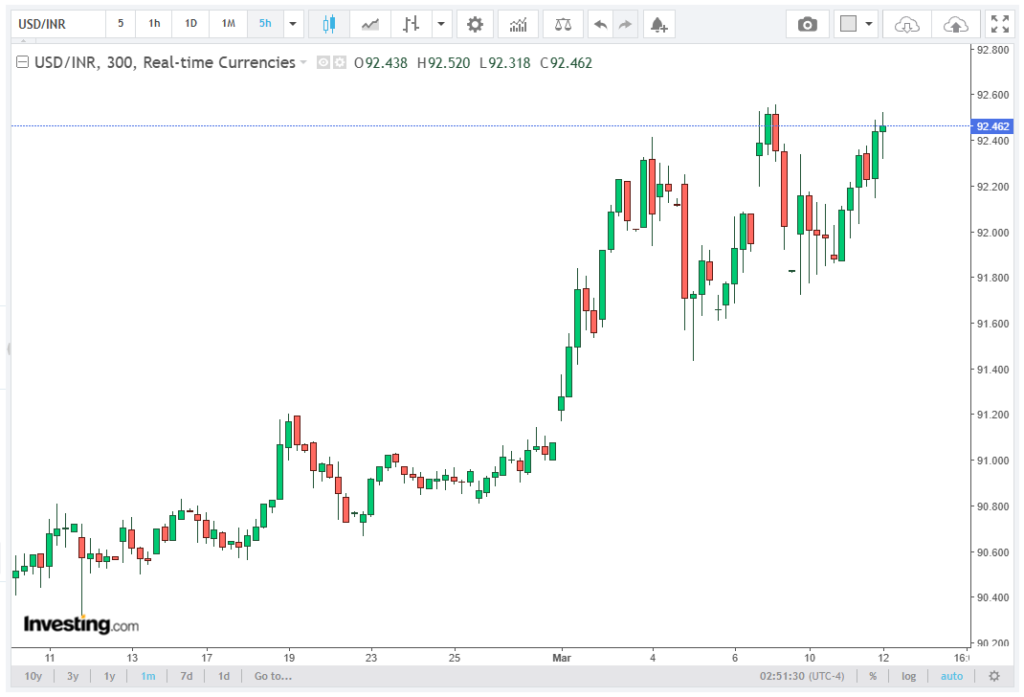
On the upside, immediate resistance is located near the upper boundary of the ascending channel, close to the all-time high of 92.81. A decisive breakout above this level could open the door for further USD strength against the rupee.
On the downside, initial support lies at the nine-day EMA near 92.06, followed by stronger support around the lower boundary of the channel near 91.30. A break below this level could signal a short-term correction, although the broader trend would likely remain positive unless deeper support zones are breached.
Outlook
Looking ahead, the trajectory of USD/INR will likely be shaped by a combination of geopolitical developments, energy market dynamics, and key US inflation data. While declining oil prices offer some relief for the Indian Rupee, ongoing foreign outflows, hedging demand, and safe-haven flows into the US Dollar continue to limit the currency’s upside potential.
As a result, the USD/INR pair may remain range-bound in the near term, with volatility driven by global risk sentiment, central bank expectations, and the evolving Middle East geopolitical landscape.


