
The USD/INR currency pair continues to display strong bullish momentum, rebounding after minor losses in the previous trading session. The pair recently surged toward its all-time high of 92.81, reflecting persistent selling pressure on the Indian Rupee (INR) amid a backdrop of global risk aversion and elevated crude oil prices. In this article, TibiPro brokers deliver a complete overview of the subject.
Market sentiment has shifted toward safe-haven assets, boosting demand for the US Dollar (USD). As investors seek protection against geopolitical uncertainty and market volatility, the greenback remains well supported, driving the USD/INR exchange rate higher. The renewed upward movement underscores the fragility of emerging market currencies when faced with rising geopolitical risks and commodity price shocks.
Although the pair recorded slight declines earlier, bullish sentiment quickly returned, pushing the exchange rate back toward the 92.50–92.60 region. This recovery highlights the structural strength of the US Dollar in the current macroeconomic environment.
RBI Interventions Support the Domestic Currency
Another key factor supporting the Indian Rupee has been active intervention by the Reserve Bank of India (RBI). The central bank reportedly stepped in to stabilize the foreign-exchange market after the currency briefly weakened beyond the 92-per-dollar level during recent market turbulence.
The RBI has been active in both offshore and domestic FX markets, deploying a range of tools aimed at limiting excessive volatility. Such interventions are designed to maintain financial market stability and prevent abrupt currency movements that could disrupt trade flows and investor confidence.
Central bank participation in the USD/INR market reflects growing concern about the speed of the Rupee’s depreciation. While policymakers generally allow market-driven currency movements, excessive swings often prompt strategic interventions to smooth fluctuations.
The measures appear to have provided short-term relief, helping the Rupee avoid deeper losses even as global risk sentiment remains cautious.
Oil Prices Remain a Critical Driver for the Rupee
Oil prices remain a major external factor influencing the USD/INR exchange rate. West Texas Intermediate (WTI) crude recently rebounded toward $88 per barrel, reflecting continued volatility in the global energy market.
Although the US President’s comments regarding a potential resolution to the Iran conflict helped cool some of the earlier price spikes, oil markets remain highly sensitive to geopolitical developments and supply disruptions. Even minor escalations in conflict can trigger rapid price swings, affecting the currencies of energy-importing nations.
Adding another layer of market support, the International Energy Agency (IEA) reportedly discussed a coordinated release of emergency oil reserves among member countries. Such measures are typically deployed during periods of severe supply disruption, aiming to increase short-term oil supply and stabilize prices.
If implemented, a coordinated reserve release could limit further price spikes, easing pressure on the Indian Rupee. However, analysts caution that such measures usually offer only temporary relief, particularly if underlying geopolitical risks persist.
Technical Analysis: USD/INR Remains in a Strong Uptrend
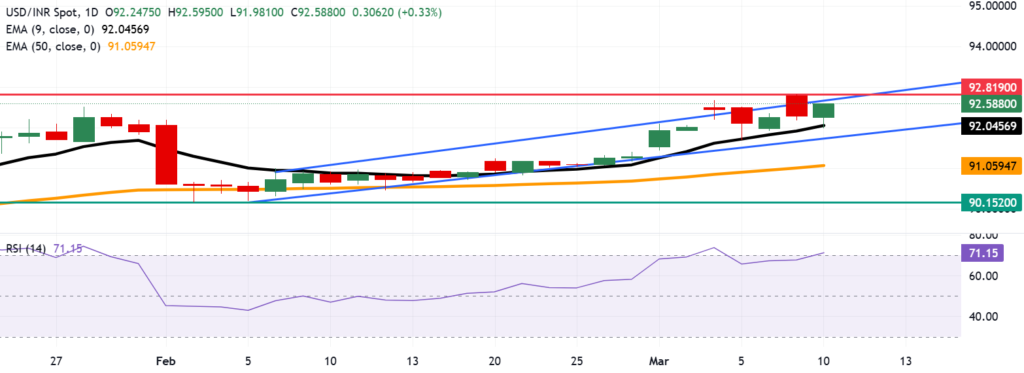
From a technical perspective, USD/INR continues to display a strong bullish structure. At the time of writing, the pair trades around 92.60, hovering close to the record high of 92.81 established earlier in the week.
The daily chart reveals that the pair remains firmly within an ascending channel pattern, a classic indication of sustained upward momentum. This structure suggests that buyers remain in control, with price action continuing to respect higher highs and higher lows.
Short-term indicators further support the bullish outlook. The exchange rate trades well above the 50-day Exponential Moving Average (EMA) and maintains a comfortable distance from the nine-day EMA, indicating persistent upward pressure following the recent breakout.
Momentum indicators also reinforce the positive bias. The Relative Strength Index (RSI) currently sits near 70, signaling strong bullish momentum while also approaching overbought territory. This level suggests that while buyers dominate the market, the pair may experience short-term consolidation or minor pullbacks as traders lock in profits.
Key Support and Resistance Levels
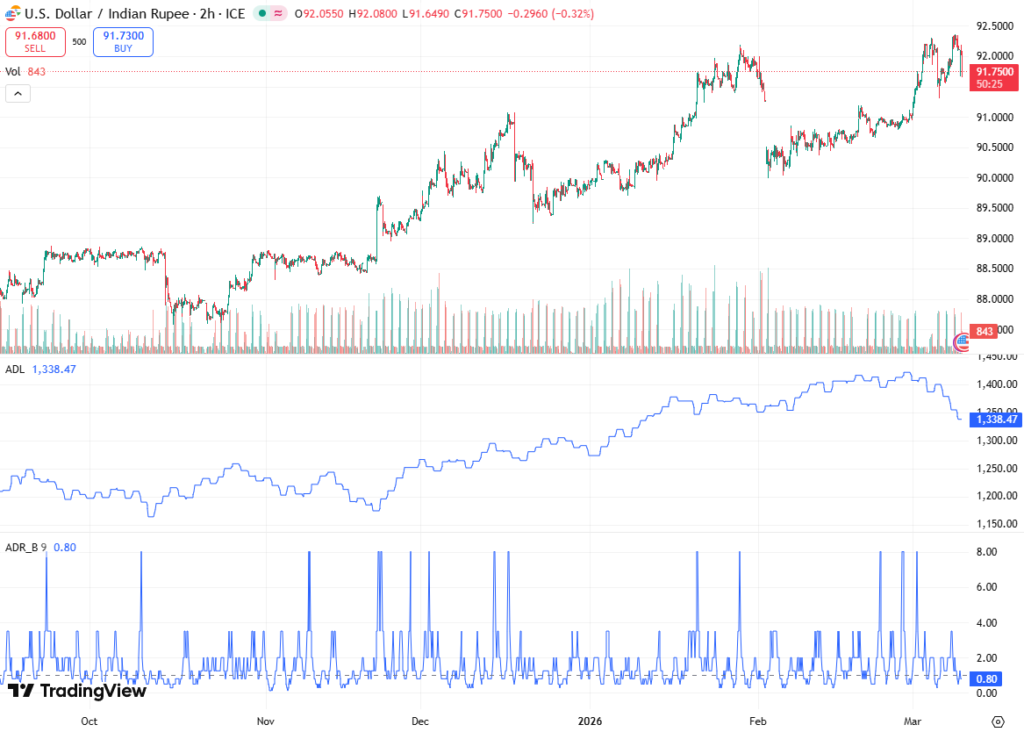
In the near term, immediate resistance appears near 92.70, corresponding with the upper boundary of the ascending channel. A decisive break above this level could open the path toward a fresh record high beyond 92.81, potentially extending the bullish trend further.
On the downside, initial support is located at the nine-day EMA near 92.04, which currently acts as the first line of defense against deeper corrections. A break below this level could expose the lower boundary of the channel around 91.70.
As long as the pair remains within this ascending channel formation, the broader bullish trend in USD/INR is likely to remain intact. However, traders will continue to monitor geopolitical developments, oil prices, and central bank interventions, all of which could significantly influence the next directional move in the currency pair.


