
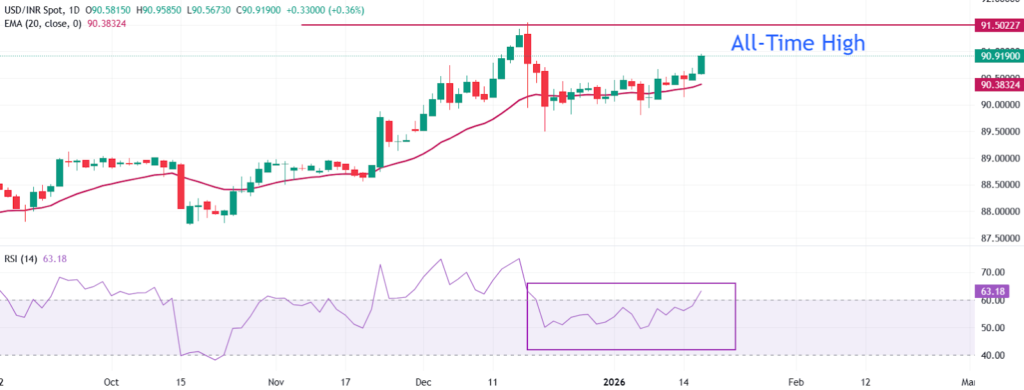
The Indian Rupee (INR) dropped to a new two-month low against the US Dollar (USD) on Friday, as the USD/INR pair surged close to 90.90. This decline is driven by continued selling pressure from Foreign Institutional Investors (FIIs) in the Indian equity market.
The currency weakness reflects the combination of capital outflows, expectations of domestic monetary easing, and sustained global dollar strength. FlexFlume professionals unpack the complexities of the topic through a detailed analysis.
Key Highlights
The Indian Rupee has declined sharply, reflecting persistent selling pressure as Foreign Institutional Investors (FIIs) continue to offload stakes in Indian equities. This sustained outflow indicates reduced foreign investment sentiment, raising concerns about market volatility and the capital account balance.
The Reserve Bank of India (RBI) is expected to pursue further rate cuts in the near term, aiming to support economic growth and stimulate domestic consumption. Analysts suggest that the RBI may adopt a gradual and measured approach, balancing inflationary pressures with the need to maintain financial stability.
FIIs Outflow Hits Indian Market
On Wednesday, FIIs offloaded holdings worth ₹4,781.24 crore, according to NSE data. This sustained selling pressure has kept the Indian stock market under pressure, particularly amid the absence of a definitive US-India trade deal.
January has witnessed FIIs acting as net sellers in nine out of ten trading sessions, totaling ₹21,706.27 crore in divestments. Economists at HSBC have highlighted that the lack of foreign capital inflows is a major factor weighing on the Indian Rupee, reducing its ability to recover against the USD.
Trade discussions between India’s External Affairs Minister Subrahmanyam Jaishankar and US Secretary of State Marco Rubio were described as “good” on social media. However, investor sentiment remains weak, given the absence of concrete trade agreements.
Domestic Inflation and RBI Outlook
On the economic front, India’s retail and wholesale inflation data for December indicate rising price pressures. The Consumer Price Index (CPI) rose 1.33% Year-on-Year (YoY), remaining below the RBI’s tolerance band of 2%-6%, suggesting that monetary easing is likely to continue.
Analysts expect the RBI to maintain a pro-growth stance, with interest rate cuts on the cards in the near term. Despite the INR’s weakness, the RBI’s accommodative policy aims to boost domestic consumption, improve credit growth, and support economic activity.
US Dollar Strength and Fed Policy
While the INR trades lower, the USD has edged down marginally ahead of an extended US weekend. The US Dollar Index (DXY) stands near 99.28, slightly below its six-week high of 99.50.
Hawkish Fed commentary has strengthened the USD. Kansas Fed President Jeffrey Schmid and Atlanta Fed President Raphael Bostic emphasized the importance of maintaining a restrictive policy stance to mitigate upside inflation risks. They noted that inflation remains high and price pressures are likely to continue through 2026 as businesses incorporate tariffs into costs.
The CME FedWatch tool indicates a high probability of the Fed holding rates in the 3.50%-3.75% range during the January meeting. Market participants are also watching for the announcement of the new Fed Chair, with candidates including Kevin Hassett, Kevin Warsh, Christopher Waller, and Michelle Bowman.
Technical Analysis: USD/INR Momentum
The USD/INR pair has surged to near 90.90, supported by a bullish technical setup. The 50-day Exponential Moving Average (EMA) is rising, providing dynamic support for the pair, and price action remains above this EMA, containing pullbacks. The 14-day Relative Strength Index (RSI) stands at 58.76, above its midline, confirming steady bullish momentum.
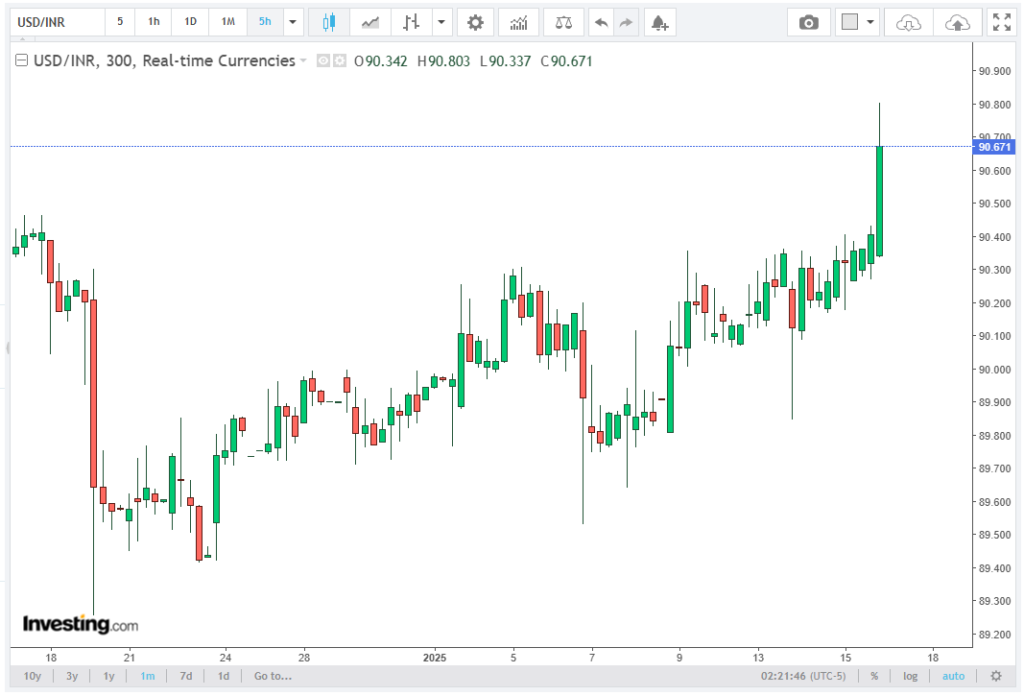
Initial support is located at the 50-EMA level of 89.9134. As long as the pair remains above this average, upside extensions are favored. A close below the EMA could soften the tone, signaling a deeper retracement.
Momentum may strengthen if the RSI extends toward the 60s, while a drop toward 50 could cap upside and favor consolidation. The technical setup suggests that traders should monitor key support and resistance levels, as FIIs outflows and global USD trends continue to influence the pair.
Outlook
The Indian Rupee is currently under pressure due to a combination of persistent FIIs outflows, expectations of RBI rate cuts, and continued USD strength. Although domestic inflation remains within manageable levels, allowing for potential monetary easing, global monetary policies, particularly those of the Federal Reserve (Fed), will continue to play a decisive role.
Going forward, market participants are likely to focus on FIIs activity in the Indian stock market, RBI’s policy announcements and rate decisions, Fed statements and the US inflation trajectory, as well as technical levels such as the 50-day EMA and RSI ranges.
In conclusion, the USD/INR pair remains in a bullish trend, with upside potential toward 91.00, unless significant foreign inflows or a RBI policy shift intervene.


