
Tesla continues to attract global attention as the electric vehicle manufacturer navigates a mix of market volatility, slowing regional sales, and ambitious long-term technology goals. The TSLA CEO’s latest comments about Tesla’s future are influencing investor sentiment and the ongoing debate around the company’s long-term valuation.
Despite recent challenges, Tesla’s chief executive remains confident about the company’s trajectory and has encouraged investors to hold on to their Tesla shares for the long term.
The TSLA CEO recently suggested that Tesla’s future could extend far beyond the electric vehicle industry, pointing toward space infrastructure, artificial intelligence systems, and advanced technology manufacturing as potential growth drivers over the coming decades.
Market analysts at Noxi Rise examine how the latest comments about Tesla’s future are influencing investor sentiment and the ongoing debate around the company’s long-term valuation.
Tesla Navigates Volatility Amid Slowing Sales
Over the past year, Tesla has faced increasing scrutiny from both investors and regulators.
The company has dealt with legal challenges related to hiring practices, while also reporting weaker sales performance in key global markets, particularly Europe and China, two regions that have historically played an important role in Tesla’s international growth strategy.
These developments have contributed to short-term volatility in Tesla’s share price, prompting renewed debate among investors about the company’s near-term growth outlook.
TSLA CEO Outlines a Radical Future for Tesla
In recent remarks, the TSLA CEO suggested that Tesla could eventually build manufacturing facilities beyond Earth, including potential production operations on the Moon within the next 20 years.
According to the TSLA CEO, these futuristic facilities could be used to support satellite manufacturing and artificial intelligence infrastructure projects, potentially reducing the cost of launching technology into orbit.
The concept involves building space-based factories capable of producing AI-related hardware and satellites, which could then be deployed directly into orbit without relying on traditional rocket launches from Earth.
The TSLA CEO argued that such developments could transform the economics of space infrastructure and create entirely new revenue opportunities for Tesla’s technology ecosystem.
Strategic Shift from Mars to Lunar Development
Interestingly, the TSLA CEO’s comments represent a shift in emphasis compared with some of Tesla leadership’s earlier space ambitions.
For many years, Tesla leadership has spoken extensively about the goal of establishing human colonies on Mars through SpaceX, the private aerospace company closely associated with the firm’s leadership.
However, more recent statements indicate that the TSLA CEO may now be exploring the idea of building self-sustaining infrastructure on the Moon first, which could serve as a stepping stone for future space exploration and industrial development.
The concept of self-growing lunar cities and industrial facilities would theoretically allow companies to produce advanced technologies in space, benefiting from lower gravitational constraints and improved launch economics.
Although these ideas remain largely conceptual, the TSLA CEO’s comments highlight the extremely long-term vision being promoted for Tesla and its broader technology ecosystem.
Tesla Stock Performance Remains Mixed
Tesla’s stock performance over the past year reflects the company’s dynamic and often unpredictable position within global technology markets.
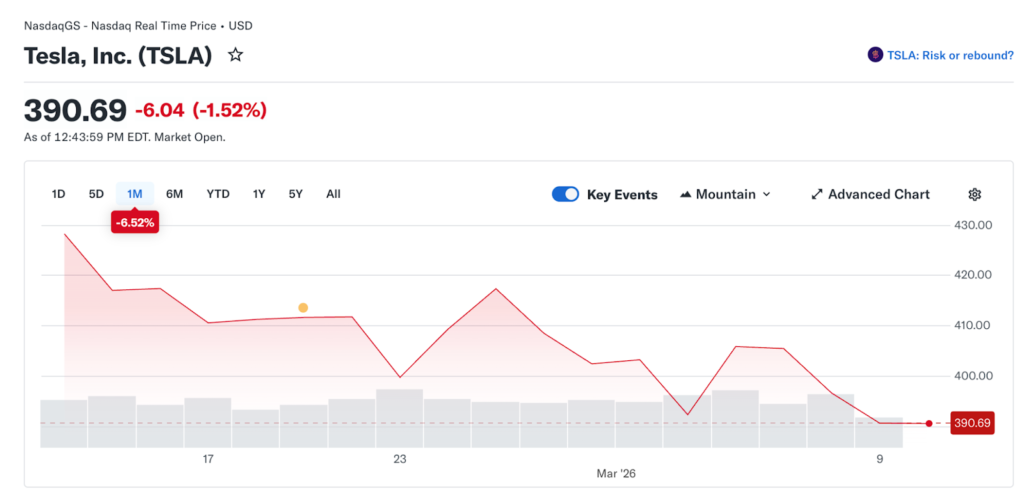
As of early March, Tesla shares were down roughly 8 percent since the beginning of 2026, reflecting investor concerns about slowing vehicle demand and intensifying competition in the electric vehicle industry.
However, the longer-term trend remains significantly stronger.
Over the past 12 months, Tesla’s stock has gained approximately 44 percent, demonstrating that many investors still see substantial long-term growth potential in the company.
Long-Term Vision Continues to Shape Investor Sentiment
For many Tesla supporters, the TSLA CEO’s ambitious outlook remains a central part of the company’s investment narrative.
Beyond electric vehicles, Tesla has expanded into several emerging industries, including autonomous driving technology, artificial intelligence development, energy storage systems, and robotics.
The TSLA CEO frequently emphasizes that Tesla should be viewed not simply as an automobile manufacturer but rather as a technology and AI-driven innovation company.
This broader positioning has helped justify Tesla’s relatively high market valuation compared with traditional automotive manufacturers.
However, critics argue that Tesla’s valuation continues to rely heavily on future technological breakthroughs and long-term market expansion, which remain uncertain.
Investors Weigh Risk Against Future Potential
The debate surrounding Tesla ultimately reflects the broader tension between near-term financial performance and long-term technological ambition.
On one hand, the company faces growing competition in the global electric vehicle market, evolving regulatory pressures, and cyclical fluctuations in consumer demand.
On the other hand, Tesla continues to invest heavily in next-generation technologies, including artificial intelligence systems, robotics, advanced manufacturing, and energy infrastructure.
For investors, the TSLA CEO’s vision of space-based manufacturing and lunar infrastructure may sound highly ambitious, but it also illustrates the scale of the company’s long-term technological goals.
For now, Tesla remains a company defined by bold innovation strategies, strong investor attention, and a willingness to pursue ideas that extend far beyond the traditional automotive industry.


