
Two separate storylines pulled markets in opposite directions on Wednesday, and neither fully won out. Crude oil prices surged again after tanker attacks in Iraqi waters and a halt at a key Omani export terminal added physical disruption evidence on top of the diplomatic signals markets had already been pricing.
At the same time, AI stocks delivered another genuinely strong session, with Oracle jumping 9.2% and NVIDIA pushing toward a key technical level on the back of a significant investment announcement. Senior financial analyst at TibiPro examines what the split between energy anxiety and AI resilience means for investor positioning heading into the rest of the week.
Oil Found New Reasons to Keep Climbing
WTI crude jumped another 4.55% to $87.25 per barrel on Wednesday, then pushed above $93 in Thursday’s early session after spiking briefly to $95 overnight. The catalyst was no longer just diplomatic rhetoric. Iraq confirmed that two oil tankers were attacked in its waters on Wednesday night, prompting the country’s oil terminals to halt operations. Oman suspended activity at one of the last remaining Persian Gulf oil export terminals still handling crude for global markets, temporarily removing another loading point from the already-constrained network.
The IEA formally proposed a record release of 400 million barrels from member nations’ reserves on Wednesday, more than double the previous record. Markets had largely anticipated the announcement given prior signals, which is why oil had already pulled back from the near-$120 overnight peak hit earlier in the week.
The Navy Timeline Remains the Central Variable
Energy Secretary Chris Wright addressed the escort question directly in Thursday’s comments, providing slightly more concrete guidance than prior statements. He confirmed the US Navy is not yet ready to escort tankers through the Strait of Hormuz but indicated that capability should be operational by the end of the month.
Oman’s export terminal resumed operations after a few hours, but the episode underscored how fragile Gulf oil logistics remain. Iraq’s tanker attacks and terminal halt represent exactly the second-order disruption that turns a diplomatic standoff into an operational supply crisis with measurable barrel shortfalls.
Oracle’s Earnings Changed the AI Narrative for the Week
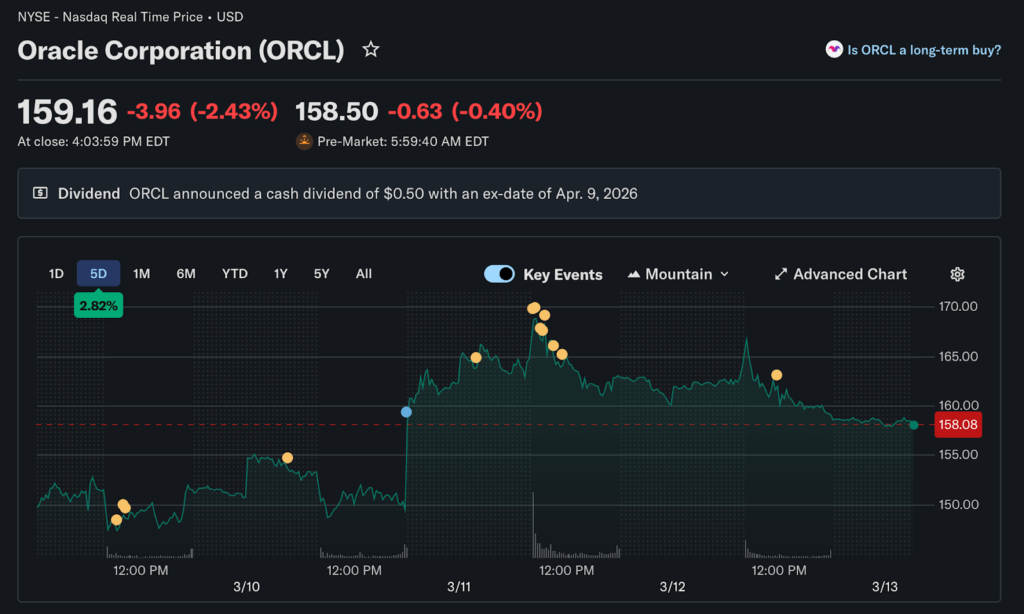
Against the oil backdrop, Oracle’s earnings provided the week’s most constructive fundamental data point for equity investors. Shares jumped 9.2% on Wednesday after the company reported revenue and earnings that beat estimates by meaningful margins, with cloud revenue growing 44% year over year and remaining performance obligations surging to $553 billion.
The strong results eased market concerns about whether Oracle’s aggressive AI data center investment strategy was generating returns, and gave the broader AI infrastructure sector a positive reference point during a week dominated by geopolitical headlines.
Oracle stock remains in a downtrend and ran into resistance at its 50-day moving average on the jump. A stall at the 50-day in a downtrending name suggests the bounce may be sentiment-driven rather than a genuine trend reversal, though the fundamental data backing the move is solid.
NVIDIA Adds a $2 Billion Investment in Nebius
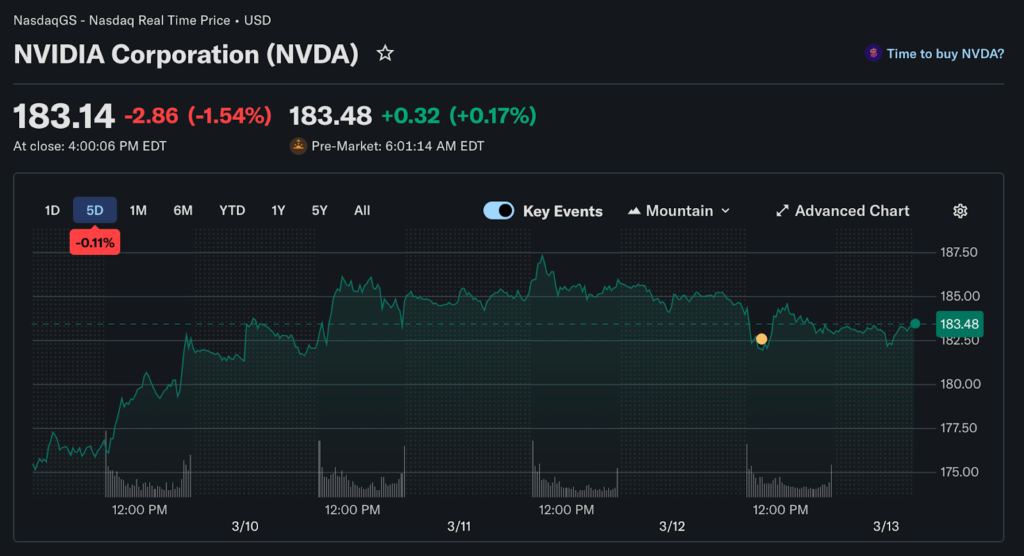
NVIDIA announced a $2 billion investment in Nebius, a cloud computing provider, on Wednesday. NVIDIA stock edged up 0.7% to 186, just clearing its own 50-day line. The Nebius deal fits a pattern NVIDIA has developed of taking stakes in companies that subsequently purchase NVIDIA hardware, creating a circular reinforcement of both its revenue pipeline and its strategic relationships in the AI infrastructure space.
Nebius surged 16.15% to 112, clearing short-term resistance within a deep consolidation. Other data center providers moved higher in sympathy, and the semiconductor ETF SMH climbed 0.9%. Taiwan Semiconductor rose 2.15% to 354.56, running into resistance at its 21-day moving average.
The Split Market and What It Means
Wednesday’s session captured the split condition that has defined markets for several weeks. The Dow fell 0.6%, and the S&P 500 dipped 0.1%, while the Nasdaq eked out a 0.1% gain. The 10-year Treasury yield jumped seven basis points to 4.21%, its highest close in more than a month. Energy ETF XLE popped 2.5%, while the Financial Select ETF dropped 0.8%, and industrials declined 0.3%.
The divergence between AI stocks and everything else reflects a market separating company-specific earnings quality from macro-driven fear. NVIDIA holds its annual GTC conference the following week, and Micron Technology reports earnings on March 18, two catalysts that could extend the sector’s relative strength or confirm that strong fundamentals cannot fully overcome the broader macro pressure.
Where Investors Stand
Wednesday marked day three of a stock market rally attempt, technically opening the door for a follow-through confirmation as soon as Thursday. With large intraday swings defining the recent pattern, any confirmation needs to be measured against the reality that oil price volatility can reverse a day’s equity gains in hours. Patience over forced positioning remains the more defensible stance until the Strait of Hormuz situation produces a clearer directional signal on energy prices.


