
The NZD/USD currency pair weakened on Thursday, trading around 0.5740 during European hours, as strong US economic data bolstered the US Dollar (USD) and reinforced market expectations that the Federal Reserve (Fed) will maintain its current interest rate policy.
Market participants are now closely monitoring the weekly US Initial Jobless Claims, which could influence short-term sentiment in the foreign exchange (FX) market. This article by PrimeLuno offers expert commentary and a complete explanation of the subject.
US Economic Data Boosts the Dollar
The US Census Bureau reported that Retail Sales climbed 0.6% in November, reaching $735.9 billion, surpassing the 0.4% market forecast. This followed a 0.1% decline in October, signaling that consumer spending remains resilient despite ongoing macroeconomic uncertainties. The stronger-than-expected data fueled demand for the USD, prompting a retracement in NZD/USD from gains seen earlier in the week.
Meanwhile, the Producer Price Index (PPI) for November rose sharply, with both headline and core PPI hitting 3% year-over-year (YoY). This uptick in producer inflation added to expectations that the Fed will maintain rates at current levels rather than cut them in the near term.
Fed Expectations and Market Sentiment
Comments from Minneapolis Fed President Neel Kashkari on Wednesday underscored the resilience of the US economy, noting that tariff pass-through effects have been less pronounced than anticipated. Kashkari highlighted that inflation remains elevated but is showing signs of moderation.
Reflecting the recent data, Morgan Stanley analysts revised their rate-cut expectations, pushing potential Fed easing to June and September, later than previously anticipated in January and April. These shifts in expectations strengthened the USD, applying pressure on NZD/USD and contributing to its recent losses below 0.5750.
NZD Weakness Amid US-China Tensions
The New Zealand Dollar (NZD) has been particularly sensitive to geopolitical risks, with renewed concerns over US–China trade tensions exacerbating its decline. On Wednesday, US President Donald Trump signed two executive orders: one imposing a 25% tariff on certain semiconductors and another authorizing potential levies on critical minerals.
The White House emphasized that the US is 100% net-import reliant on 12 critical minerals and over 50% reliant on another 29 minerals, a vulnerability that enhances China’s leverage in ongoing trade negotiations. Given China’s pivotal role in New Zealand’s exports, particularly in the agriculture and commodities sectors, these developments have weighed on the NZD, intensifying downward pressure against the USD.
Technical Outlook for NZD/USD
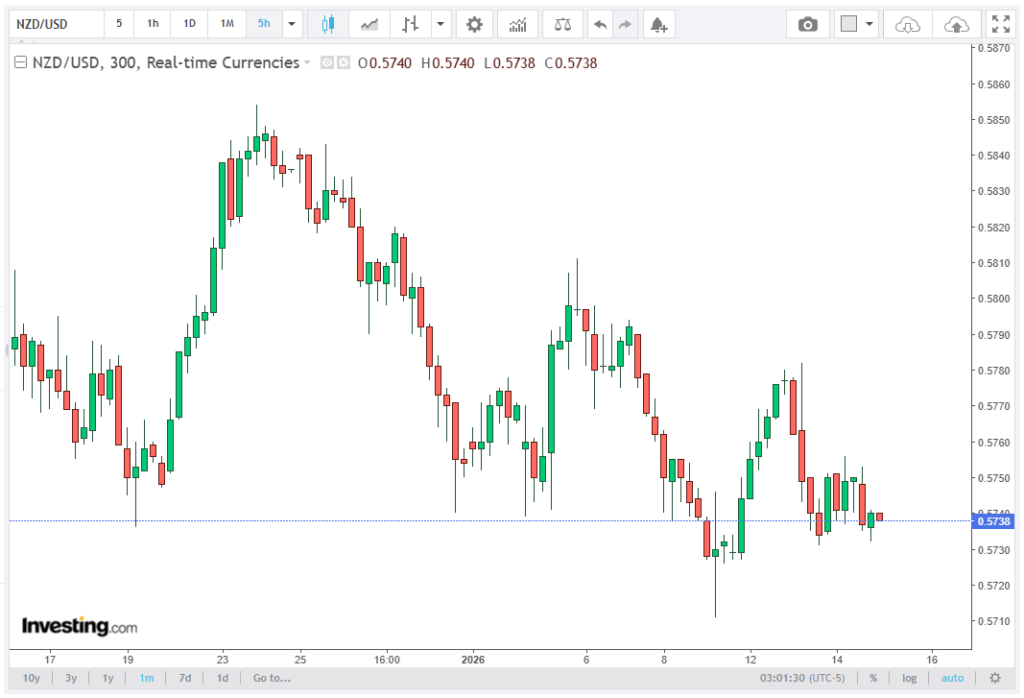
From a technical perspective, NZD/USD is trading below the key resistance at 0.5750, reflecting both fundamental and geopolitical headwinds. Short-term support levels are likely near 0.5720–0.5730, with further declines possible if the USD remains strong ahead of the US Initial Jobless Claims.
Traders will closely monitor jobless claims, as a surprise increase could ease Fed tightening expectations, potentially offering relief to the NZD. Conversely, lower-than-expected claims would reinforce the narrative of a resilient US labor market, further boosting the USD and pressuring NZD/USD lower.
Market Implications
The current NZD/USD weakness underscores several important dynamics shaping the FX markets. US economic resilience, reflected in strong Retail Sales and Producer Price Index (PPI) data, continues to support the USD and reduces the likelihood of immediate Fed rate cuts.
Geopolitical risks, including renewed US–China trade tensions and tariffs on critical minerals, weigh on NZD sentiment, given New Zealand’s exposure to China. Interest rate differentials also play a crucial role, as the Fed signals patience, keeping the USD–NZD spread favorable to the greenback and influencing capital flows.
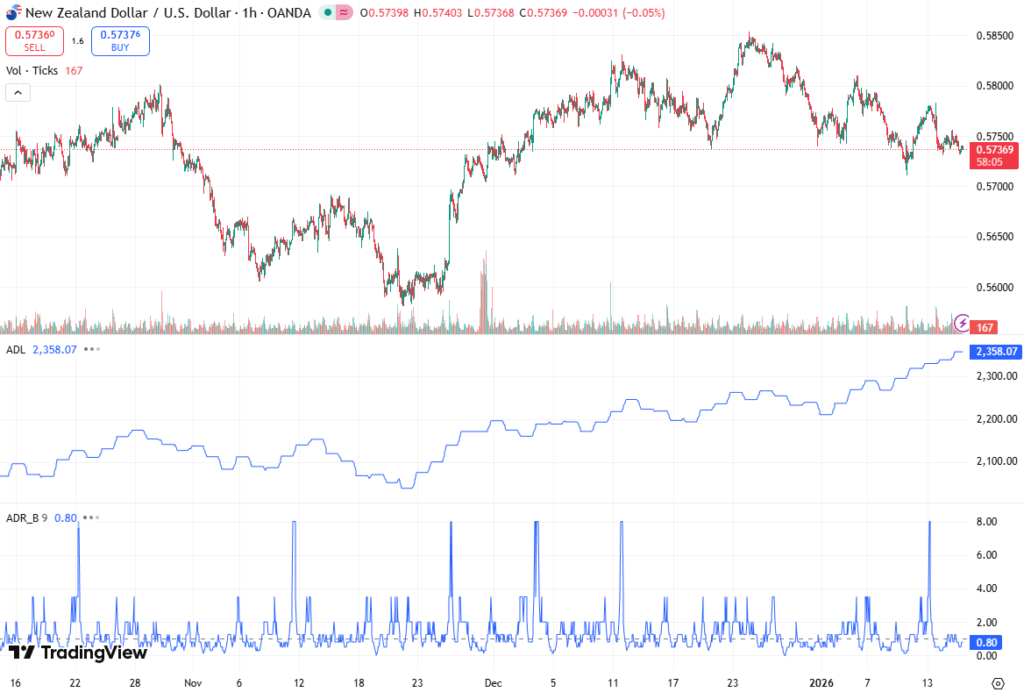
Finally, technical pressure is evident, as the pair’s failure to reclaim 0.5750 highlights ongoing bearish momentum, which could persist if risk aversion dominates amid geopolitical uncertainties.
Key Levels to Watch
Key levels to watch for NZD/USD include resistance at 0.5750–0.5760 and support around 0.5720–0.5730. The immediate catalyst for price action is the US Initial Jobless Claims, expected later in the session, which could influence market sentiment and short-term volatility.
Conclusion
In summary, NZD/USD has pared recent gains, trading below 0.5750, as the USD strengthens on the back of robust US economic data and persistent expectations that the Fed will maintain current rates. The NZD continues to face headwinds from geopolitical tensions, particularly in the context of US–China trade relations.
Traders and investors are now awaiting the US Initial Jobless Claims, which could provide short-term direction. Should the data suggest labor market resilience, the USD may maintain its upward trajectory, further pressuring NZD/USD. Conversely, a weaker report could offer temporary relief for the New Zealand Dollar, but underlying fundamentals suggest a cautious outlook in the near term.
NZD/USD remains sensitive to US economic releases, geopolitical developments, and Fed policy expectations, making it a key pair for traders seeking exposure to both macro and geopolitical risk factors in the FX market.


