
The rapid expansion of artificial intelligence in the entertainment industry is beginning to reshape how streaming platforms invest in technology and creative production tools. Major media companies are increasingly exploring AI systems that can improve filmmaking workflows while supporting faster content development.
Netflix recently confirmed plans to acquire InterPositive, an artificial intelligence startup founded by Oscar-winning filmmaker Ben Affleck, in a deal reportedly valued at up to $600 million. If the full valuation is achieved, the transaction would represent the largest acquisition in Netflix’s history.
The agreement comes shortly after Netflix stepped away from a much larger potential deal involving Warner Bros. Discovery’s studio and streaming assets valued at approximately $82.7 billion. Financial researchers from EPIQUI note that the move highlights how streaming leaders are shifting toward targeted technology acquisitions, particularly those connected to AI-driven production tools that can improve long-term content development efficiency.
Strategic Shift From Building Technology To Acquiring Innovation
For many years, Netflix emphasized a strategy of building most of its technology internally rather than acquiring external companies. The purchase of InterPositive signals a change in that philosophy as artificial intelligence becomes increasingly important in modern film production.
InterPositive was quietly developed beginning in 2022, when Affleck assembled a small engineering team to design AI tools specifically for the filmmaking process.
The startup’s technology focuses primarily on post-production refinement, rather than generating films independently. The platform analyzes visual continuity, editing patterns, and cinematic composition, helping filmmakers address technical issues that can occur during complex productions.
These adjustments may involve missing shots, background replacements, lighting inconsistencies, and scene continuity corrections, allowing filmmakers to refine projects more efficiently during the editing stage.
AI Systems Designed To Support Creative Decision Making
According to Affleck, the software was engineered with a clear objective of supporting creative workflows while preserving artistic control.
The platform’s first model was trained to understand visual logic, narrative editing structure, and cinematic consistency, enabling it to analyze scenes according to professional filmmaking standards.
Unlike some generative AI systems designed to create entirely new content, InterPositive focuses on assisting filmmakers during postproduction rather than replacing human input.
Affleck explained that the tools incorporate built-in safeguards designed to protect creative intent, ensuring that final decisions remain in the hands of directors, editors, and production teams.
The technology therefore functions as a technical enhancement system that can help production teams refine scenes while maintaining the original storytelling vision.
Hollywood’s Expanding Investment In Artificial Intelligence
Netflix’s acquisition arrives during a period in which AI investment across the entertainment industry is accelerating rapidly.
Several major media companies have begun experimenting with artificial intelligence to support production workflows and new digital experiences.
For example, Amazon has been developing AI production tools within Amazon MGM Studios aimed at reducing costs and improving filming efficiency.
Meanwhile, Walt Disney reportedly reached a $1 billion agreement with OpenAI allowing viewers to generate AI-created videos using Disney characters.
Financial Structure Of The Transaction
Although Netflix did not publicly disclose the exact financial terms, reports indicate that the acquisition could reach up to $600 million if certain performance milestones are achieved.
The initial cash payment is believed to be lower, with additional compensation tied to future operational and technology performance targets.
Netflix confirmed that InterPositive’s engineering team will join the company, while Affleck will remain involved as a senior adviser supporting the technology’s development.
Integrating the platform into Netflix’s internal production operations may help filmmakers identify technical issues earlier and refine projects more efficiently.
Market Reaction Following The Announcement
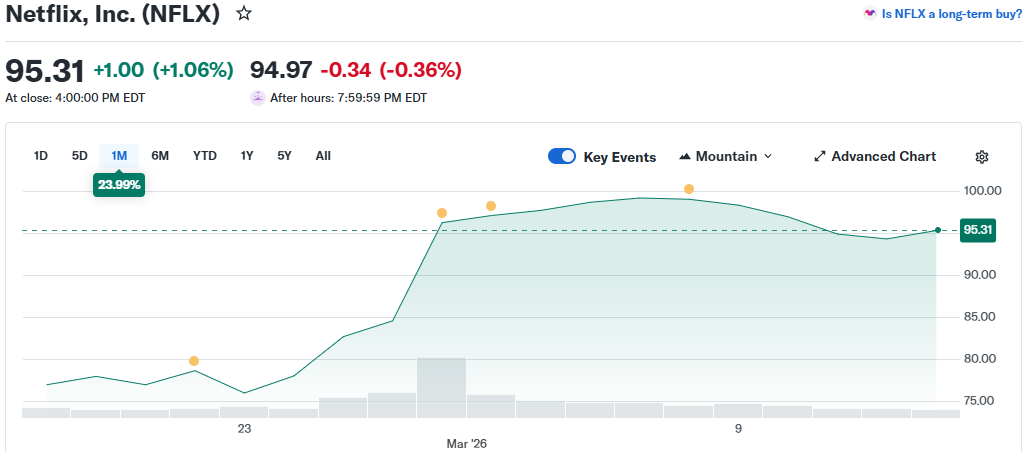
Following news of the acquisition, Netflix shares declined approximately 0.6 percent, though the stock still performed better than the broader market during the session.
The S&P 500 index dropped roughly 1.5 percent on the same day, meaning Netflix experienced relative outperformance compared with the overall market.
The acquisition announcement came just days after Netflix abandoned its effort to purchase Warner Bros. Discovery’s studio and streaming business, which was ultimately acquired by Paramount Skydance.
The contrast between the two developments suggests that Netflix may currently favor smaller technology-focused acquisitions rather than large media consolidation deals.
The Investment Landscape As AI Transforms Entertainment Production
Artificial intelligence is becoming an increasingly important factor in how media companies approach content development, production efficiency, and digital distribution.
For streaming platforms that release hundreds of films and television programs annually, improvements in production workflows can have significant effects on timelines, operational costs, and content quality.
Netflix’s investment in specialized filmmaking technology reflects a broader industry movement toward AI-enhanced production infrastructure.
Rather than replacing creative professionals, many studios appear focused on using artificial intelligence to solve technical production challenges and support creative teams.
As artificial intelligence continues to evolve, acquisitions like this may influence the longer-term financial trajectory of the streaming sector, shaping how studios combine creative talent, advanced technology, and large-scale digital distribution to produce modern entertainment content.


