
Gold prices (XAU/USD) struggled for the fourth consecutive session, hovering around $5,000 per troy ounce during European trading hours on Monday. The non-yielding metal continues to face headwinds as rising energy prices stoke inflationary pressures, weakening expectations that the US Federal Reserve and other major central banks will implement interest rate cuts. The brokers at Noxi Rise provide a comprehensive breakdown of this topic in this article.
Inflation Pressures Weigh on Gold
The precious metals market has remained subdued as investors reassess the outlook for monetary policy. With energy costs rising sharply, inflation expectations have surged, reducing the likelihood that central banks will move toward easing measures. Gold, often seen as a hedge against inflation, is losing some of its appeal because higher interest rates increase the opportunity cost of holding non-yielding assets.
Analysts note that the current inflationary environment is driven not only by oil price volatility but also by broader commodity price pressures, which have contributed to elevated consumer price indices in major economies. This backdrop has weakened speculative long positions in gold, contributing to its subdued trading near the $5,000 mark.
Geopolitical Tensions Fuel Market Uncertainty
Over the weekend, the United States (US) carried out a military strike on Iran’s main oil-export hub, Kharg Island, raising concerns about global energy supply. While the US President clarified that oil infrastructure was not targeted, the strike triggered retaliatory attacks from Tehran on Israeli targets and energy assets in other Middle Eastern countries.
The ongoing US-Israel conflict with Iran has entered its third week without a clear resolution, rattling financial markets and prompting a surge in oil prices. For commodities such as gold, geopolitical risks often act as a catalyst for safe-haven demand, but recent developments have created a more nuanced picture.
Safe-Haven Demand Eases
Interestingly, the demand for gold as a safe-haven asset has softened in response to reports that the US may announce a coalition to escort ships through the Strait of Hormuz, a critical chokepoint for global oil transportation. The US President called on allied nations, including the United Kingdom, France, China, and Japan, to participate in securing the Strait, potentially reducing geopolitical risk premiums in oil and gold markets.
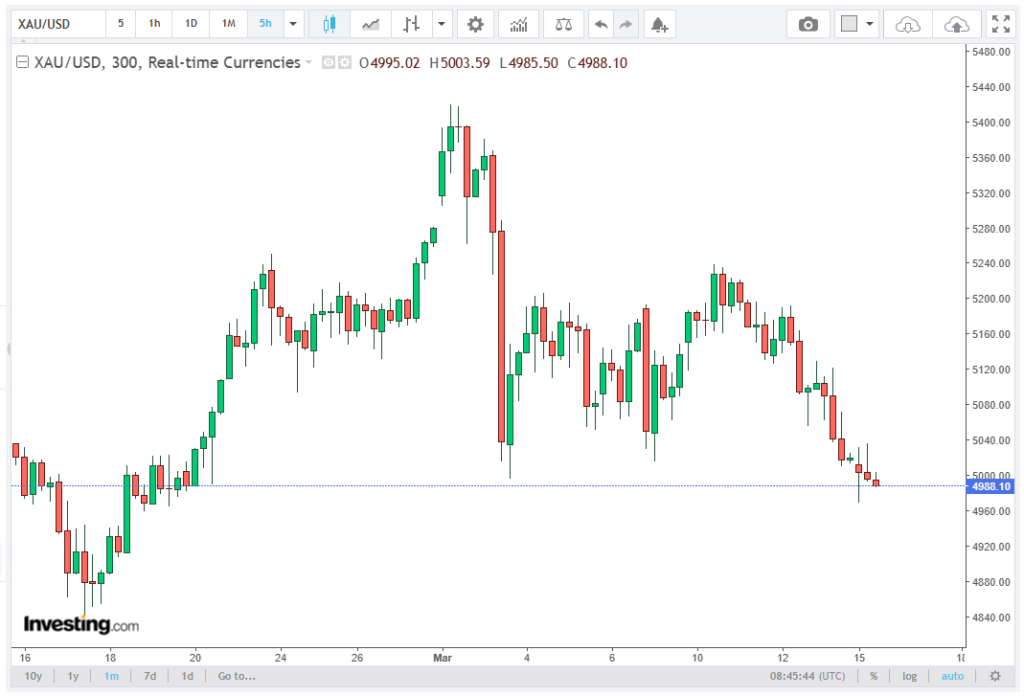
Meanwhile, European Union (EU) foreign ministers convened in Brussels to discuss a possible naval response to the effective closure of the Strait, signaling a coordinated approach to regional security. Market participants interpreted these diplomatic developments as a potential mitigation of extreme supply shocks, which in turn lowered immediate safe-haven demand for gold.
Outlook for Oil and Inflation
The trajectory of gold prices remains closely linked to energy markets. US Energy Secretary Chris Wright recently commented that he expects the US-Israel conflict with Iran to conclude within “the next few weeks,” which could lead to the restoration of oil supply channels and a potential decline in energy prices.
If energy prices stabilize or decline, inflationary pressures may ease, allowing the Federal Reserve and other central banks to reconsider rate-cut expectations. This scenario would likely reinforce gold’s subdued trading range as higher yields in alternative assets make holding bullion less attractive.
Technical Analysis and Market Sentiment
From a technical perspective, gold is navigating a consolidation phase near the $5,000 per troy ounce level. Analysts highlight that a sustained move above key resistance levels, such as $5,050–$5,100, could reignite bullish momentum and attract renewed investor interest.
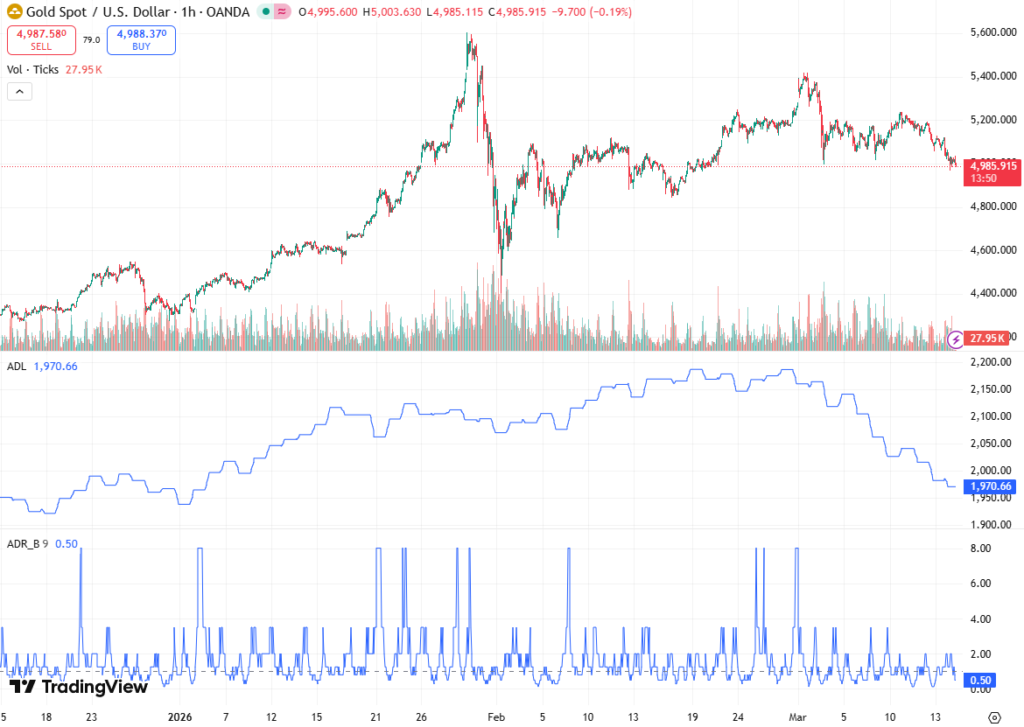
Conversely, failure to maintain support around $4,950–$5,000 may prompt further downside, potentially testing lower support zones near $4,900. Technical indicators, including moving averages and the Relative Strength Index (RSI), suggest that the market is currently in a neutral to slightly bullish phase, but volatility remains elevated.
Market sentiment remains cautious, reflecting uncertainty in monetary policy, inflation trajectories, and geopolitical dynamics. Investors are closely monitoring developments in the Middle East, as well as central bank communications, for cues on future interest rate decisions.
Conclusion
Gold remains subdued near $5,000, pressured by inflation-driven rate expectations, rising energy prices, and easing safe-haven demand amid diplomatic interventions in the Strait of Hormuz. The US military action on Kharg Island and subsequent retaliatory attacks have elevated geopolitical risks, but announcements regarding a potential coalition to secure maritime routes have tempered precautionary buying.
Looking ahead, the market will closely track oil price movements, Fed policy signals, and the resolution of the US-Israel-Iran conflict. Any significant escalation in the Middle East could boost gold’s appeal as a hedge, while stabilizing energy prices and a dovish central bank stance could keep the XAU/USD pair range-bound around current levels.
In sum, gold’s trajectory over the coming weeks will hinge on the interplay between inflation trends, geopolitical developments, and monetary policy expectations, with the $5,000 mark serving as a critical psychological and technical level for traders.


