
Gold (XAU/USD) is trading with modest gains on Tuesday, extending a rebound from the $5,000 psychological support level as investors continue to seek safety amid rising geopolitical tensions.
The precious metal attracted renewed safe-haven inflows during the Asian session after officials in Iran dismissed claims from the US President that the ongoing Middle East conflict could end soon. This article features a thorough breakdown of the topic by TibiPro brokers.
Iranian authorities characterized such comments as unrealistic, emphasizing that regional security dynamics will be determined by Tehran rather than Washington. Furthermore, the Islamic Revolutionary Guard Corps (IRGC) reiterated that Iran would decide the timeline of the conflict. These developments have heightened global risk sentiment, encouraging investors to increase exposure to defensive assets such as gold.
Historically, gold tends to perform well during periods of geopolitical instability, as market participants reduce exposure to risk-sensitive assets like equities and move capital into store-of-value instruments. The current geopolitical environment is reinforcing that trend, allowing the yellow metal to maintain a constructive tone despite competing macroeconomic forces.
However, the upside momentum remains limited, suggesting that traders are cautious about aggressively adding new bullish positions until clearer macro signals emerge.
Rising Energy Prices Reinforce Inflation Concerns
Another factor supporting gold is the rebound in Crude Oil prices, which regained upward traction after a sharp reversal from levels not seen since June 2022. The earlier rally in oil was driven by concerns over potential supply disruptions linked to the closure of the Strait of Hormuz, one of the world’s most critical energy shipping routes.
The renewed strength in energy markets has intensified inflation expectations among global investors. If energy prices remain elevated, the ripple effects could push consumer inflation higher, complicating the policy outlook for the US Federal Reserve (Fed).
Higher inflation expectations typically increase the likelihood that central banks maintain tighter monetary policy for longer periods. In the current environment, markets are beginning to reassess earlier expectations for aggressive Fed rate cuts, particularly if inflation proves sticky.
As a result, US Treasury bond yields remain elevated, reinforcing demand for the US Dollar (USD). A stronger dollar often acts as a headwind for gold, since the metal is priced in USD and becomes more expensive for holders of other currencies.
This dynamic explains why, despite ongoing geopolitical risks, gold remains capped below the $5,200 resistance level. The interplay between safe-haven demand and macroeconomic constraints continues to shape the metal’s short-term trajectory.
USD Strength Limits the Bullish Momentum
The US Dollar Index has stabilized after retreating from a three-month high, supported by expectations that the Federal Reserve may delay interest-rate cuts if inflation pressures persist.
Because gold is a non-yielding asset, it becomes less attractive in environments where interest rates or bond yields remain elevated. Investors seeking yield may prefer Treasuries or other interest-bearing assets, reducing the opportunity cost advantage that gold usually enjoys during periods of looser monetary policy.
This fundamental backdrop has created a balanced market structure, where safe-haven inflows support gold prices, while USD strength and elevated yields limit further upside.
Consequently, the precious metal has entered a range-bound trading phase, reflecting uncertainty about the next major macroeconomic catalyst.
Technical Analysis: Range-Bound Structure Persists
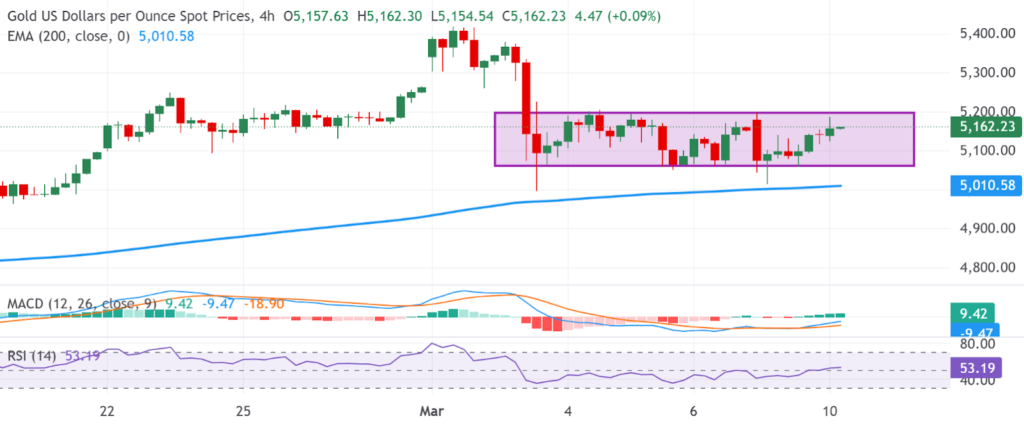
From a technical perspective, the XAU/USD pair has been trading within a defined consolidation range over the past week. The metal has consistently found support near the rising 200-period Exponential Moving Average (EMA) on the 4-hour chart, currently located around $5,010.
This level represents a critical technical pivot, as it coincides with the lower boundary of the recent trading range.
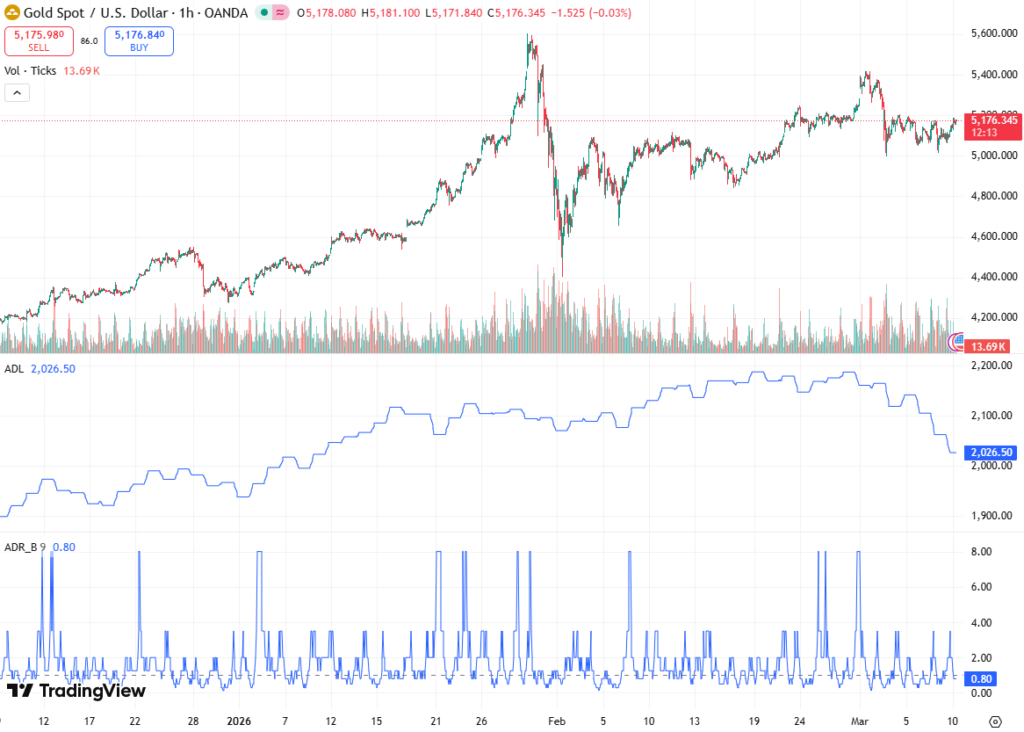
Momentum indicators suggest early signs of bullish recovery:
The Moving Average Convergence Divergence (MACD) indicator has turned positive, with the MACD line crossing above the signal line and the histogram expanding. This indicates strengthening upward momentum following the recent consolidation phase.
The Relative Strength Index (RSI) remains just above the 50 level, signaling mild bullish pressure without entering overbought territory.
Taken together, these signals indicate that buyers are gradually regaining control, though the move remains tentative.
Outlook: Caution Before the Next Breakout
In the near term, gold’s outlook remains cautiously constructive, supported by geopolitical uncertainty and safe-haven demand. However, the presence of persistent inflation risks, firm Treasury yields, and moderate US Dollar strength continues to cap aggressive upside moves.
Until the market receives clearer signals from US inflation data and Federal Reserve policy expectations, traders are likely to remain cautious. As a result, range-bound trading conditions could persist, with $5,010 and $5,200 acting as the key boundaries for the next significant price move.
For now, gold remains caught between defensive demand and macroeconomic headwinds, waiting for the next catalyst to define its medium-term direction.


