
The GBP/USD exchange rate has come under renewed selling pressure, retreating sharply after the United States released its latest Consumer Price Index (CPI) data. The move lower was also reinforced by rising geopolitical risks, which encouraged investors to rotate into the US dollar, a traditional safe-haven currency.
As a result, the pair slid to a low of 1.3435, well below the year-to-date high of 1.3565, signaling that bearish momentum is starting to dominate the near-term outlook. In this article, PrimeLuno brokers examine the key aspects of the topic with clarity.
GBP/USD Slides After US CPI Release
The GBP/USD pair dropped notably after the Bureau of Labor Statistics (BLS) published the latest CPI report. According to the data, headline inflation remained unchanged at 2.7% in December, while core CPI, which excludes volatile food and energy prices, eased to 2.6%.
For currency markets, this data reinforced the view that US inflationary pressures are gradually cooling, even if progress remains uneven. However, instead of weakening the dollar, the report initially strengthened it, as traders interpreted the figures as insufficiently soft to justify imminent Federal Reserve rate cuts.
At the same time, escalating geopolitical risks increased demand for dollar-denominated assets, compounding downside pressure on the British pound. The combination of risk aversion and monetary policy divergence pushed GBP/USD decisively lower.
Signs of Cooling Inflation in the US
Looking ahead, there are growing indications that US inflation may continue to decline in the coming months. One key driver is the recent drop in energy prices, which tends to feed through into headline inflation with a lag. Additionally, mortgage rates have fallen to a three-year low, easing financial conditions for households.
Another factor attracting market attention is a recent announcement by the US President, calling for Fannie Mae to purchase up to $200 billion in mortgage-backed securities. If implemented, this move could further suppress borrowing costs, support housing activity, and indirectly influence inflation dynamics.
Despite these developments, markets remain cautious about assuming a rapid shift in Federal Reserve policy, especially given the resilience of the US economy and labor market.
US Retail Sales Data Ahead
The next major catalyst for the GBP/USD exchange rate will be a series of high-impact US economic releases scheduled for later today.
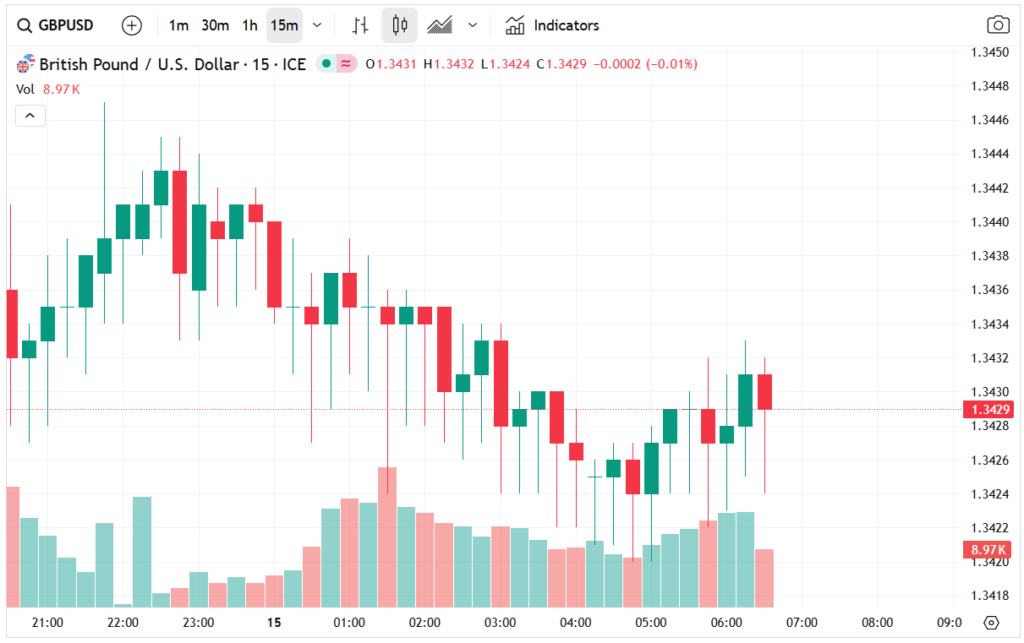
First, the BLS will publish the latest Producer Price Index (PPI) data, offering additional insight into pipeline inflation. A softer PPI reading would reinforce the narrative that pricing pressures are easing across the supply chain.
Second, the Commerce Department will release US retail sales figures, a critical indicator of consumer spending. Strong retail sales would underscore the resilience of the US consumer, potentially supporting the dollar. Conversely, a weaker print could revive expectations of monetary easing later in the year.
Federal Reserve Speakers in Focus
In addition to hard data, traders will closely monitor remarks from several Federal Reserve officials, including Stephen Miran, Neel Kashkari, John Williams, and Anna Poulson. These will be their first public comments since the release of the latest jobs and inflation data.
While their tone could influence short-term volatility, these statements are unlikely to materially alter expectations for near-term policy. Current market pricing suggests the probability of a rate cut in January is close to 100% against, reinforcing the view that the Fed will remain patient and data-dependent.
GBP/USD Technical Analysis
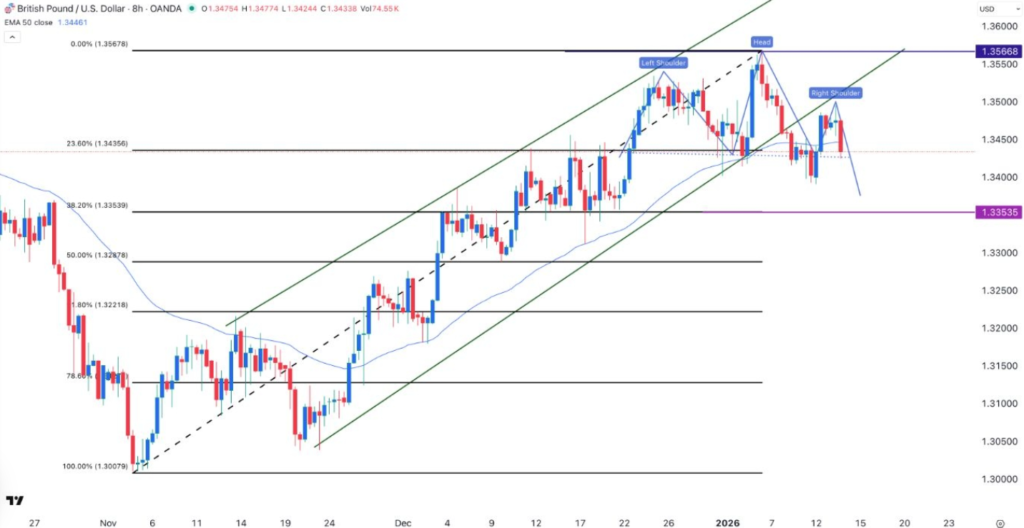
From a technical perspective, the outlook for GBP/USD has deteriorated noticeably. In the eight-hour timeframe, the pair has pulled back sharply over the past two weeks, falling from a January 6 high of 1.3566 to around 1.3435.
Crucially, the price has broken below the lower boundary of an ascending channel, signaling a loss of bullish structure. Even more significant is the formation of a head-and-shoulders pattern, one of the most widely recognized bearish reversal formations in technical analysis.
Adding to the negative bias, GBP/USD has moved both the Supertrend indicator and the 50-period Exponential Moving Average (EMA). These indicators now act as dynamic resistance, limiting the potential for near-term rebounds.
Downside Targets and Outlook
Given the current setup, the path of least resistance appears to be lower. Sellers are likely to target the 38.2% Fibonacci Retracement level at 1.3355, which sits approximately 60 basis points below current levels. A decisive break below this support could open the door to deeper losses, especially if upcoming US data surprises to the upside.
In summary, both fundamental and technical factors point to continued downside risks for the GBP/USD pair. Unless the pound receives a strong domestic catalyst or the US dollar weakens materially, rallies may be viewed as selling opportunities rather than the start of a sustained recovery.


