
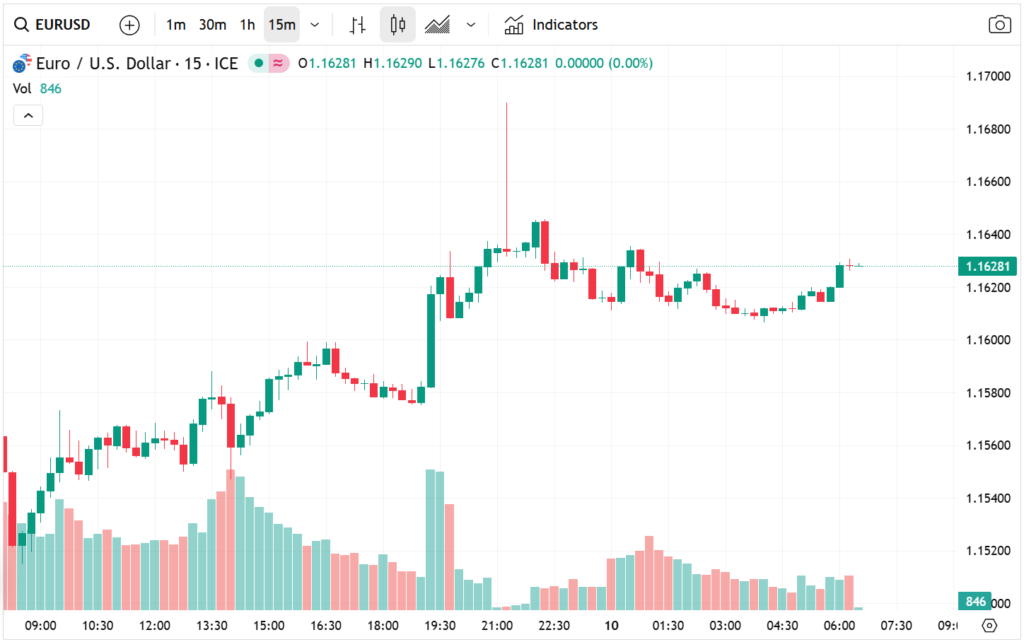
The EUR/USD currency pair moved higher at the start of the week after the United States released weaker-than-expected labor market data for February. Following the report, the pair climbed to 1.1616 on Monday, rebounding from last week’s low of 1.1530. In this article, the brokers at TibiPro present a detailed analysis of the topic.
Despite the short-term bounce, broader market dynamics suggest that the pair may face renewed downward pressure as investors assess upcoming US consumer inflation data and rising geopolitical tensions.
Currency traders are closely monitoring the Federal Reserve’s monetary policy outlook, the trajectory of global energy prices, and escalating conflict in the Middle East, all of which could influence the direction of the US dollar and the euro in the coming days.
From both fundamental and technical perspectives, the outlook for the EUR/USD pair appears increasingly bearish, particularly if upcoming inflation data reinforces expectations of persistent price pressures in the US economy.
US Consumer Inflation Data in Focus
The primary catalyst for the foreign exchange market this week will be the upcoming US Consumer Price Index (CPI) report, scheduled for release on Wednesday. This data is one of the most influential economic indicators for currency markets because it shapes expectations about interest rate policy.
Economists expect the headline CPI to show that inflation rose by 2.4% in February, signaling that price pressures remain above the Federal Reserve’s long-term target.
If the CPI report comes in stronger than expected, it could reinforce the idea that the Federal Reserve must maintain restrictive monetary policy for longer. Such an outcome would likely support the US dollar, placing additional downside pressure on the EUR/USD pair.
Weak US Jobs Report Raises Policy Questions
The recent US February jobs report triggered the initial rise in the EUR/USD pair. According to the Bureau of Labor Statistics (BLS), the US economy lost 92,000 jobs in February, a significant deviation from expectations.
In January, the economy added 126,000 jobs, and analysts had predicted that more than 56,000 new jobs would be created in February. The unexpected contraction suggests that the labor market may be losing momentum.
Additionally, the US unemployment rate increased from 4.3% in January to 4.4% in February, indicating a modest deterioration in employment conditions.
A weaker labor market typically increases the likelihood that the Federal Reserve will consider lowering interest rates to support economic growth. Some policymakers, including Stephen Miran and Christopher Waller, have already expressed support for a more accommodative monetary stance.
EUR/USD Technical Analysis
From a technical analysis perspective, the EUR/USD pair remains under downward pressure, despite the recent rebound.
The pair has recently stabilized around the 23.6% Fibonacci Retracement level, suggesting that the recovery may only represent a temporary correction within a broader bearish trend.
Several technical indicators reinforce this cautious outlook. The Supertrend indicator has turned red, signaling a shift toward bearish momentum for the first time since February. The pair has fallen below the 50-day moving average, a key indicator that often marks the transition from bullish to bearish market sentiment.
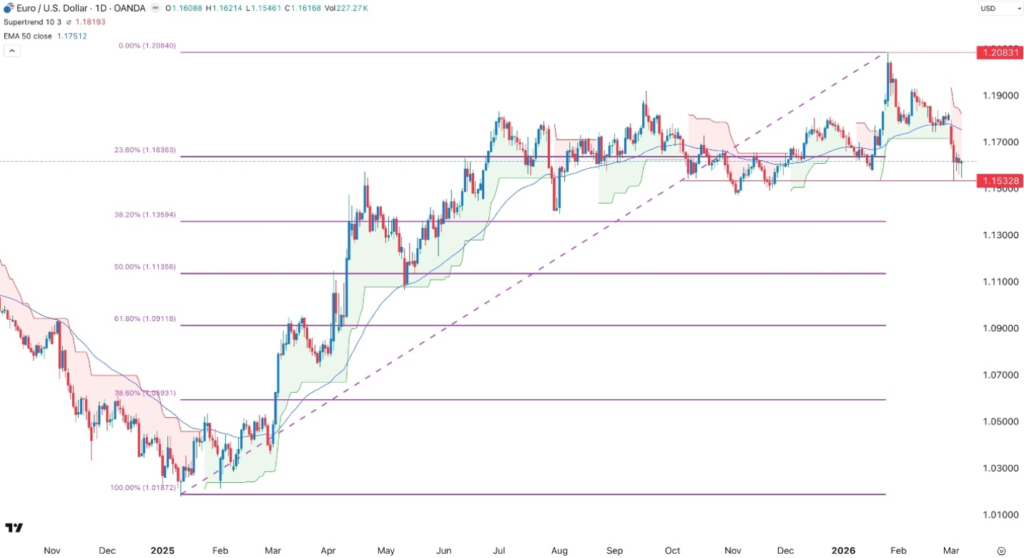
These signals suggest that selling pressure remains dominant, particularly if macroeconomic data strengthens the US dollar.
Formation of a Bearish Pennant Pattern
Another important technical development is the formation of a bearish pennant pattern, a continuation pattern that often appears during strong downward trends.
This pattern consists of two primary components. A sharp vertical decline, known as the flagpole, and a consolidating triangle formation, representing temporary market indecision.
When the pattern completes, prices typically break lower in the direction of the original trend, suggesting that the EUR/USD pair may resume its downward movement in the near term.
Key Support and Target Levels
Technical traders are closely watching several critical price levels.
The most important support level currently sits at 1.1533. A decisive break below this level would likely confirm the bearish pennant breakout, opening the door for further downside.
If selling momentum accelerates, the pair could move toward the psychological support level at 1.1400, which represents the next major target for bearish traders.
On the upside, sustained trading above 1.1616 would weaken the bearish outlook, but such a move would likely require significantly weaker US inflation data or a sharp shift in Federal Reserve policy expectations.
Conclusion
While the EUR/USD pair experienced a short-term rebound following weaker US employment data, the broader outlook remains bearish.
If inflation proves sticky or higher than expected, the Federal Reserve may maintain restrictive monetary policy, strengthening the US dollar and pushing the EUR/USD pair toward lower support levels.
As a result, traders should closely monitor Wednesday’s CPI release, which could act as the key catalyst determining the next major move in the forex market.


